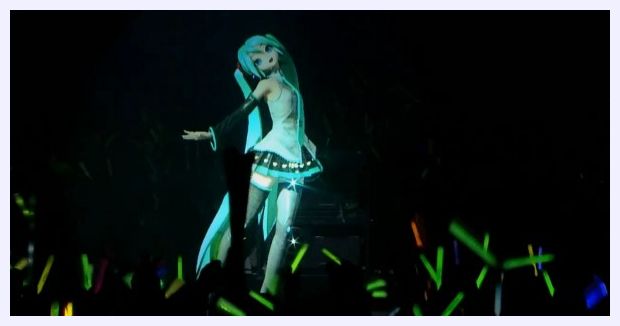
Hatsune Miku has topped the pop charts in Japan, sold out stadium concerts and become a legitimate cultural phenomenon. The interesting thing is that Miku doesn't exist -- at least not in any traditional sense of the word. Miku is a computer-generated avatar that performs songs with the help of a live band. But unlike say, Gorillaz, a cartoon band that merely serves as the public face of an artistic collective, everything about Miku comes from a computer. She is the product of a company called Crypton Future Media, which synthesizes Miku's voice using Yamaha's Vocaloid software.
Creating the character -- which appears as a girl with blue pigtails and a cyberpunk version of the traditional Japanese school-girl uniform -- was a meticulous process. First, the creators recorded voice actress Saki Fujita making individual phonetic sounds at a specific pitch and tone. Then, they recombined the samples and fed them through the synthesis software to produce an almost endless number of words and sounds. Users can actually purchase a copy of Miku to run on their home PCs, and have her perform songs of their own creation.
Despite Miku's availability for private performances on home PCs, crowds still shell out for live concerts, where Miku is able to whip her legions of fans into a frenzy (as seen in the video below). At these sold-out shows, Miku is materialized, so to speak, as a 3-D hologram. She parades and dances around the stage as she belts out pop-rock songs, while her human band provides a musical backdrop for her J-Pop crooning.
The tech behind both the vocals and the public displays is impressive, but we have a feeling this will remain a distinctly Japanese phenomenon. American consumers don't seem like they're ready to shell out the big bucks to watch a 'Final Fantasy' character robotically plow through second-rate Avril Lavigne knockoff tunes.

I remember a long time ago being excited about animated productions from Japan. One of the big and popular ones featured exactly this scenario; a digitally generated pop star. The only difference was that nobody knew it was a fabrication. It was used as a propaganda tool in an artificial war in a completely manufactured society where people didn't realize they were actually living on a giant star ship rather than the Earth. "Megazone 23" was one of the films the Wachowski brothers drew their inspiration from in making the "The Matrix."
Anyway. . , considering that humans can be programmed, it seems clear that we're already living in an age of artificial people leading social behavior patterns. -And that we've been there for a long time. This creepy display was just an ugly mirror.
Also, the "fans" all held little glow sticks. That suggests a marketing department was handing them out for a larger visual effect and thus heavily involved in promoting this product. Even the audience was manufactured.
Um then all audiences are manufacured...if people are having a good time what is the problem?
I really don't understand why people are freaking out over this like its scary or dare I say it, a "sign of the times". If it is evidence of a changing modern world it is only that Vocaloid software has opened the way for increased and diversified genesis of creative works by individuals, amateurs, and professionals alike. Outsiders to this phenomena are so caught up in this ONE concert, and this one character (though her cuteness makes he a winner in places where that has appeal), and ignore what Vocaloid is really about: Vocaloid gives an aspiring musician or musical group a lead singer capable of singing in a huge range of keys, suited to a wide range of genres, and capable of vocal feats than no one human is capable up. As such it opens up countless possibilities for both standard genres and experimental music. The phenomena has really taken off, while this articles seems to only focus on the "concert", what it misses is the real Vocaloid world and community, the one where millions of fans are drawn together on the internet to listen to tens of thousands of songs created by thousands of established and aspiring producers, often with results much better and more creative than the mainstream. Should Miku come to America? Maybe not, but if software like her would allow for greater creative expression in the western world than dang I am all for it. Miku's character design, her memorabilia, and all else associate with her is simply the same kind of branding you see with every smart company or product. If all these musicians and the original company can share in profits, awareness, and consumer loyalty under one name, one mascot, and one record lable (KarenT, look it up) than all the better. If you just forget about this image that is creeping you out and look into Vocaloid you might find something that interests you, or makes you at least admire the creativity of others, there is probably over 100,00 songs already, I'm sure you can find something.
Also no one expected this concert to become as popular as it is. The concert itself was solely a medium to low budget affair to promote a video game which features vocaloid songs and characters. The fact that popular response to it among fans was so strong (even though the graphics, song choices, and dancing weren't the best or higher budget) has sent ripples through the online consciousness until now 8 months later countless blogs and news outlets in the west are running features. Vocaloid fans or the corporation who made Miku never tried to make this bigger than it is (promotional, advertising concert for a game), the internet mythos has simply grown.
Vocaloid is more about people following their favorite artists (called Ps, or producers in Japan) and discussing, watching, commenting on, and buying their albums and singles. Aka just like every other music scene out there, the only difference is that you will find Vocaloid songs in every musical genre you could ever imagine. Now as for the quality, that is up to individuals to decide.
I remember a long time ago being excited about animated productions from Japan. One of the big and popular ones featured exactly this scenario; a digitally generated pop star. The only difference was that nobody knew it was a fabrication. It was used as a propaganda tool in an artificial war in a completely manufactured society where people didn't realize they were actually living on a giant star ship rather than the Earth. "Megazone 23" was one of the films the Wachowski brothers drew their inspiration from in making the "The Matrix."
Anyway. . , considering that humans can be programmed, it seems clear that we're already living in an age of artificial people leading social behavior patterns. -And that we've been there for a long time. This creepy display was just an ugly mirror.
Also, the "fans" all held little glow sticks. That suggests a marketing department was handing them out for a larger visual effect and thus heavily involved in promoting this product. Even the audience was manufactured.