
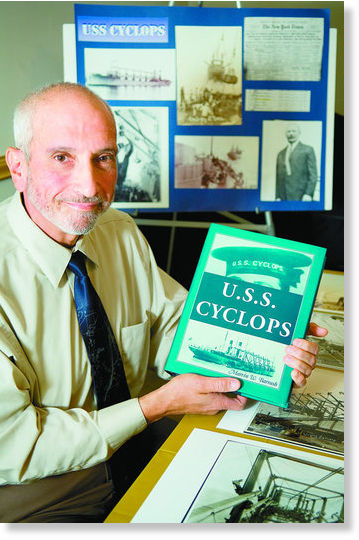
© Nicole MartynMarvin Barrash, of Reisterstown, has written a book, "U.S.S. Cyclops," about a ship that was lost in the Bermuda Triangle in the early 20th century. Barrash's great-uncle, U.S. Navy Seaman Lawrence Merkel, was on the ship when it was lost at sea.
To this day, Reisterstown resident Marvin Barrash knows precious little about his great-uncle, U.S. Navy Seaman Lawrence Merkel, a Baltimore native who lived his brief life in obscurity until it ended suddenly sometime in early March, 1918, in the months immediately following the United States' entry into World War I.
Merkel was one of 309 crew members and passengers to vanish on the USS Cyclops, a naval coal-hauling vessel lost with all hands somewhere in the Caribbean Sea in what has been described as the worst non-combat-related disaster in U.S. naval history.
"My uncle died even before my father was born," said Barrash, 57, a longtime Department of Defense employee and author of the recently published USS Cyclops, a 794-page, hardback tome that delves exhaustively into the construction, operation and disappearance of the 542-foot, 12,500-ton capacity "floating coalmine."
"My grandmother knew him, of course, but I didn't really talk about him with her when I was a child," Barrash said of his great-uncle, who was in his early 20s when he spent the final months of his life serving on the Cyclops first as a $17.60-a-month Apprentice Seaman and then later after being promoted, as a Fireman Second-Class.
"I had met some of his brothers and sisters, but most of them were gone by the time I got involved in my research. My father even died a couple years before I started this project.
"I know my great-uncle worked in his parents' tailor shop on Laurens Street, in west Baltimore. I do know that my great-grandparents were very distraught over his loss," Barrash added.
"Even now, there really isn't that much I've been able to find out about him," said Barrash, who, in the course of his 13 years of research, did eventually unearth nearly 50 pages of his uncle's naval records, along with the only picture of him Barrash has ever seen, which he found in the archives at the U.S. Navy Yard in Washington.
Never Planned to Write a Book
But after more than a dozen years, 794 pages and roughly 2,300 footnotes, there is little that Barrash does not know about the ship on which his uncle served -- everything from the intricacies of its design and construction to the make-up of its crew. Over the years, he even tracked down and corresponded with several dozen other descendants of Cyclops crew members.
Using original blueprints, ship's logs, ledger books, photographs, insurance records, court transcripts and even antiquarian textbooks on maritime design and engineering, he familiarized himself with nearly every detail of the ship's design and operation, right down to its refrigeration system and the horsehair in its hull, which served as insulation.
At the outset, Barrash, a Milford Mill High School graduate, who served seven years in the Maryland National Guard, and is the father of three adult daughters, knew next to nothing about World War I era naval history. He merely hoped to learn more about his uncle. He says that if he'd found even one credible book about the Cyclops, which was built in Philadelphia and launched in 1910, it would have never crossed his mind to write one.
"I'd never written a book before and never planned on writing a book," he recalled. "I started at a zero knowledge point."
Barrash came to realize that for the most part the Cyclops had been pretty much relegated to footnote status amid all the dubious legends and hyperbole about the so-called Bermuda Triangle, the storied region of the Caribbean where the ship disappeared.
But when he began scouring the National Archives, the Library of Congress and various other maritime museums and archives up and down the East Coast, he was surprised by the "geometric multiplication" of documentation he found about the ship.
"I've ended up with a whole den-full of material, including more than 25 binders of original documents," Barrash said
"The most important part of the USS Cyclops's story, though, is the people," he added. "There were so many people stories, good and bad, that came out of my research. So many things happened during the life of the ship, some humorous, some strange, all interwoven with its normal operations."
Barrash did not succeed where so many others had failed: He was unable to solve the mystery of the ship's disappearance.
But he does offer some informed speculation as to what may have caused the Cyclops to founder and sink as she hauled an 11,000-ton cargo of manganese ore, bound for Baltimore's steel mills, through a region of the Caribbean notorious for its quixotic and treacherous weather conditions.
At the time, the ship was also having engine trouble and may have sustained structural damage from a fire in one of the coal holds several years earlier.
It clearly bothers Barrash that the identities of his uncle and most other crewmen have been largely forgotten as the Cyclops became woven into tall tales about the Bermuda Triangle with dubious supernatural overtones.
He said overheated speculation about the ship's fate dates to the very first news stories published about the ship's disappearance. (A headline in the April 16, 1918 Washington Post proclaimed: "Fate of Ship Baffles.")
"Most people think the Cyclops was built to disappear," Barrash said with mild irritation. "It's strange how it went from being the workhorse to a mystery ship. I hope I have dispelled that. I hope I have proved that she served her country well and was manned by real people and is not the mystery ship she's been made out to be, even though her disappearance has yet to be solved."
The hardcover book, U.S.S. Cyclops ,by Marvin Barrash can be purchased through Heritage Books by calling 1-800-876-6103 or contacting http://heritagebooks.com. Price is $152. Marvin Barrash will give a talk and sign copies of his book at Constellation Books, 3030 Main St., Reisterstown on Dec. 4 at 3 p.m.



Reader Comments
to our Newsletter