

© Lucinda Leonard, Geological Survey of CanadaA so-called "ghost forest" along the coast of Washington state with the remains of trees inundated by seawater from a tsunami that occurred following the last major Cascadia "mega-quake" in January 1700.
The message isn't exactly "breathe easy, B.C."
But a new study of the historical earthquake and tsunami record along the Pacific Coast of southern Canada and the northern U.S. has found that the British Columbia stretch of the 1,200-kilometre-long seismic hazard zone - including Vancouver and Vancouver Island - is significantly less likely than California and Oregon to experience the next 9.0 "mega-quake" that's expected to hit the region some day.
A sleuthing team of Canadian geologists, after examining coastal tsunami deposits and other evidence to reconstruct the 6,500-year history of earthquakes in the volatile offshore area known as the Cascadia subduction zone, has concluded that major "megathrust" quakes - the last of which occurred there in January 1700 - happen about every 230 years along the southern part of the fault line but only every 480 years, on average, in the north.
The hitch, however, is that even if the epicentre of the next monster Pacific quake lies off the coast of California, the wall of sea water triggered by the event could well reach Canada, the study's lead author Lucinda Leonard, a researcher with the Geological Survey of Canada, told Postmedia News.
"It's fair to say that the probability of a major subduction earthquake is higher in the southern area, but we cannot be complacent in the north," she said. "Even if the next one ruptures only the southern part of the margin, the resultant tsunami will likely be hazardous to the B.C. coast."
There's also, of course, the difficulty of precisely predicting when, where and how the grinding of the Juan de Fuca and North America tectonic plates will produce the next "Big One" in the region. Despite an average historical frequency of 480 years between major ruptures in the northern part of the hot zone, Leonard points out that successive mega-quakes have occasionally occurred there within gaps as short as 200 years and as long as 700 years.
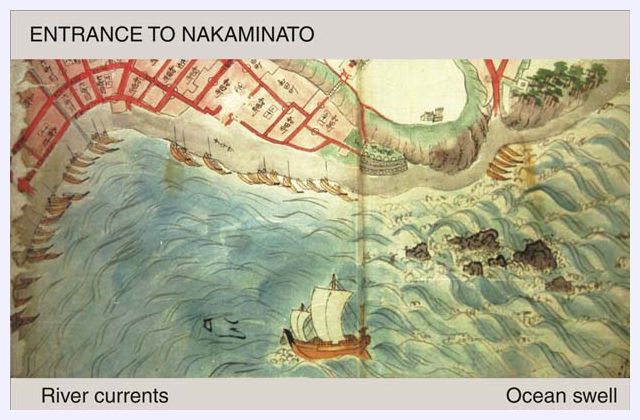
© Handout, City of Hitachinaka, JapanThis 1842 picture-map shows a ship entering the river at Nakaminato, Japan. A ship loaded with rice sank near this site in January 1700 after it was struck by a tsunami triggered by a massive earthquake off the coast of Vancouver Island.
Leonard said the likelihood of a major quake happening off the B.C. coast is between five and 10 per cent in the next 50 years, while the chance of one occurring in the southern Cascadia zone in the same time period is 20 per cent or more, depending on the forecasting model used.
The new research paper was co-authored by Leonard and two of her GSC colleagues - Stephane Mazzotti and Roy Hyndman, both of whom also teach at the University of Victoria - along with University of Alberta scientist Claire Currie.
Among the features examined by the team were cross-sections of soil from marshlands along the Pacific Coast that showed clearly where the 1700 tsunami had deposited sediments. The researchers also have identified "ghost forests" with the remains of ancient trees inundated by floodwaters following the undersea mega-quake three centuries ago.
Leonard says differences in seabed features between the northern and southern parts of the earthquake zone appear to explain the different frequencies in megathrust events.
"It seems that the northern part ruptures only when the whole thing goes - about 50 per cent of the time - whereas the southern part often ruptures independently," she said.
"There is not yet a conclusive answer, but the main theory is that the difference is due to there being a thicker pile of sediments on the oceanic Juan de Fuca plate in the north compared to the south."
Scientists have previously pegged the date of the last megathrust earthquake in the region to Jan. 26, 1700.
That degree of precision is partially due to the 2003 discovery of shipping records in Japan that detailed the sinking of a rice barge in the harbour of modern-day Hitachinaka, Japan - evidently the result of the tsunami unleashed when the seabed ruptured 7,000 kilometres away, off the North American coast.
The shipwreck documents were the first direct evidence of what was happening on the surface of the water on the Asian side of the Pacific.
Scientists said at the time that the sinking of the barge amid freakishly large waves in Japan clarified the duration and distance over which the effects of the earthquake were felt, and thus the severity of the initial shock wave.


Reader Comments
to our Newsletter