
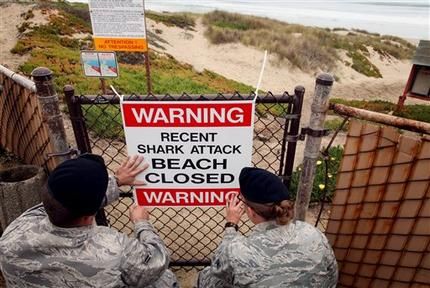
© Spencer Weiner/AP PhotoAirmen 1st class Daniel Clark, left, and Staff Sgt. Keri Embry, post a sign warning surfers of a recent shark attack Friday, Oct. 22, 2010, at Vandenburg Air Force Base, Calif.
The three beaches north of Santa Barbara - including Surf Beach where the attack took place - would be closed at least through the weekend and officials on Monday would decide when to reopen them, said Jeremy Eggers, spokesman for Vandenberg Air Force Base, which owns the beach property.
Eggers said he expected base officials would reopen the beaches Monday, but there was too much uncertainty and confusion surrounding the attack to say for sure.
"There's a lot of fog and friction in these kinds of situations," said Eggers. He said his bosses determined the shutdown "was the right thing to do as a safety precaution."
Lucas Ransom, a 19-year-old student at the University of California, Santa Barbara, was bodyboarding with friend Matthew Garcia off Surf Beach some 130 miles northwest of Los Angeles on Friday when the shark pulled him under the water. He resurfaced with his leg nearly severed amid what Garcia told The Associated Press was a wave of pure red.
Garcia said his friend already appeared dead.
Ransom had a severe wound to his left leg and died a short time later at Surf Beach, the Santa Barbara County Sheriff's Department said in a statement.
Federal and state Fish and Game officials were working to identify the type of shark that attacked Ransom. A shark expert told the Los Angeles Times, based on its behavior and Ransom's injury, it most likely was a great white.
"It takes a shark of massive size and jaw to inflict that kind of injury," Andrew Nosal of the Scripps Institute of Oceanography told the newspaper Saturday.
Authorities have issued several warnings this year after great white shark sightings up and down the California coast.
There have been nearly 100 shark attacks in California since the 1920s, including a dozen that were fatal, according to the California Department of Fish and Game. But attacks have remained relatively rare even as the population of swimmers, divers and surfers sharing the waters has soared.



be anymore attacks for a while the shark is full.
I live on the coast in shark waters and in the region we have attacks quite regularly.
In my experience and opinion these attacks are the sharks being confused as to what is their natural prey. This can happen because of chumming, the practice of throwing offal from a boat to attract them for the tourists to see them in action. The Shark becomes habituated to humans and food.
More often than not the shark sinks his teeth into the human and releases immediately
Perhaps realizing his mistake?
The point here is that the Shark is doing what he was designed to do and we are the intruder into his domain.