

© Meghan E. Strong, SCA
Rudj-Ka, the Purifier
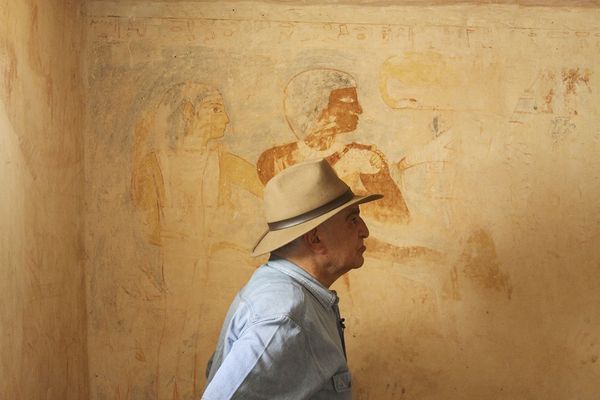
A painting on the wall of a newfound Egyptian tomb shows the occupant, Rudj-Ka (right), and his wife. Rudj-Ka probably lived during the end of ancient Egypt's 5th dynasty, roughly 4,350 years ago, archaeologists say (ancient Egypt time line).
Artwork and artifacts found in his elaborate tomb, found in and along a cliff near the Great Pyramids at Giza (map), indicate Rudj-Ka was a priest in the mortuary cult of the 4th-dynasty pharaoh Khafra, who ruled from 2558 to 2532 B.C. Khafra is best known as the force behind the second of the three Great Pyramids and of the Great Sphinx. (Watch video of the Great Pyramids at Giza.)
In the Old Kingdom, "after the death of the king, there was a pyramid city," said Zahi Hawass, secretary general of Egypt's Supreme Council of Antiquities (SCA). "In this pyramid city lived priests and people who maintained the cult of the king, to make the cult of the king living." (Take an ancient Egypt quiz.)
Rudj-Ka appears to have been a priest charged with overseeing purification rituals performed in honor of the dead pharaoh.
© Meghan E. Strong, SCA
Egyptian Offerings
Zahi Hawass surveys painted offerings of bread, goose, and beef in a wider view of the portrait of Rudj-Ka and his wife inside the newfound Egyptian tomb. (Also see pictures: "Ancient Egyptian Tombs Found With False Doors.")
The ancient tomb, announced Monday, may be part of a larger cemetery complex yet to be unearthed around Giza, Hawass said.
"You have new tombs now for the priests who maintained the cult of Khafra," said Hawass, who is also a National Geographic explorer-in-residence. "This is the first time the cartouche of Khafra was found in this area."
© Meghan E. Strong, SCA
Gone Fishing, Ancient Egyptian Style
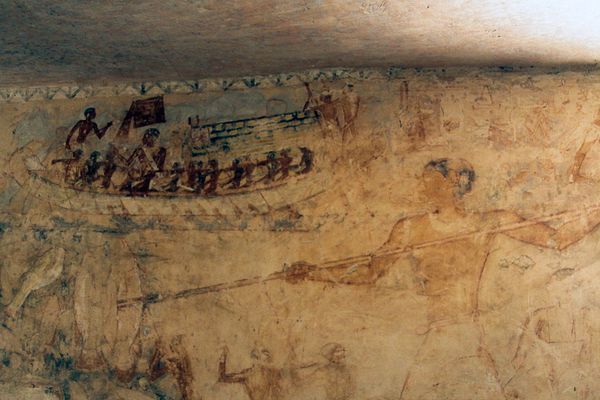
Another painting in the newfound tomb shows Rudj-Ka fishing in the Nile River, with boaters in the background. Ancient Egyptian burials often depicted such scenes of daily life - activities the tombs' occupants hoped to enjoy in the afterlife.
"In dynasty five and six, the priests were not from high society," Hawass added. "They could be from the regular people. Even workmen could be promoted to be a priest." (Also see "Rare Middle-Class Tomb Found From Ancient Egypt.")
That's not to say Rudj-Ka ever fished for a living - archaeologists caution that none of the tomb paintings indicate exactly what Rudj-Ka did before he became a mortuary priest.
© Meghan E. Strong, SCA
Portal to the Afterlife
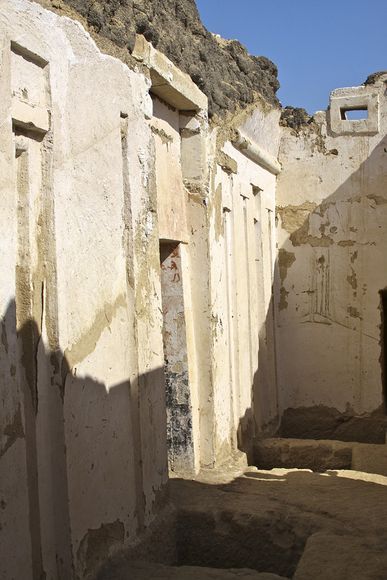
The entrance to Rudj-Ka's tomb (pictured) leads to a maze of corridors constructed from limestone blocks. The inner burial complex was cut into a cliff and intended to accommodate the burials of all the priest's family members.
The lavish tomb would have been arduous and expensive to construct, the SCA's Hawass said: "Everything is difficult, but the quest for immortality led them to do this." (Also see pictures: "Secret Tunnel Explored in Pharaoh's Tomb.")
In any case, Rudj-Ka could afford it, in all likelihood - priests often became wealthy after receiving their titles. In exchange for their services, priests received a share of the goods given to the temples, part of a system known as "reversion of offerings."
© Kenneth Garrett, National Geographic
Pyramid Builders' Cemetery
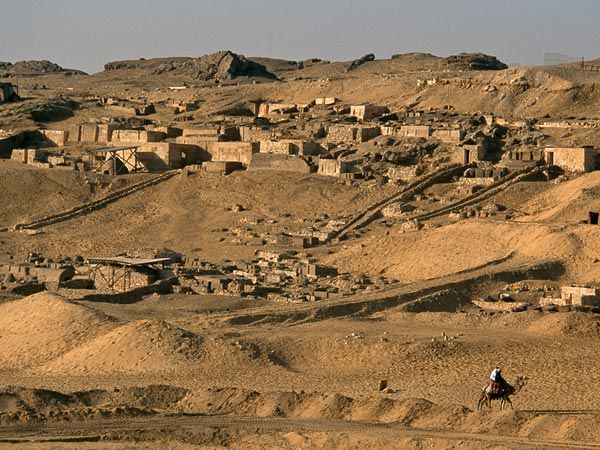
The cemetery of the pyramid workers, shown in 2001, sits to the north of Rudj-Ka's tomb. Discovered about a decade ago, the workers' cemetery helped reveal how construction of the Great Pyramids at Giza mobilized ancient Egyptian society and created an entire city around the monuments.
(See "Pyramid Builders' Village Found in Egypt.")
Rudj-Ka's tomb might have been separate from the workers' tombs because of his title as priest, Hawass said, adding that he hopes the newfound tomb will turn out to be part of another, as yet unearthed necropolis dedicated to the priests of the royal court.
© Kenneth Garrett, National Geographic
Discoveries Loom at Pyramids?
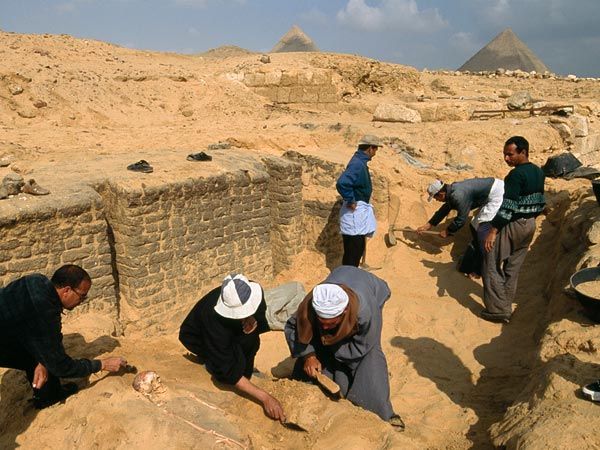
Workers brush sand from artifacts at the pyramid builders' cemetery in 2001.
Although Hawass thinks the workers' graves and the newfound tomb might be linked, another possibility is that the tomb of Rudj-Ka could be a western extension of the massive necropolis of Memphis, on the edge of modern-day Cairo, he said.
"The location is surprising," Hawass said. "We never expected to find a big, large tomb like this in the south of the pyramid builders' [cemetery] at all."
(Related: "'Lost' Pyramid Found Buried in Egypt.")



Reader Comments
to our Newsletter