
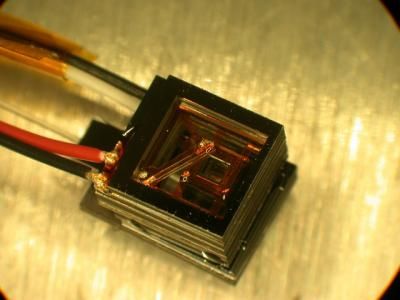
© Svenja Knappe/NISTNIST mini-sensor
The NIST mini-sensor is a small container that consists of 100 billion gaseous rubidium atoms, optics and a low-power infrared laser. This design is capable of measuring the heart's "magnetic signature" in picotesla's, which are trillionths of a tesla, and the unit tesla measures magnetic field strength. The mini-sensor was first developed in 2004 as a "spin-off" of the miniature atomic clocks developed by NIST. The sensor has seen some recent updates, such as the addition of fiber optics to sense light signals that register magnetic field strength, and a reduction in size to make the entire system more mobile.
The mini-sensor has only been used in physics laboratories up until this point, but this new study puts the mini-sensor to use in a clinical setting for the first time. It was tested at the Physikalisch Technische Bundesanstalt (PTB) in Berlin, Germany, mainly because this particular building has the "world's best magnetic shielding." This is beneficial to the experiment because the Earth's magnetic field, as well as other external sources, can interfere with high-precision measurements.
While at PTB, researchers put the NIST mini-sensor five millimeters above the left chest of a person lying flat on their back. A weak, but regular magnetic pattern of the heartbeat was detected by the sensor, and when a SQUID (superconducting quantum interference device) was used, which is considered the best of the best, the same results were recorded.
While the NIST mini-sensor recorded more noise, or interference, in the signal, it proved that it could correctly measure a human heartbeat just as well as a SQUID. An advantage that the NIST mini-sensor has over the SQUID is that it is capable of functioning at room temperature, where a SQUID operates better at temperatures of minus 269 degrees Celsius.
NIST and PTB researchers hope the mini-sensors can be used to make magnetocardiograms, which are an alternative or supplement to electrocardiograms, in the future. They would also like to see these sensors improve the latest technological techniques, such as magnetorelaxometry (MRX), which measures the magnetization decay of magnetic nanoparticles.
This study was published in Applied Physics Letters, and was lead by NIST researchers Svenja Knappe and John Kitching, along with Physikalisch Technische Bundesanstalt (PTB) researchers Tilmann Sander, Lutz Trahms, Olaf Kosch and Frank Wiekhorst.



Reader Comments
to our Newsletter