

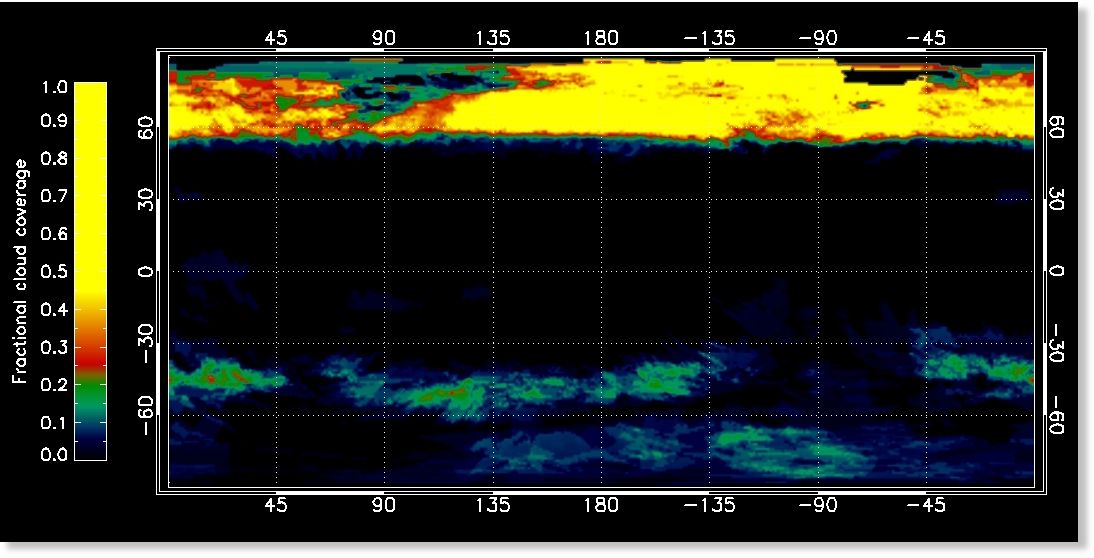
© NASA/JPL/University of Arizona/University of Nantes/ University of Paris DiderotFractional cloud coverage in Titan’s atmosphere integrated between July 2004 and April 2010. Black areas are cloud free and yellow are fully covered.
Together with Saturn in its 30-years orbit around the Sun, Titan has seasons that last for 7 terrestrial years. The team has observed significant atmospheric changes between July 2004 (early summer in the southern hemisphere) and April 2010, the very start of northern spring. The images showed that cloud activity has recently decreased near both of Titan's poles. These regions had been heavily overcast during the late southern summer until 2008, a few months before the equinox.
"Over the past six years, we've found that clouds appear clustered in three distinct latitude regions of Titan: large clouds at the north pole, patchy cloud at the south pole and a narrow belt around 40 degrees south. However, we are now seeing evidence of a seasonal circulation turnover on Titan - the clouds at the south pole completely disappeared just before the equinox and the clouds in the north are thinning out. This agrees with predictions from models and we are expecting to see cloud activity reverse from one hemisphere to another in the coming decade as southern winter approaches," said Dr. Rodriguez.
The team has used results from the Global Climate Models (GCMs) developed by Pascal Rannou (Institut Pierre Simon Laplace) to interpret the evolution of the observed cloud patterns over time. Northern polar clouds of ethane form in the Titan's troposphere during the winter at altitudes of 30-50 km by a constant influx of ethane and aerosols from the stratosphere. In the other hemisphere, mid- and high-latitudes clouds are produced by the upwelling from the surface of air enriched in methane. Observations of the location and activity of Titan's clouds over long periods are vital in developing a global understanding of Titan's climate and meteorological cycle.
© NASA/JPL/University of Arizona/University of Nantes/ University of Paris DiderotT43 flyby of Titan - 12 May 2008 - VIMS images a large cloud that caps the north pole of Titan (yellowish tones). Right: T63 flyby of Titan - 12 December 2009 - VIMS still observes a huge cloud system at 40°S (yellowish tones) and the north pole of Titan free of clouds, a few months after the equinox.
"Even having eliminated 90% of the images, we were still left with several million spectra to analyse. We developed a computer programme that picked out the cloudy pixels and we then went back and visually checked the detections to make sure that they were relevant," said Dr Rodriguez.
In Feburary 2010, the Cassini mission was extended to a few months past Saturn's northern summer solstice in May 2017. This means that Rodriguez and his team will be able to observe the seasonal changes right the way through from mid-winter to mid-summer in the northern hemisphere.
"We have learned a lot about Titan's climate since Cassini arrived in at Saturn but there is still a great deal to learn. With the new mission extension, we will have the opportunity to answer some of the key questions about the meteorology of this fascinating moon," said Rodriguez.



Reader Comments
to our Newsletter