
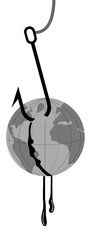
© Stephen Savage
The deal with fish oil, I found out, is that a considerable portion of it comes from a creature upon which the entire Atlantic coastal ecosystem relies, a big-headed, smelly, foot-long member of the herring family called menhaden, which a recent book identifies in its title as The Most Important Fish in the Sea.
The book's author, H. Bruce Franklin, compares menhaden to the passenger pigeon and related to me recently how his research uncovered that populations were once so large that "the vanguard of the fish's annual migration would reach Cape Cod while the rearguard was still in Maine." Menhaden filter-feed nearly exclusively on algae, the most abundant forage in the world, and are prolifically good at converting that algae into omega-3 fatty acids and other important proteins and oils. They also form the basis of the Atlantic Coast's marine food chain.
Nearly every fish a fish eater likes to eat eats menhaden. Bluefin tuna, striped bass, redfish and bluefish are just a few of the diners at the menhaden buffet. All of these fish are high in omega-3 fatty acids but are unable themselves to synthesize them. The omega-3s they have come from menhaden.
But menhaden are entering the final losing phases of a century-and-a-half fight for survival that began when humans started turning huge schools into fertilizer and lamp oil. Once petroleum-based oils replaced menhaden oil in lamps, trillions of menhaden were ground into feed for hogs, chickens and pets. Today, hundreds of billions of pounds of them are converted into lipstick, salmon feed, paint, "buttery spread," salad dressing and, yes, some of those omega-3 supplements you have been forcing on your children. All of these products can be made with more environmentally benign substitutes, but menhaden are still used in great (though declining) numbers because they can be caught and processed cheaply.
For the last decade, one company, Omega Protein of Houston, has been catching 90 percent of the nation's menhaden. The perniciousness of menhaden removals has been widely enough recognized that 13 of the 15 Atlantic states have banned Omega Protein's boats from their waters. But the company's toehold in North Carolina and Virginia (where it has its largest processing plant), and its continued right to fish in federal waters, means a half-billion menhaden are still taken from the ecosystem every year.
For fish guys like me, this egregious privatization of what is essentially a public resource is shocking. But even if you are not interested in fish, there is an important reason for concern about menhaden's decline.
Quite simply, menhaden keep the water clean. The muddy brown color of the Long Island Sound and the growing dead zones in the Chesapeake Bay are the direct result of inadequate water filtration - a job that was once carried out by menhaden. An adult menhaden can rid four to six gallons of water of algae in a minute. Imagine then the water-cleaning capacity of the half-billion menhaden we "reduce" into oil every year.
So what is the seeker of omega-3 supplements to do? Bruce Franklin points out that there are 75 commercial products - including fish-oil pills made from fish discards - that don't contribute directly to the depletion of a fishery. Flax oil also fits the bill and uses no fish at all.
But I've come to realize that, as with many issues surrounding fish, more powerful fulcrums than consumer choice need to be put in motion to fix things. President Obama and the Congressional leadership have repeatedly stressed their commitment to wresting the wealth of the nation from the hands of a few. A demonstration of this commitment would be to ban the fishing of menhaden in federal waters. The Virginia Legislature could enact a similar moratorium in the Chesapeake Bay (the largest menhaden nursery in the world).
The menhaden is a small fish that in its multitudes plays such a big role in our economy and environment that its fate shouldn't be effectively controlled by a single company and its bottles of fish oil supplements. If our government is serious about standing up for the little guy, it should start by giving a little, but crucial, fish a fair deal.
Paul Greenberg is the author of the forthcoming Four Fish: The Future of the Last Wild Food.



Most fish oil capsules do not contain menhaden. Those that do include "menhaden" or "herring" in the list of ingredients. An independent testing laboratory in England has determined that the fish oil capsules containing menhaden from Omega Protein Corp. have high levels of toxic chemicals. Other fish oil capsules meet the very rigorous safety standards of California. For more detailed information on this, see pp. 211-212 of my book THE MOST IMPORTANT FISH IN THE SEA.
H. Bruce Franklin