
|
| ©Unknown |
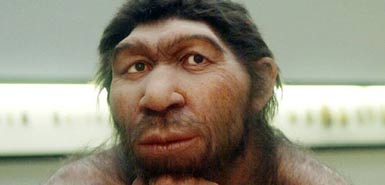
The voice of Neanderthal Man has been synthesised 30,000 years after the human relatives became extinct.
Scientists in the US have used a reconstruction of the larynx of Homo neanderthalis and computer models to mimic the way that the species probably spoke. Only one sound - the "e" - has been generated so far, which seems strangulated and nasal in comparison with its human equivalent.
Robert McCarthy, of Florida Atlantic University, who is leading the research, said that he hoped eventually to produce an entire sentence. He told New Scientist magazine that the species lacked the "quantal vowel" sounds typical of modern speech. The Neanderthal "e" did not have the quantal hallmark that would help a listener to distinguish the word "beat" from "bit".
This linguistic difference would have limited Neanderthal speech.
"They would have spoken a bit differently," Dr McCarthy said. "They wouldn't have been able to produce these quantal vowels that form the basis of spoken language."
In the 1970s research into the Neanderthal's larynx concluded that the species lacked the subtlety of modern speech. Some experts have criticised this finding, citing archaeological evidence of an oral Neanderthal culture.
Erik Trinkaus, an anthropologist at Washington University in St Louis, Missouri, believes that the notion that Neanderthals were primitive talkers did not tie in with the large brains of human beings.
"Ultimately what is important is not the anatomy of the mouth but the neuronal control of it," he said.
Last year researchers found that Neanderthals and modern Man shared a version of a gene linked to speech.



Reader Comments
to our Newsletter