OF THE
TIMES
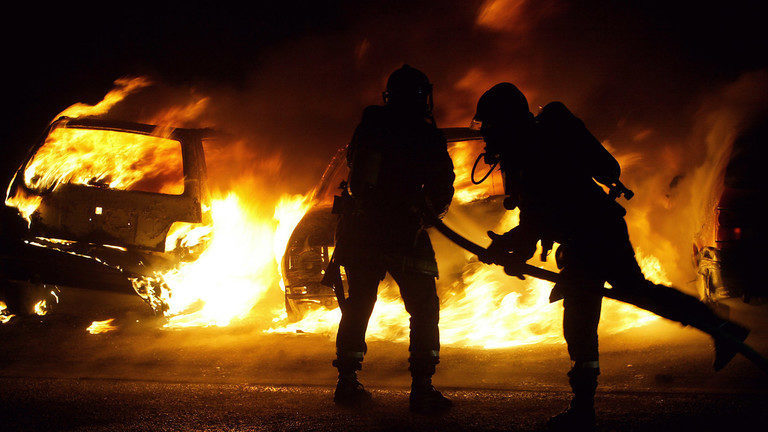
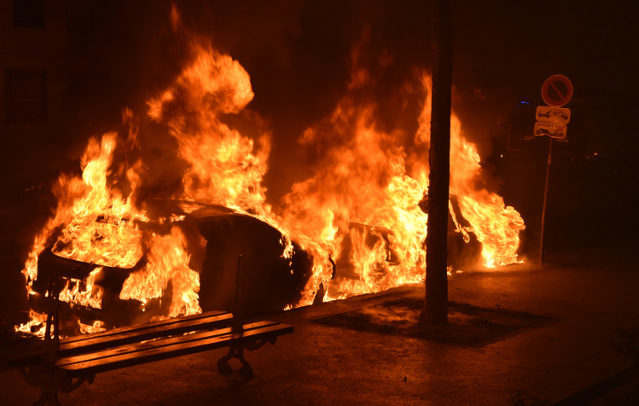
Why are hundreds of cars burned in France on New Year's Eve?See also:
Burning cars is something of a tradition in France, albeit a much hated one by authorities and car owners, and it appears to be on the rise again.
Every New Year's Eve nervous car owners across France cross their fingers in the hope they can start the New Year with their vehicle intact.
That's because of a longstanding French tradition that sees youths in certain parts of cities torching scores of cars.
The number of vehicles set alight on the night of December 31st 2018 climbed to 1,031 compared to 935 the previous New Year's Eve, while arrests rose from 456 to 510, the interior ministry said on Monday.
Nevertheless stats released last year by France's official crime data agency ONDRP reveal that the number of cars burned each year has fallen by 20 percent since 2010.
That was the good news for car owners and insurance firms.
The bad news is that tens of thousands of vehicles are still burned across the country.
The main burning season is in July and August, particularly on Bastille Day on July 14th when youths mark the annual fête nationale with their own firework shows.
The main reason for the fall according to the ONDRP is that the media take less interest now in the mass burning of cars, which means there may be less of a thrill for the arsonists.
Authorities have previously refrained from reporting on the number of torched cars on New Year's Eve after it was discovered that a district-by-district breakdown was fuelling destructive competition between rival gangs.
Added to that is that extra police are regularly deployed in sensitive areas on specific nights of the year to try to prevent the blazes.
The stats also showed that the departments most affected by the phenomenon were Haute-Corse in Corsica, Isere to the south east which includes Grenoble, and Oise, to the north of Paris.
Rural areas of France are much less affected than urban areas.
The car owners most affected are generally in the more hard-up neighbourhoods.
So why do the French burn cars anyway?
The custom of setting vehicles alight on New Year's Eve reportedly began in the east of the country, around Strasbourg, in the 1990s, in the the city's poorer neighbourhoods.
It was then quickly adopted by youths in cities across the country.
Cars are often set ablaze whenever there is an outbreak of social disorder, as seen in the 2005 riots when hundreds of vehicles were torched.
The ONDRP's Christophe Schulz told Le Parisien newspaper that there are diverse reasons that youths burn cars.
"Vehicle fires are often associated with a context of riots and urban violence. It can also be a 'game' to break the monotony, or it could be motivated by vengeance after a violent arrest. Or it could just be to get rid of a car used in a crime or as an insurance scam."
So while car owners might welcome the fall, they still face a few sleepless nights this summer.

Imran Khan promises COMPLETE PROTECTION for trans people in Muslim-majority Pakistan
At the risk of stirring a massive backlash from devout fundamentalists, Pakistani PM Imran Khan has promised to protect transgender people and incorporate them into local welfare programs.
...
While Khan's promises may not go down well in Pakistan, which has the second-largest Muslim population in the world, the trend is not entirely new. Last year, the country's parliament made history by passing the Transgender Person Act, which allowed Pakistanis to self-identify as male, female, both or neither. Under the law, they may also have their gender identity stated on national IDs, driver licenses and education diplomas.
...
It also prohibits employers and public officials from discriminating against LGBT people. Nevertheless, the country still has a penal code that provides for life imprisonment for "carnal intercourse against the order of nature with any man, woman or animal."
The transgender community was counted in the 2017 nationwide census for the first time in Pakistan's history, recording 10,418 in a population of about 207 million.

Former Hood County deputy sheriff Jack Wilson, a 71-year-old firearms instructor and trained marksman who owned a shooting range and worked as security for the church, took out the gunman - a convicted felon named Keith Kinnunen - with a single shot just seconds after the man began shooting.
Kinnunen still managed to kill Deacon Tony Wallace, who was handing out communion at the time, and Rich White, a member of the church's security team trained by Wilson.
"He's not just responsible for his actions, which ultimately saved the lives of maybe hundreds of people, but he's also responsible for training hundreds in that church," said Texas Attorney General Ken Paxton.
Regional Director of Texas Department of Public Safety Jeoff Williams agreed that "the citizens who were inside that church undoubtedly saved 242 other parishioners."
Kinnunen was a transient who had been arrested many times in many different jurisdictions. The church had reportedly given him food several times, but he "became angry when they wouldn't give him money." His criminal convictions include aggravated assault with a deadly weapon, third-degree arson, illegal possession of a concealed weapon, and theft.
The gun-control crowd pointed out that Wilson wasn't just a random person pulling out his gun and saving the congregation, but someone trained to do exactly what he did. They suggested that the average person intervening in a mass shooting would likely cause further harm.

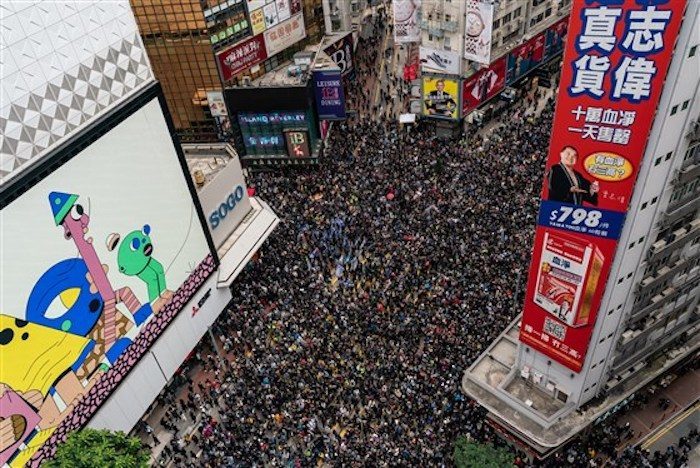
Comment: Xi Jinping's comments regarding the instability and its effects on people are noteworthy as surveys indicate the quality of life is sinking and Hong Kong citizens are showing an 'alarming' deterioration of mental health amid the protest crisis.