Best of the Web:


Meteor

Best of the Web: Ireland: Search on for 'Huge' Meteorite

Meteor
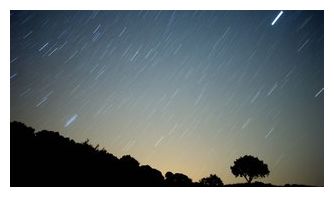
© RTÉ NewsAstronomy - A meteor streaks across the sky during a meteorite shower in Spain.

The search is on for fragments of a meteorite which blazed across Irish skies yesterday evening.

The meteor - described as 'huge' by Astronomy Ireland - is known as a fireball.

Astronomy Ireland says it is likely to be a piece of a comet or asteroid that passed near Earth's orbit sometime in the past.

It appeared in the moonlit sky at approximately 6pm, or shortly after.

If it survived the fall to Irish soil, keen treasure hunters may fetch hundreds of Euro per gram of meteorite if found.

Blackbox

Best of the Web: Fall of Roman Empire Linked to Wild Shifts in Climate

Image
© Carlos Gotay/GettyOutlook is bleak
Centuries of unpredictable climate may have been partly to blame for the fall of the western Roman Empire. A detailed record of 2500 years of European climate has uncovered several links between changing climate and the rise and fall of civilisations.

Climate fluctuation was a contributing factor alongside political failures and barbarian invasions, says Ulf Büntgen of the Swiss Federal Institute for Forest, Snow and Landscape Research in Birmensdorf, Switzerland, who led the project.

Büntgen used tree rings to build up a history of European climate. Using nearly 9000 samples from oak, pine and larch, Büntgen and colleagues were able to reconstruct how temperatures and rainfall in western Europe changed over the last 2500 years.

Family

Best of the Web: U.S.: Sick Gulf Residents Beg Officials for Help

Image
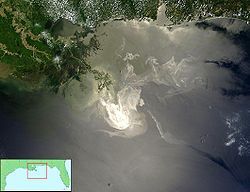
© National Aeronautics and Space AdministrationThe oil slick as seen from space by NASA's Terra satellite on May 24, 2010.
In an emotionally charged meeting this week sponsored by the National Commission on the BP Deepwater Horizon Oil Spill, fishermen, Gulf residents and community leaders vented their increasingly grave concerns about the widespread health issues brought on by the three-month-long disaster.

'Today I'm talking to you about my life,' Cherri Foytlin told the two commissioners present at the Jan. 12 meeting. 'My ethylbenzene levels are 2.5 times the 95th percentile, and there's a very good chance now that I won't get to see my grandbabies...What I'm asking you to do now, if possible, is to amend [your report]. Because we have got to get some health care.'

Ethylbenzene is a form of benzene present in the body when it begins to break down. It is also present in BP's crude oil.

Bizarro Earth

Flashback Best of the Web: Walls of Water 10ft High in a Month-Long Mega Hurricane: California Told to Prepare for Biblical 'ARkStorm'

ARkstorm flooding
© UnknownA map of the flood area of the hypothetical ARkStorm event
Scientists are now warning Californians that the long-awaited 'big one' earthquake could be the least of their environmental concerns.

Another more deadly threat awaits the West coast of America - in the form of a biblical 'ARkStorm', which could bring death and destruction on a scale never before seen.

Walls of water 10ft high, rain falling in feet instead of inches, and nine million people's homes flooded during a hurricane-like megastorm that could last more than month.

The every-other-century event last happened in 1861 and left the central valley of California impassable.

The cost was impossible to quantify - but should a similar event happen today the damage could total more than $300billion.


Comment: Feb 16, 2017: It does not have to be a hurricane as continuous stormsystems loaded with water aka Atmospheric Rivers would be enough to create the scenario outlined here. Something that California is experiencing now in the beginning of 2017.


Radar

Best of the Web: Did Australia's obsession with global warming contribute to the Brisbane floods?

Image
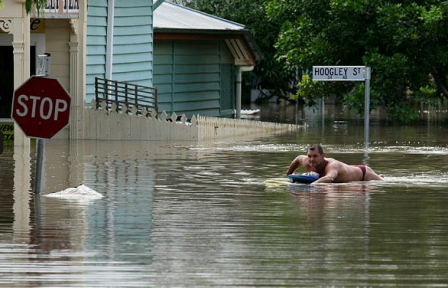
© GettyA man paddles down a street in a Brisbane suburb
Who, if anyone, is to blame for the terrible flooding in Brisbane? Commentators are pointing their collective finger at the usual suspects. For the extreme green magazine Grist, the floods expose mankind's arrogance in believing that he can build settlements anywhere he likes, even on floodplains. Nature is "taking a perverse pleasure in pointing out just where the shiny, might city is weakest", gloats Grist. Others are blaming Aussie property developers, for thoughtlessly throwing up flood-prone buildings, and yet others think Queensland politicians should have done more to improve flood defences.

But might there be another, so far overlooked, contributing factor to the floods? Might the politics of environmentalism itself - the contemporary obsession with global warming as the greatest threat to mankind - have exacerbated the impact of the flooding in Brisbane? It seems possible that Aussie politicians' and officials' deeply held conviction that the main problem we face today is increased heat, droughts and a lack of rainfall caused them to take their eye off the ball in Brisbane, and to be unprepared for something as relatively normal as very heavy rainfall.

Meteor

Best of the Web: Catastrophist Theories of Life Gaining Ground: It Came From Outer Space

They're called catastrophists, a group of British scientists who question many of the aspects of Darwinian evolution and argue that life on Earth and the geology of the planet have been constantly reshaped by asteroid strikes and other external shocks.

The latest sally from the catastrophist camp comes from the astronomer and mathematician Chandra Wickramasinghe, who told a scientific congress in California in July that he had found microbes in air samples scooped up by a balloon flying 25 miles (about 40 kilometers) above the Earth's surface.

Mr. Wickramasinghe, director of the department of Astrobiology at Cardiff University in Wales, said it was the first positive identification of extraterrestrial microbial life outside the atmosphere. The fact that a major British university has set up a department dedicated to a theory still regarded with much skepticism and hostility in the academic community is one indication of how accepted catastrophist ideas have become in British science.

Meteor

Best of the Web: 25 Sun-Diving Comets in 10 days?

The sun has just experienced a storm - not of explosive flares and hot plasma, but of icy comets.

"The storm began on Dec 13th and ended on the 22nd," says Karl Battams of the Naval Research Lab in Washington, DC. "During that time, the Solar and Heliospheric Observatory (SOHO) detected 25 comets diving into the sun. It was crazy!"

Sundiving comets - a.k.a. "sungrazers" - are nothing new. SOHO typically sees one every few days, plunging inward and disintegrating as solar heat sublimes its volatile ices. "But 25 comets in just ten days, that's unprecedented," says Battams.


"The comets were 10-meter class objects, about the size of a room or a house," notes Matthew Knight of the Lowell Observatory in Flagstaff, Arizona. "As comets go, these are considered small."

SOHO excels at this kind of work. The spacecraft's coronagraph uses an opaque disk to block the glare of the sun like an artificial eclipse, revealing faint objects that no Earth-bound telescope could possibly see. Every day, amateur astronomers from around the world scrutinize the images in search of new comets. Since SOHO was launched in 1996, more than 2000 comets have been found in this way, an all-time record for any astronomer or space mission.

Battams and Knight think the comet-storm of Dec. 2010 might herald a much bigger sungrazer to come, something people could see with the naked eye, perhaps even during the day.

"It's just a matter of time," says Battams. "We know there are some big ones out there."

Ambulance

Best of the Web: Modern Psychiatry - The Thud Experiment

The Rosenhan experiment (also known as the the 'Thud' experiment, was a famous investigation into the validity of psychiatric diagnosis conducted by psychologist David Rosenhan in 1973. It was published in the journal Science under the title "On being sane in insane places."

Rosenhan's study was conducted in two parts. The first part involved the use of healthy associates or "pseudopatients" who briefly simulated auditory hallucinations in an attempt to gain admission to 12 different psychiatric hospitals in five different states in various locations in the United States. All were admitted and diagnosed with psychiatric disorders. After admission, the pseudopatients acted normally and told staff that they felt fine and had not experienced any more hallucinations. Hospital staff failed to detect a single pseudopatient, and instead believed that all of the pseudopatients exhibited symptoms of ongoing mental illness. Several were confined for months.

Despite constantly and openly taking extensive notes on the behavior of the staff and other patients, none of the pseudopatients were identified as impostors by the hospital staff, although many of the other psychiatric patients seemed to be able to correctly identify them as impostors. In the first three hospitalizations, 35 of the total of 118 patients expressed a suspicion that the pseudopatients were sane, with some suggesting that the patients were researchers or journalists investigating the hospital.

All were forced to admit to having a mental illness and agree to take antipsychotic drugs as a condition of their release.

The second part involved asking staff at a psychiatric hospital to detect fake patients that Rosenhan agreed to send. After a month, the staff identified large numbers of ordinary patients as impostors. Rosenhan then revealed that he had not sent any fake patients.


Butterfly

Best of the Web: Even The Troops Are Waking Up

Poor and working people in this country are sent to kill poor and working people in another country to make the rich richer.


Snowflake Cold

Best of the Web: US: Snow In 49 States Right Now (MAP)

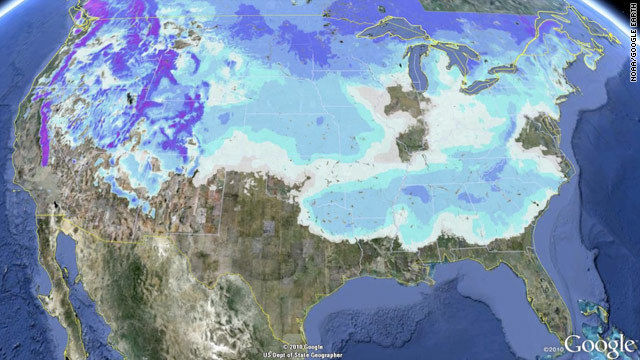
A map of snowfall in the United States is revealing right now: 49 states have snow on this 1/11/11 and only one does not.

From the southern snow storm heading north, which is affecting air travel, to the pending storm in New York City, and flurries out west, there's plenty of white stuff going around.

The lone state without a flake? It's the Sunshine State...Florida. Locals are celebrating the fact, though interestingly, parts of the state saw snow just days ago.

Even Hawaii has snow, in Mauna Kea on the Big Island.

Have a look at the map for yourself:

map
© Google
CNN meteorologist Angela Fritz calls this "extremely unusual," though notes that statistics aren't generally kept on how many states have snow at the same time.