
© Egypt’s Ministry of Tourism and Antiquities via Facebook
A Spanish-Egyptian excavation team working at the ancient site of Oxyrhynchus (modern-day El-Bahnasa) has uncovered a Roman-era necropolis containing mummies adorned with golden tongue amulets.
The discovery was announced by Egypt's Ministry of Tourism and Antiquities, highlighting it as one of the most significant recent finds in Middle Egypt. The excavation was led by researchers from the University of Barcelona and the Institute of the Ancient Near East, under the direction of Dr. Maite Mascort and Dr. Esther Pons Mellado.
A Rare Blend of Egyptian and Greek Traditions
The newly uncovered tomb complex dates to the Roman period and lies east of a previously identified Ptolemaic tomb known as Tomb 67. Archaeologists opened a trench revealing three limestone burial chambers, now largely deteriorated due to age and ancient looting.
Inside these chambers, researchers found unusual burial practices. Large ceramic vessels contained cremated human remains — an uncommon feature in Egyptian archaeology — alongside bones of infants and even feline skulls, all wrapped carefully in textiles. This suggests a ritual blending cremation with traditional burial customs, offering new insights into evolving funerary practices during the transition from the Ptolemaic to Roman eras.
Nearby, the team also discovered terracotta and bronze figurines, including representations of the god Harpocrates depicted as a rider and a small statue of Cupid. These artifacts reinforce the presence of Greco-Roman religious influences in the region, pointing to a culturally diverse society where Egyptian, Greek, and Roman beliefs coexisted.
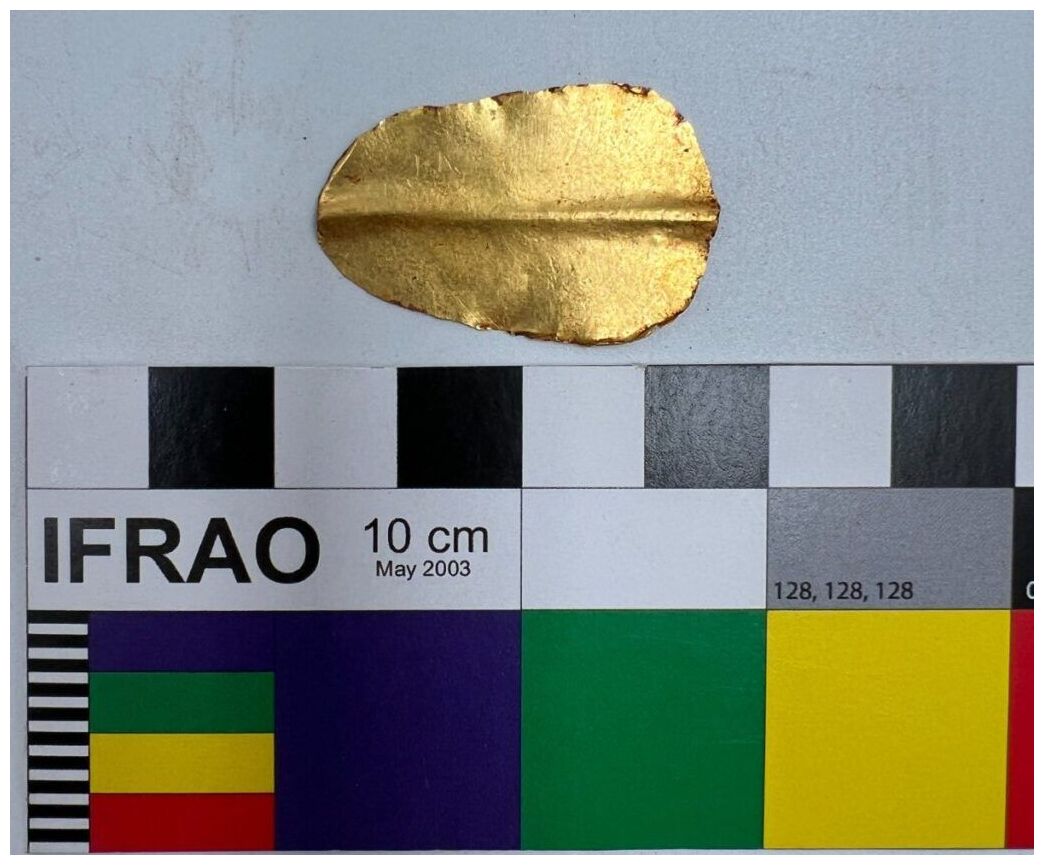
© Egypt’s Ministry of Tourism and Antiquities via FacebookOne of the golden tongues.
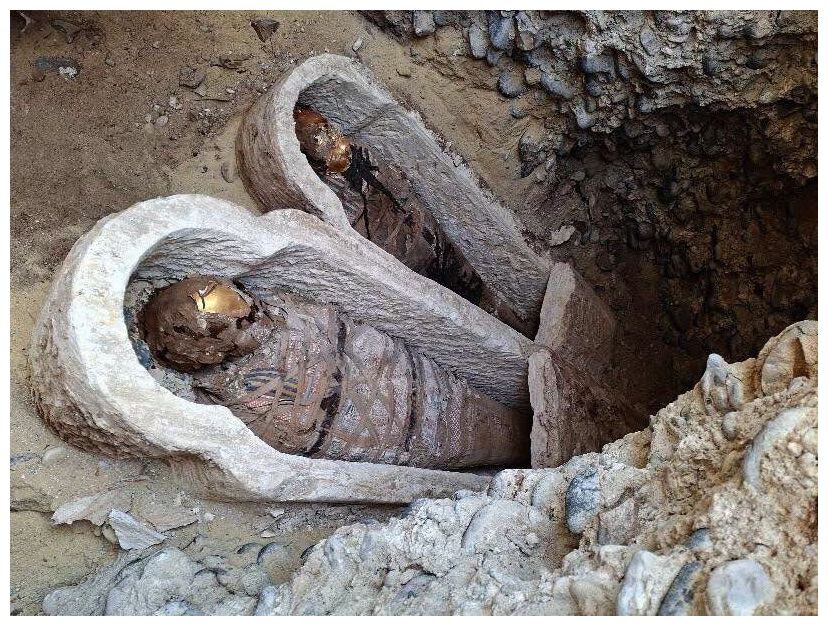
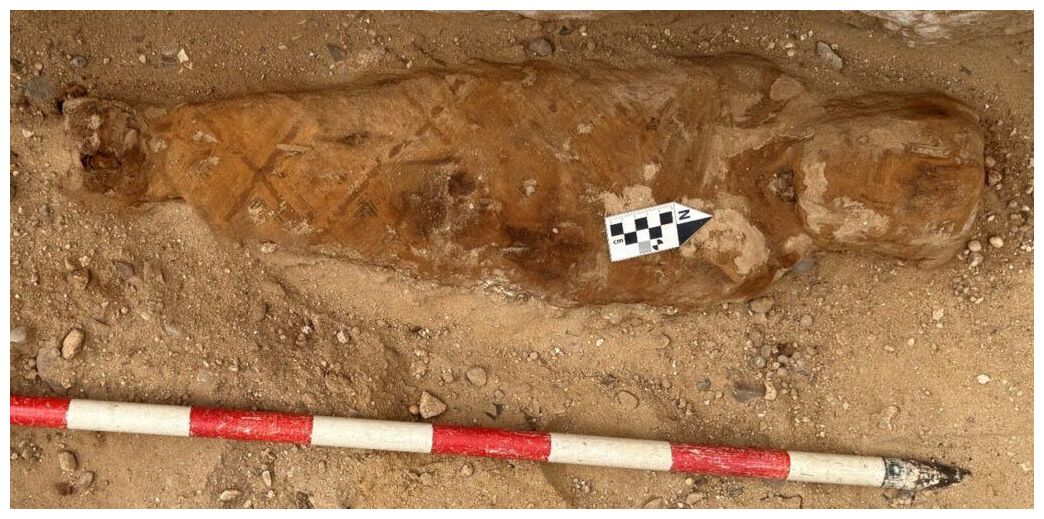
One of the most striking elements of the discovery comes from another burial structure known as Tomb 65 — a hypogeum, or underground chamber. Here, archaeologists uncovered several Roman-era mummies, some wrapped in linen decorated with geometric patterns and accompanied by painted wooden coffins.
Among the burial goods were three golden tongues and one copper tongue, placed inside the mouths of the deceased. These amulets were believed to ensure the dead could speak in the afterlife, particularly when facing judgment before Osiris, the Egyptian god of the underworld.
This practice, while documented elsewhere, is especially significant at Oxyrhynchus due to its direct association with a hypogeum setting and additional evidence of gold leaf applied to some mummies. Such details suggest that the individuals buried here likely belonged to a wealthy or elite class.
The Iliad Papyrus: A Literary Mystery
The most captivating discovery, however, lies within one of the mummies: a rare papyrus fragment containing text from Book II of Homer's Iliad. Specifically, the passage corresponds to the famous "Catalog of Ships," which lists the Greek forces that sailed to Troy.
Finding a classical Greek literary text inside an Egyptian mummy is exceptionally rare and opens up fascinating questions. Why was this text included in the burial? Was it meant as a symbol of education, status, or cultural identity? Or did it hold a deeper ritual significance?
Dr. Hisham El-Leithy, Secretary General of Egypt's Supreme Council of Antiquities, emphasized that this discovery adds a new intellectual dimension to the site. It suggests that the local elite in Oxyrhynchus were not only influenced by Greek culture but actively engaged with its literary traditions.
© Egypt’s Ministry of Tourism and Antiquities via Facebook
Oxyrhynchus is already famous among historians for the vast number of papyri discovered there since the late 19th century, including literary works, official documents, and everyday records. However, most of those texts were found in ancient rubbish heaps — not within burial contexts.
This makes the Iliad papyrus particularly significant. Its placement inside a mummy suggests a deliberate choice, potentially linking literature with beliefs about the afterlife or personal identity.
Scholars believe further analysis of the papyrus could reveal more about literacy, education, and the circulation of Greek texts in Roman Egypt. It may also provide clues about how classical works were valued outside major cultural centers like Alexandria.
Preservation and Future Research
The artifacts recovered from the site — including the papyrus — are now undergoing conservation and detailed study. Experts will use advanced imaging and papyrological techniques to analyze the text and its context.
Egypt's Minister of Tourism and Antiquities, Sherif Fathy, described the discovery as part of a series of important archaeological finds in Minya, underscoring the region's rich and diverse historical heritage.
As research continues, the combination of cremation burials, traditional mummification, golden tongue amulets, and a fragment of the Iliad paints a vivid picture of a society in cultural transition. It reflects how Egyptian traditions adapted and merged with Greek and Roman influences during a dynamic period of history.
A Discovery That Bridges Civilizations
This unique find at Oxyrhynchus does more than add artifacts to museum collections — it connects worlds. The presence of Homer's Iliad in an Egyptian tomb highlights the far-reaching influence of Greek literature and its integration into local customs.
At the same time, the continuation of distinctly Egyptian burial practices, such as mummification and afterlife rituals, demonstrates strong cultural continuity.
Together, these elements make the discovery not just an archaeological milestone, but a powerful reminder of how interconnected ancient civilizations truly were.
Source: Egypt's Ministry of Tourism and Antiquities






In this context, I would not have been surprised if the fragments had been from a Harrods catalog ... [Link]