
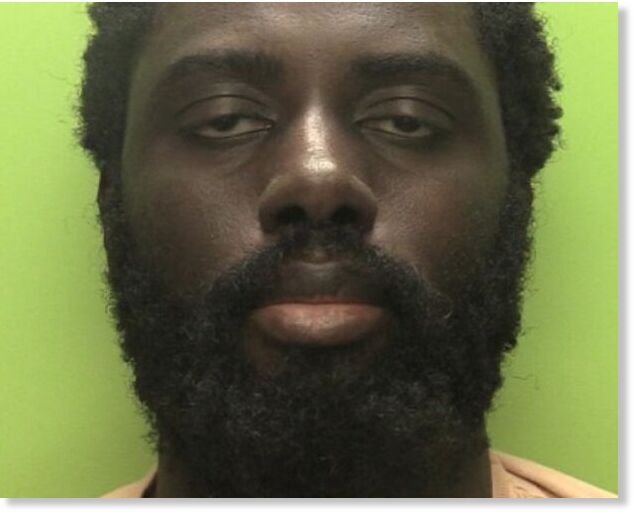
© Nottinghamshire Police/PAValdo Calocane, who killed three people and severely injured three others in 2023, had been involved in a violent incident in 2020
Calocane, who has paranoid schizophrenia, fatally stabbed 19-year-old students Barnaby Webber and Grace O'Malley-Kumar, and 65-year-old Ian Coates, and severely injured three others on 13 June 2023.
He was sentenced to an indefinite hospital order in January 2024 after admitting three counts of manslaughter on the grounds of diminished responsibility and three counts of attempted murder.
A public inquiry began on Monday to assess the "events, acts and omissions" that allowed Calocane to be free to kill and what can be done to prevent something similar happening again.
During the first day of the hearing, counsel to the inquiry Rachel Langdale KC said Calocane was arrested on 24 May 2020 after "repeatedly kicking and punching" a door in his student accommodation. A neighbour had to "restrain" Calocane before officers arrived, Langdale said.
Calocane, who was a student at University of Nottingham at the time, later had a mental health assessment where he described hearing voices. The assessment concluded Calocane was dealing with a first episode of psychosis, which was attributed to sleep deprivation and exam-related stress.
Langdale said a doctor involved in the assessment had been "leaning towards" sectioning Calocane due to it being his "first presentation of psychosis" and a lack of information about his risk history. However, a team of mental health professionals considered research evidence that examined the over-representation of young black men in detention.
It was then concluded that the crisis team could provide a "safe and reasonable alternative" and Calocane could be admitted to hospital if the community treatment plan failed. Calocane agreed to being prescribed medication and home treatment, including twice daily visits from the crisis team, Langdale said.
Shortly after Calocane was released from custody, he repeatedly kicked another neighbour's door which left her so frightened that she jumped out of a first-floor window, causing serious damage to her spine, Langdale said. Calocane was then arrested and sectioned for about three weeks, the first of four admissions to hospital before the attacks in Nottingham.
A report by the Care Quality Commission into Calocane's care at the Nottinghamshire healthcare NHS foundation trust between May 2020 and September 2022 found there had been a "series of errors, omissions and misjudgments" and, without action, the issues would "continue to pose an inherent risk to patient and public safety".
Langdale said, despite concerns expressed by Calocane's mother that it was too early for her son to be released, he was first discharged from hospital on 17 June 2020. In just under a month, Calocane was sectioned again after he forced his way into a property and assaulted someone on 13 July.
It was discovered during another mental health assessment that Calocane had stopped taking his medication two weeks after he was first discharged from hospital, the inquiry heard.
This is one of several incidents where Calocane repeatedly misled healthcare professionals regarding his mental health and medication usage, the inquiry heard. Langdale detailed another incident the following year, when Calocane visited MI5 on 31 May 2021 claiming he had information about a case and requested to be arrested. Two days before Calocane's mother had contacted the crisis team concerned he was not taking his medication.
In a joint statement before the beginning of the inquiry, the families of Webber, O'Malley-Kumar and Coates said they had been met with "failure and silence" for too long and the inquiry was "about holding those who neglected their jobs to account".
"We want it to expose systemic neglect with a thorough examination of the missed opportunities by mental health services, law enforcement, and judicial bodies," the statement added.
The inquiry continues.



Reader Comments
We could write for hours about what prevents even the least dangerous person in the UK struggling with mental health issues to get access to basic support levels and levels before something as horrific as what occurred here. The system is failing at the very beginning of the intervention process.
In the UK you are basically turned away for support unless you keep pressuring the system to acknowledge you. It's not uncommon for someone with severe mental health issues to wait 5 years or more to receive recognition and support for their issues. Some, by then, have given up believing they will get help. They then slip through the cracks of a failing social system and it's anyone's guess where they end up. They may never get picked up by the system again or it may be too late the next time they do and when that happens the person has probably attempted to make contact with mental health services several times and failed or someone has reported them (family, friends, work etc) and again failed.
People are struggling to get appointments for routine health issues let alone severe mental illnesses like paranoid schizophrenia.
The illness itself is also a big challenge. It can be difficult to spot and plenty of people hide in plain sight with schizophrenia while maintaining seemingly normal lives. The majority will be released back into the community and get on with their lives after treatment. Some won't even get sectioned in the first place because you don't need to have a full blown psychotic breakdown like this man did to get help. You can have symptoms of the illness but not experience the psychosis. You can also experience psychosis and not have paranoid delusions that result in violence. Psychosis is a break from reality. It doesn't mean you believe everyone is out to get you. Plenty of people go through psychotic episodes in their life without even realizing it. Depression for example can have psychotic features. You might only need mild support whereas someone else may become so unwell they have paranoid beliefs their family is plotting to harm them in some way.