
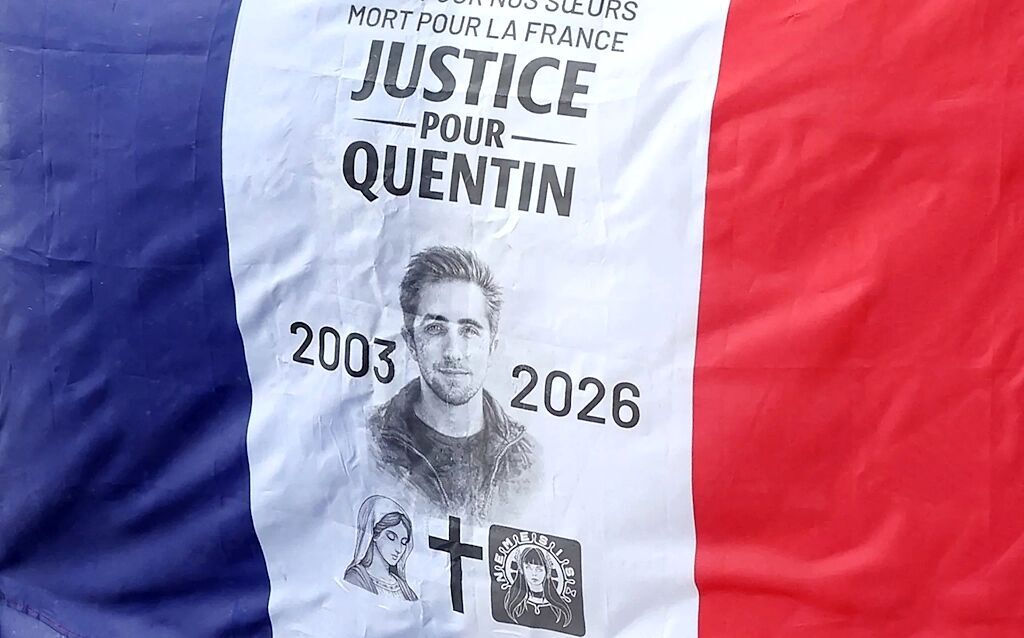
© Alain Jocard/AFPQuentin Deranque was attacked February 12, 2026, at a protest organised by his friends who are part of a female-led activist group
They are members of Némésis, a feminist collective founded by Alice Cordier who argues that women's rights and dignity are being eroded by mass immigration and Islamist pressure. Their activism is deliberately confrontational but non-violent: they place banners on university buildings, organise silent demonstrations, and use sharp slogans about sexual violence and forced marriages. In exchange, Némésis' members are used to being shouted at, followed, and threatened.
Because Némésis occupies an ideological space the French Left detests - feminist, anti-Islamist, unapologetically critical of immigration - their events rarely pass quietly. Alice and her peers are accused of being "far-Right", "racist", "fascist". Their meetings are generally targeted for disruption. Venues are pressured to cancel bookings. And so security becomes an existential necessity.
On Thursday, that protection included a 23-year-old man, Quentin Deranque, along with several other young men who had come to support their female friends as they gathered on the margins of a conference held at Sciences Po Lyon where the controversial MEP Rima Hassan spoke. Hassan has publicly aligned herself with activist networks that present confrontation as a legitimate political tool. Her language of struggle and rupture has drawn criticism for blurring the line between democratic protest and coercive activism.
Unsurprisingly, the event drew both supporters and opponents onto the streets. According to Cordier, Quentin "was attacked with extreme violence. The antifascists knocked him to the ground and beat him. Quentin was swept to the floor, his skull struck the ground, and then he was lynched with kicks." By the following day, Quentin had been declared clinically brain dead.
Although, at this stage, no official confirmation has established the identity or affiliation of the attackers, Cordier has alleged that those responsible may be linked to the Jeune Garde Antifasciste, a militant-Left group dissolved by French authorities in 2025 on the grounds of repeated violent incidents. The group had previously attracted national attention after several of its members were convicted over the anti-Semitic assault of a teenager at a separate public event. The latter appeared in a photograph posted on Instagram in 2024, smiling among the hard-left activists led by Raphaël Arnault, who was elected deputy that same year.
Political violence in France is still widely framed as a phenomenon of the Right, which inevitably creates a blind spot. When aggression comes from activists who brand themselves antifascist, it is often contextualised, diluted, or absorbed into the background noise of "protest culture". This week, for example, Quentin's death was immediately presented by some media as the result of a concerted "fight between rival groups", which Némésis and the lawyer of the victim's family firmly deny.
The young women of Némésis know this better than anyone since, for them, threats are not theoretical. They organise knowing that police protection may be minimal, that counter-protesters may arrive masked and armed, that a banner drop can turn into a physical confrontation, and that they will have to defend themselves physically and legally when opponents attempt to silence them through the courts. They continue nonetheless, convinced that silence would be worse.
What happened in Lyon last week was the foreseeable outcome of a climate in which certain forms of intimidation have been normalised. When right-wing activists are routinely described as "fascists" and shutting down their freedom speech is treated as a moral duty by others, escalation is only a matter of time.
There is a further discomfort at the heart of this story. Némésis has long focused on crimes against women committed by men from Islamist backgrounds, arguing that sections of the political class are reluctant to confront the issue for fear of appearing discriminatory. In doing so, they have collided not only with radical Left activists but with a broader political culture that has struggled to address Islamist extremism consistently.
Although the pattern of selective vigilance is recognisable elsewhere, France's debate over secularism, immigration, and Islamism is uniquely intense. Some threats are loudly named while others are tiptoed around. Some victims are mourned unequivocally and others are folded into arguments about "context", such as the horrible killings of 12-year-old Lova Daviet in 2023 and 19-year-old Philippine Le Noir de Carlan in 2024.
Those also echo the deaths of teachers Samuel Paty in 2020, and Dominique Bernard in 2023 whose murderer specifically targeted him because he transmitted "the love and attachment to the Republic, democracy and human rights". Quentin was a 23-years-old student in mathematics who loved tennis and philosophy, and was invested in pastoral life, active in his paroissial choir. He is now dead because he stood with a group of young women targeted by a crowd that believed they should not be allowed to speak. That is the irreducible fact.
This should not be a story about Left versus Right. Rather, it should be a story about whether democracies can uphold a simple principle: political disagreement never justified violence. If France responds to this killing with equivocation and treats it as an unfortunate by-product of passionate politics, it will send a message to every militant fringe that force works. The women of Némésis will continue to face threats. Others with unfashionable views will too.
In Lyon, that protection failed. And a young man will never go home again.








At the end of the day, Bad People kill people.
The news no longer reports news, without omissions or biased narratives.
Sorry if that sounds too biased.