
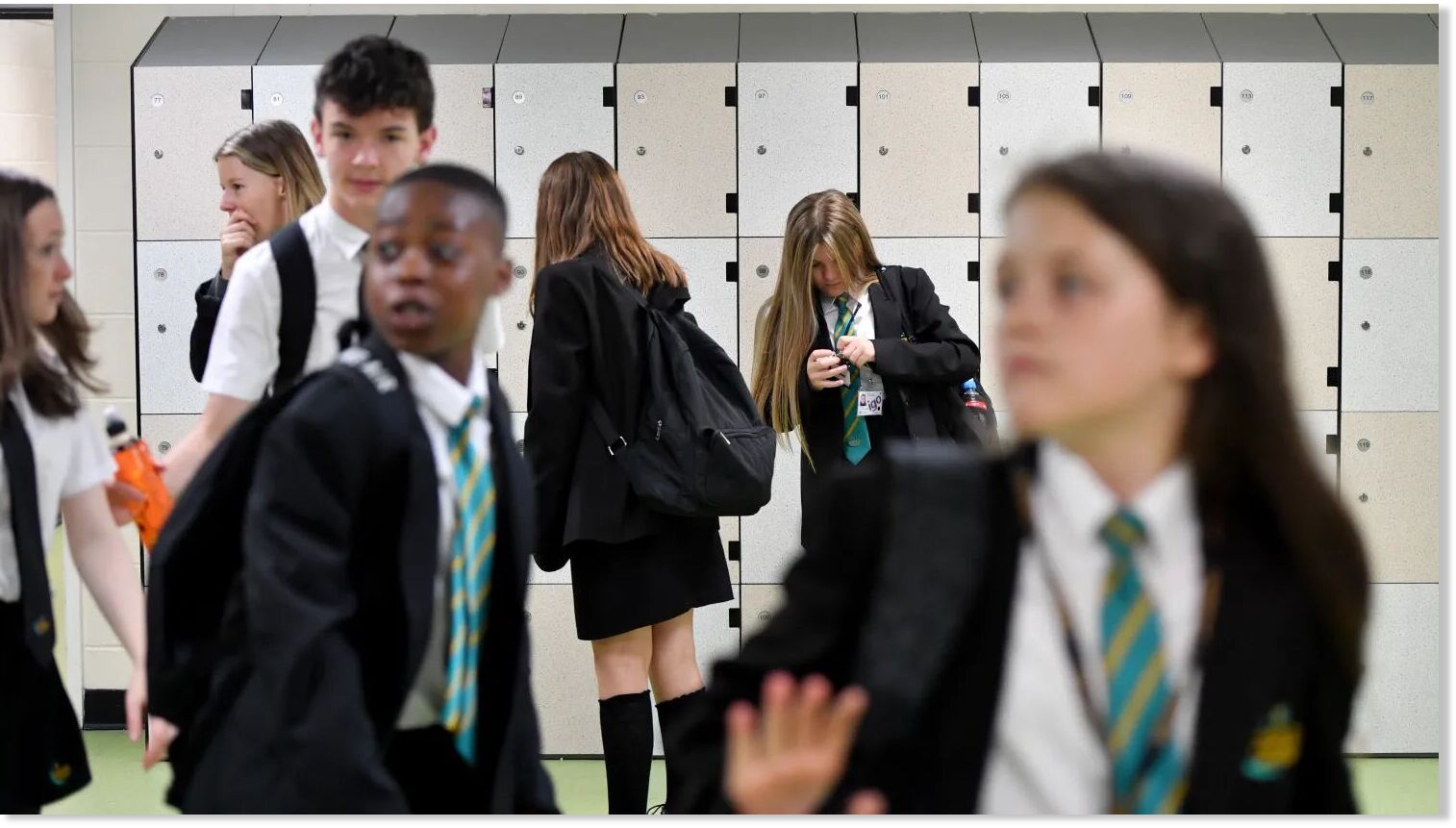
© ANTHONY DEVLIN/GETTY IMAGES
New guidance issued by Bridget Phillipson, the education secretary, will allow children to use pronouns of the opposite sex but only after schools have consulted with parents. It says clinical advice should be taken into account.
Primary schools are told to exercise particular caution because allowing children to change their gender can put them on an "irrevocable pathway" and have significant, lasting effects. "We would expect support for full social transition [including changing names, pronouns and uniform] to be agreed very rarely," the new rules say.
It represents a significant change from guidance proposed by the Tories in 2023, when they were in power, which included an outright ban on the use of different pronouns for primary aged children.
The new guidance states that schools should not "initiate any action" in suggesting that children change their gender. It points to the fact that some children "engage in activities that are less typically associated with their sex".
It says that children should be allowed to change their gender if they make a request and it is considered to be in their "best interests". They will be barred from using toilets, changing rooms and other facilities of the opposite sex. They will also be unable to join single-sex PE classes.
A government source said schools would be "held accountable" and would fail safeguarding checks by Ofsted, the schools inspector, if they did not comply with the new guidance.
Ministers said the aim was to move the debate away from culture-war rhetoric and place decisions firmly within child protection law. But Laura Trott, the shadow education secretary, claimed the guidance "weakens the role of parents".
She said: "Primary school children should not be navigating changes in pronouns at all. But, shockingly, Labour's guidance opens the door to children as young as four being referred to in a way that does not reflect their biological sex."
Maya Forstater, chief executive of the campaign group Sex Matters, said it was a "dangerous fairytale" to let children be treated as the opposite gender at all.
"Schools are still being left with the idea that they can facilitate 'social transition' — which remains undefined — and that they should negotiate this on a case-by-case basis," Forstater said. "It should be clear by now that allowing children and parents to think that a child who starts their education as a girl can graduate as a boy, or vice versa, is a dangerous fairytale."
However the guidance, which for the first time explicitly links requests to change gender to safeguarding, has been backed by Baroness Cass, who authored a landmark report into child gender services in 2024. She said the new guidance was "practical" and reflected her recommendations.
A Labour source said: "Opposition parties who praised Dr Cass's initial research to the hilt cannot now oppose schools guidance which she supports. They cannot pick and choose. They either back the evidence or they don't."
Meanwhile, Phillipson is still delaying guidance on single-sex spaces for businesses and public services. The Equality and Human Rights Commission submitted its guidance to ministers almost five months ago but it has yet to be laid before parliament.
Phillipson told the regulator it must calculate the cost to businesses and the government has said the delay is because it wants to get the guidance right. But critics argue the delay has allowed organisations to break the law by letting transgender people use facilities that do not align with their biological sex.
The new guidance tells schools there can be no "one size fits all" response if a pupil asks to be called by a different name or pronouns. Teachers will be told to take a "very careful approach" when a child asks to socially transition. It says children under 11 should only be supported to socially transition in "exceptionally rare" circumstances and argues that early social transition can have significant psychological and practical consequences and should not be treated as a neutral act.
In secondary schools, headteachers will have more discretion but are still told that parents must be involved. Only in cases where seeking parents' views would create a safeguarding risk, such as in cases of abuse, can schools proceed without informing families.
Children over eight should not be permitted to use toilets designated for the opposite biological sex, while those over 11 should not access opposite-sex changing rooms.
Mixed-sex sleeping arrangements on residential trips are also ruled out. Schools are advised to consider alternative arrangements where possible for distressed pupils, but not at the expense of maintaining lawful single-sex provision. It says it is "vital" that a child's birth sex must be accurately recorded in school and college records.
In sport, pupils can be separated by biological sex "where the physical strength, stamina or physique of the average girl would put her at a disadvantage in competition with the average boy (or vice versa)".
Phillipson said the changes would give teachers "the clarity they need" and offer reassurance to parents. "Parents send their children to school and college trusting they'll be protected. Teachers work tirelessly to keep them safe. That's not negotiable and it's not a political football," she said.
A government source added: "This government is taking the heat out of this issue after years of the previous government playing politics with the welfare of children, some of whom are very distressed or vulnerable.
"This is practical guidance that ensures children and families and school staff are properly supported. It is not a 'one size fits all' approach and we expect schools to put children's wellbeing at the centre. They can and will be held accountable if they don't follow this statutory guidance."
Schools will be expected to follow the new guidance from September, after a ten-week consultation.



Reader Comments
Dumb as....