
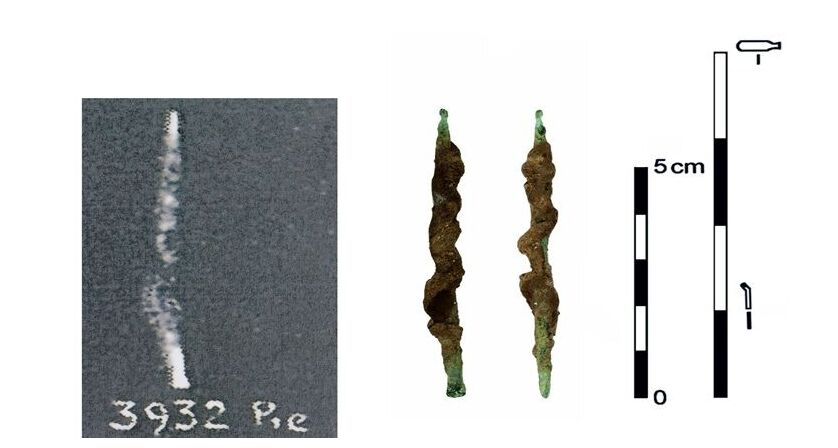
© Newcastle UniversityOriginal photograph of the artefact published in 1927 by Guy Brunton (left) and the actual artefact, photo by Martin Odler.
The artefact (catalogued as 1924.948 A in the Museum of Archaeology and Anthropology, University of Cambridge) was found in Grave 3932, the burial of an adult man. When first published in the 1920s, the artefact - which is only 63 millimetres long and weighs about 1.5 grams - was described as "a little awl of copper, with some leather thong wound round it." That brief note proved easy to overlook, and the object attracted little attention for decades.
However, under magnification, the researchers found that the tool shows distinctive wear consistent with drilling: fine striations, rounded edges, and a slight curvature at the working end, all features that point to rotary motion, not simple puncturing.
The research, which is published in the journal Egypt and the Levant, also described six coils of an extremely fragile leather thong, which the researchers argue is a remnant of the bowstring used to power a bow drill, an ancient equivalent of a hand drill, where a string wrapped around a shaft is moved back and forth by a bow to spin the drill rapidly.
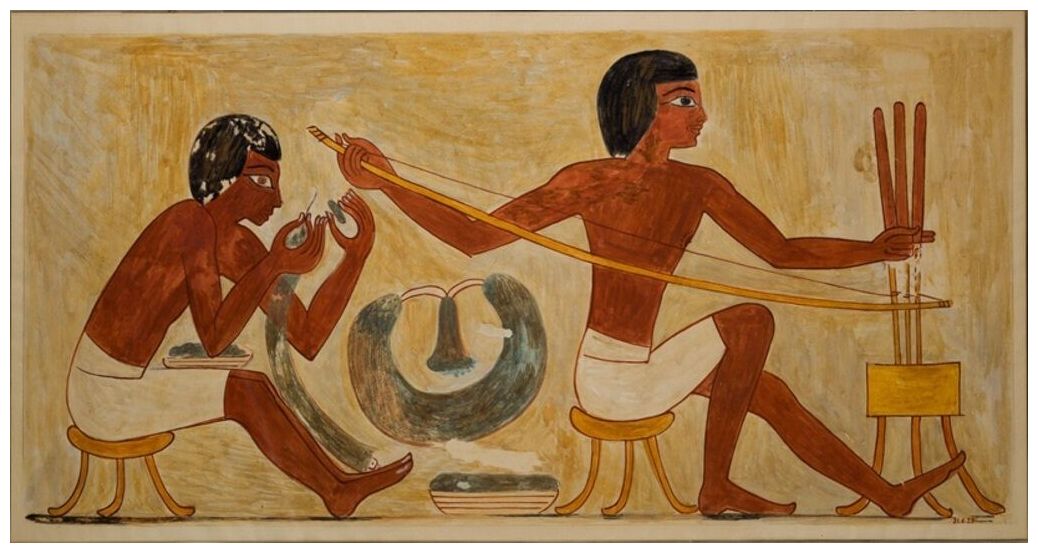
© Public DomainBow drill in action, New Kingdom tomb painting from Western Thebes, Tomb of Rekhmire, object 31.6.25, The Metropolitan Museum of Art, public domain.
"This re-analysis has provided strong evidence that this object was used as a bow drill - which would have produced a faster, more controlled drilling action than simply pushing or twisting an awl-like tool by hand. This suggests that Egyptian craftspeople mastered reliable rotary drilling more than two millennia before some of the best-preserved drill sets."
Bow drills are well known from later periods of Egyptian history, including surviving New Kingdom examples from the middle to late second millennium BCE, with tomb scenes showing craftsmen drilling beads and woodwork, the tombs located in the modern-day West Bank of Luxor area.
Chemical analysis by the team, using portable X-ray fluorescence (pXRF), found the drill was made from anunusual copper alloy. Co-author Jiří Kmošek explains: "The drill contains arsenic and nickel, with notable amounts of lead and silver. Such a recipe would have produced a harder, and visually distinctive, metal compared with standard copper. The presence of silver and lead may hint at deliberate alloying choices and, potentially, wider networks of materials or know-how linking Egypt to the broader ancient Eastern Mediterranean in the fourth millennium BCE."
The study, which is linked to the UKRI-funded EgypToolWear project (Horizon Europe Guarantee), also highlights how museum collections can still provide major discoveries. A small object, excavated long ago and described in a single line, turns out to preserve not only early metalworking but also a rare trace of organic material, evidence for how the tool was actually used.
Reference: "The Earliest Metal Drill of Naqada IID Dating", Martin Odler and Jiří Kmošek Ägypten und Levante / Egypt and the Levant (Vol. 35, 2025) DOI: 10.1553/AEundL35s289






The authoritar insist that copper was all they had back then even though iron and steel items have been found in at least one recent ancient Egyptian burial site. Nickel is the hardest metal in the above list. The others are soft metals. Even with Nickel present the end result still wouldn't be hard enough for granite, limestone, etc.
The evidence of machine tools being used are all over the museum exhibits themselves, but most people skip past them not realising what it is they are looking at. Perfect drill holes of all sizes and cut marks from circular saws. Statues and busts have perfect symmetry. One such granite slab example of many tons was a write off because the saw cut went wrong and had to be abandoned. We have been led not believe our own eyes in the same we were led to believe that flu was a deadly virus and that Saddam had WMD's.