
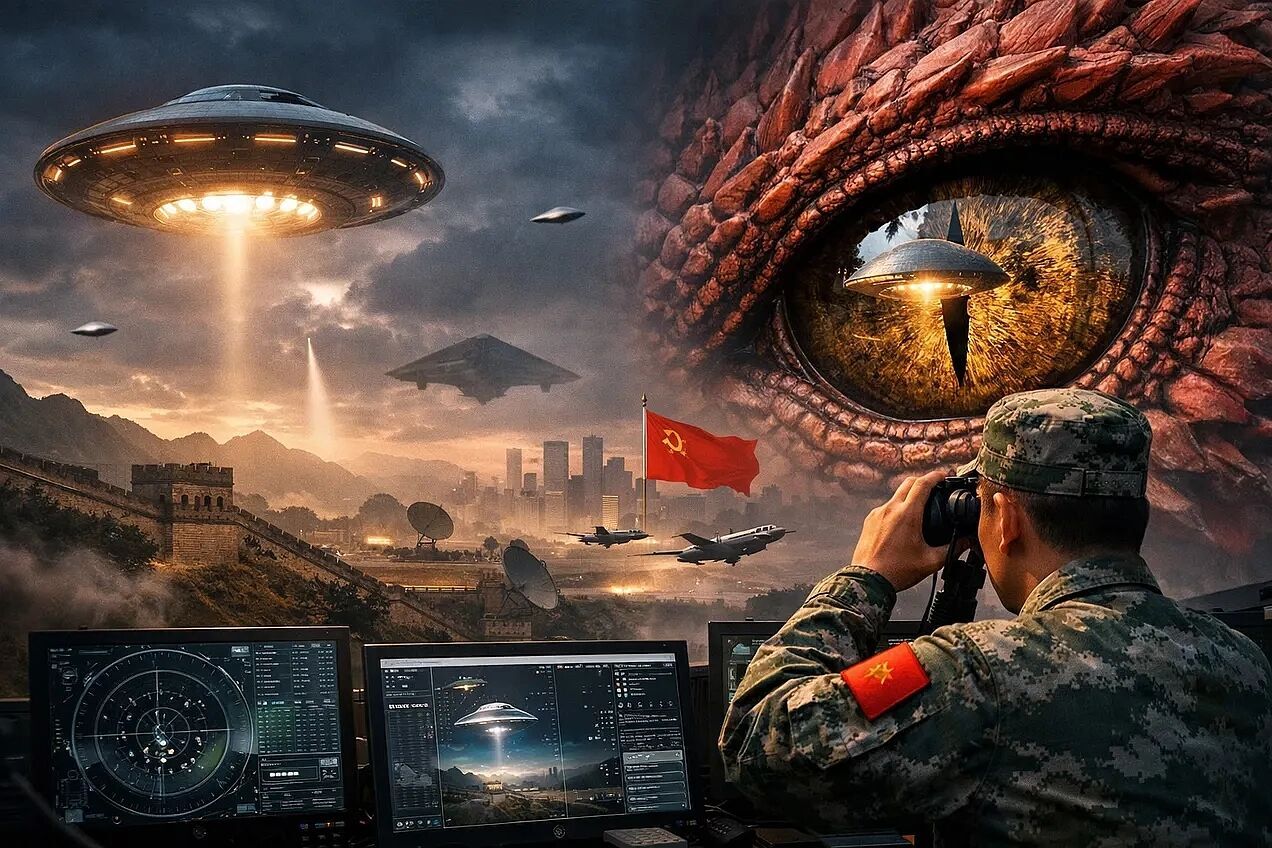
Executive Summary: The Strategic Calculus of the Unknown
The global discourse regarding Unidentified Anomalous Phenomena (UAP), historically and colloquially termed Unidentified Flying Objects (UFOs), has undergone a radical and irreversible transformation in the third decade of the twenty-first century. No longer the exclusive domain of fringe speculation or tabloid curiosity, the subject has migrated decisively into the center of global defense strategy, legislative oversight, and high-level scientific inquiry.1
While the United States has publicly formalized its investigation through the establishment of the All-domain Anomaly Resolution Office (AARO) and the release of unclassified reports by the Office of the Director of National Intelligence (ODNI), the People's Republic of China (PRC) has engaged in a parallel, albeit significantly more opaque, mobilization of state resources to address what the People's Liberation Army (PLA) terms "Unidentified Air Conditions" (UAC).2
This report constitutes a high-level geopolitical and intelligence threat assessment focusing exclusively on the PRC's engagement with UAP and potential Non-Human Intelligence (NHI). Based on an exhaustive review of credible information from leading authorities, state media reports, academic papers, and intelligence snippets, this analysis posits that Beijing views UAP not merely as a scientific curiosity or a potential extraterrestrial event, but as an immediate, acute challenge to "air defense security," national sovereignty, and social stability.2
The assessment identifies a critical divergence in narrative and operational handling between Washington and Beijing. While the U.S. moves toward a model of controlled transparency, driven by legislative pressure and pilot safety concerns, China maintains a posture of information dominance utilizing UAP reports as a mechanism for both internal security validation and external geopolitical signaling. This was most notably observed during the February 2023 balloon crisis, where UAP sightings were weaponized to create a narrative equivalency between U.S. and Chinese airspace incursions.3
Furthermore, the PRC's reliance on Artificial Intelligence (AI) for UAP analysis introduces a profound technological "black box" risk. The PLA has integrated AI algorithms to manage "overwhelming" sighting data, utilizing a distinct "threat indexing" system to categorize anomalies.2 This technological reliance creates a strategic hazard: machine-learning algorithms, tasked with identifying anomalous flight characteristics in real-time, may inadvertently escalate tensions by miscategorizing foreign stealth platforms or natural phenomena as hostile actors or exotic threats.4
The implications of China's UAP strategy extend beyond the atmosphere. With the operation of the Five-hundred-meter Aperture Spherical radio Telescope (FAST), the world's largest single-dish radio telescope, China possesses a sovereign capability to detect technosignatures from Non-Human Intelligence (NHI).8 The deletion of a 2022 report regarding "suspicious signals" detected by FAST underscores the tension between China's scientific ambition to be the first to contact NHI and the Chinese Communist Party's (CCP) imperative to control information that could destabilize the social order or contradict dialectical materialism.8
1. The Strategic Context: Sovereignty, Science, and the "Dark Forest"
To understand the Chinese approach to UAP, one must first dismantle the Western-centric view of the phenomenon. In the United States, the modern UAP narrative is driven by flight safety, pilot destigmatization, and congressional oversight. In China, the narrative is shaped by three distinct forces: the imperative of territorial sovereignty, the drive for scientific supremacy, and a deep-seated cultural engagement with the concept of "cosmic sociology."
1.1 The Sovereignty Imperative
For the CCP, control over the airspace is an extension of its monopoly on power. The presence of unidentified objects, whether they are advanced US drones, domestic unauthorized flights, or genuine anomalies, represents a breach of this sovereignty.
The "Sovereignty and the UFO" framework suggests that states are eager to "securitize" all manner of threats to their societies; by securitizing UAP, the state expands its power and justifies the deployment of advanced surveillance assets.10
The PLA's terminology reflects this securitization. By labeling these events "Unidentified Air Conditions" (UAC) rather than "flying objects," the PLA broadens the scope to include electronic warfare, atmospheric anomalies, and optical phenomena, thereby integrating UAP into the standard Air Defense Identification Zone (ADIZ) monitoring protocols.2 This linguistic shift is not trivial; it moves the phenomenon from the realm of "flying saucers" to the realm of "battlespace awareness," allowing military personnel to report sightings without the stigma associated with alien folklore.2
1.2 The "Dark Forest" Psyche
While not official state doctrine, the "Dark Forest" theory, popularized by Chinese science fiction author Liu Cixin in The Three-Body Problem, permeates the intellectual climate regarding NHI in China. The theory posits that the universe is a "dark forest" where every civilization is an armed hunter stalking through the trees; upon discovery, the only rational response is immediate elimination to ensure survival.
This cultural backdrop influences how Chinese researchers and the public perceive the search for NHI. While Western SETI (Search for Extraterrestrial Intelligence) often assumes a benign or communicative interlocutor, the Chinese strategic mindset, honed by centuries of geopolitical encirclement and the "Century of Humiliation, ' is more predisposed to view NHI as a potential existential threat or a technological competitor.12 The fictional "Red Coast Base" in Liu's work, which sought alien contact to gain a technological edge, mirrors the real-world ambitions of projects utilizing the FAST telescope: the nation that makes contact first may gain access to physics-shattering technology.12
1.3 Civil-Military Fusion in UAP Research
China's approach is characterized by a high degree of "Military-Civil Fusion" (MCF). Unlike the siloed nature of US intelligence, where data sharing between the Pentagon and civilian academia is fraught with classification hurdles, China's UAP architecture integrates data from the PLA Air Force (PLAAF), the Chinese Academy of Sciences (CAS), and civilian observatories into a unified national database.2 This allows for a more holistic analysis of anomalies, leveraging the sensor density of the military with the analytical depth of the academy.
2. Institutional Architecture: The PLA's "Unidentified Air Conditions" Strategy
The organizational response of the People's Republic of China to the UAP phenomenon is centralized, data-driven, and integrated directly into its early warning infrastructure. The shift in terminology and the establishment of dedicated task forces signal a maturation of the PLA's handling of the unknown.
2.1 Terminological Warfare: From UFO to UAC
The PLA has adopted the term "Unidentified Air Conditions" (UAC) to describe these phenomena.2 This terminology mirrors the U.S. Department of Defense's shift to "Unidentified Aerial Phenomena" and "Unidentified Anomalous Phenomena," representing a concerted effort to destigmatize the observation of anomalous objects.2
However, the Chinese term implies a broader operational picture. "Conditions" suggests that Chinese analysts are considering the electromagnetic environment, weather anomalies, and phantom radar tracks alongside solid craft. This aligns with the PLA's doctrine of "Intelligentized Warfare," where the electromagnetic spectrum is a contested domain and "phantom" signals can be as dangerous as physical kinetic weapons if they confuse command and control systems.14
2.2 The Three-Tier Reporting System
Intelligence indicates that the PLA has established a sophisticated, multi-tier reporting system designed to funnel data from the tactical edge to central command. According to reports citing the South China Morning Post and PLA sources, this architecture operates on three distinct levels 2:
Tier 1: Collection
Military radar stations, PLAAF pilots, police stations, weather stations, CAS observatories
Raw Data Acquisition: This tier acts as a wide-area sensor dragnet, incorporating both military and civilian inputs. It captures radar cross-sections (RCS), visual descriptions, and electromagnetic signatures.
Immediate transmission to Regional Command.
Tier 2: Regional Processing
PLA Regional Military Commands (e.g., Eastern Theater Command)
Preliminary Analysis & Filtering: Data is processed to remove obvious conventional explanations (e.g., commercial air traffic, known meteorological events, unauthorized civilian drones) before escalation.
Filtered "Anomalous" data sent to National Database.
Tier 3: National Analysis
PLA Headquarters / National UAC Task Force
Advanced Analysis & Threat Indexing: Utilization of AI and centralized threat assessment. Assignment of "Threat Index" scores. Cross-referencing with strategic intelligence on foreign adversaries.
Strategic Intelligence Products for CMC (Central Military Commission).
This structure suggests that the PLA is not treating UAP as isolated incidents but as a persistent data stream that requires systematic filtering. The inclusion of police stations and weather stations in Tier 1 indicates a "whole-of-government" approach to data collection, ensuring that low-altitude or ground-observed anomalies are captured alongside high-altitude radar tracks.6
2.3 The Role of the PLA Air Force Early Warning Academy
A pivotal node in this network is the PLA Air Force Early Warning Academy. Researcher Chen Li, affiliated with this institution, has been identified as a key figure in modernizing China's UAP response.2 In a 2019 report, Chen noted that the "frequent occurrence of unidentified air conditions... brings severe challenges to air defense security of our country".2
The Early Warning Academy is responsible for training the personnel who operate China's most advanced radar and sensor systems (such as the KJ-2000 and KJ-500 AEW&C aircraft). Their leadership in this domain indicates that UAP are treated primarily as a problem of detection and identification within the context of Integrated Air and Missile Defense (IAMD). The Academy's focus confirms that the PLA is concerned about the "clutter" UAP create in the battlespace, potentially masking the intrusion of stealth drones or other low-observable adversarial platforms.4
Chen Li's 2019 report serves as a foundational document for the current Chinese approach. It argued that the volume of sightings had overwhelmed traditional human analysis, necessitating the introduction of Artificial Intelligence to manage the "severe challenge" posed by these conditions.7 This pivot to AI marks the divergence of Chinese UAP strategy from the more forensic, case-by-case approach often seen in Western investigations.
3. The Data Processing Nexus: Artificial Intelligence and Threat Indexing
Perhaps the most distinct aspect of the Chinese approach is the heavy reliance on Artificial Intelligence to process UAP data. While the U.S. AARO employs advanced analytics, the PLA appears to have operationalized AI as the primary filter for its UAC pipeline.
3.1 AI: "Thinking Outside the Box"
Chinese analysts have reportedly been "overwhelmed" by the volume of sighting reports from military and civilian sources.2 To cope with this data deluge, the PLA's UAP task force employs AI algorithms designed to "think outside the box".2
The AI systems are tasked with three critical functions:
- Cross-Temporal Correlation: Connecting "crumbs of information" scattered across different times and locations that human analysts might miss. For example, the AI might link a radar anomaly in the South China Sea in 2018 with a visual sighting in Xinjiang in 2021 based on signature similarity, identifying a pattern of operation.2
- Contextual Pattern Recognition: Identifying correlations between UAP sightings and specific geopolitical or meteorological events. The AI analyzes whether UAP appear more frequently during major political gatherings, military exercises, or specific weather phenomena.7 This capability is crucial for distinguishing between foreign surveillance operations (which would likely correlate with military exercises) and natural phenomena.
- Predictive Modeling: Assessing the likely purpose of an object based on its behavior, helping the PLA determine if a sighting is caused by a hostile country, amateur aviation enthusiasts, nature, or "other" causes.2
3.2 The "Threat Index"
The output of this analysis is a "Threat Index" score assigned to each sighting. This quantitative metric allows PLA commanders to prioritize their response resources. The index is calculated based on a matrix of observed variables 2:
Aerodynamic DesignThe "Threat Index" is a critical tool for filtering noise. By assigning a score, the PLA can separate the "mundane" (balloons, drones) from the "truly anomalous" (Category D2 objects in AARO terms). However, the reliance on AI for this purpose introduces a strategic risk. If the training data for these algorithms is biased, or if the AI encounters a novel foreign technology (e.g., a US B-21 Raider) that mimics UAP characteristics, it could lead to misidentification or automated escalation recommendations.4
Analysis of the object's shape (e.g., saucer, cigar, V-shape) and presence/absence of flight surfaces (wings, rotors). Objects lacking flight surfaces that generate lift are flagged as high anomalies.2
Observed Behavior
Kinematic performance, including sudden acceleration, hovering, trans-medium travel, and silent flight. "Sudden/Instantaneous Acceleration" is a primary marker for high threat/high anomaly.16
Frequency
How often the object or similar signatures appear in a specific sector. High frequency may indicate a systematic surveillance campaign.2
Radioactivity
Detection of ionizing radiation associated with the object's propulsion or presence. This criterion suggests the PLA employs sensors capable of detecting nuclear or exotic radiological signatures.2
Material Composition
Spectroscopic analysis of the object's hull (if available). The PLA is looking for "metamaterials" or exotic alloys that do not match known aircraft construction.2
4. The Scientific Front: FAST, the "Sky Eye," and the Hunt for NHI
While the PLA focuses on the immediate airspace threat, China's scientific apparatus plays a dual role in the search for extraterrestrial intelligence (SETI). The centerpiece of this effort is the Five-hundred-meter Aperture Spherical radio Telescope (FAST), located in a natural depression in Guizhou province. Known as the "Sky Eye," it is the world's largest single-dish radio telescope and is "extremely sensitive in the low-frequency radio band".8
4.1 The FAST Telescope and SETI Strategy
Since September 2020, FAST has officially launched a dedicated search for extraterrestrial life, sifting through the cosmos for technosignatures.8 This project is led by the China Extraterrestrial Civilization Research Group, a collaboration between Beijing Normal University, the National Astronomical Observatory of the CAS, and international partners like UC Berkeley.8
The strategic intent behind using FAST for SETI is clear: scientific prestige and the potential technological advantage of "First Contact." Just as the fictional Red Coast Base sought to leapfrog Western technology, the real-world deployment of FAST positions China to be the first to receive a signal from an advanced civilization.
4.2 The "Suspicious Signals" Incident (June 2022)
In June 2022, a significant incident occurred involving the FAST telescope that highlighted the tension between scientific discovery and state information control. The state-backed Science and Technology Daily published a report claiming that FAST had detected "suspicious signals" that might indicate alien civilizations.8
The Claims:
The report cited Zhang Tongjie, the chief scientist of the search team, who stated that the team had detected:
- Two sets of suspicious signals in 2020 (from data collected in 2019).
- One suspicious signal in 2022 (from observation data of exoplanet targets).8
The Deletion and Denial:
Crucially, the report was deleted from the Science and Technology Daily website shortly after publication, though not before it trended on Weibo and was picked up by international media.8 The reason for the deletion remains a subject of intelligence analysis. It likely represents one of three scenarios:
- Premature Publication: The authorities may have deemed the findings inconclusive and feared public hysteria or scientific embarrassment if the signals proved to be terrestrial interference.
- Information Security: The CCP maintains strict control over narratives regarding high-impact discoveries. If the signal was genuine, or if it was actually an intercept of a classified foreign satellite, the state would move to suppress the data to protect operational security or monopolize the information.8
- Radio Frequency Interference (RFI): Zhang Tongjie himself urged caution, noting that the "possibility that the suspicious signal is some kind of radio interference is also very high".8 Dan Werthimer, a SETI researcher at UC Berkeley working with the data, later stated, "These signals are from radio interference; they are due to radio pollution from Earthlings, not from E.T.".9
5. Historical Case Studies: The Genealogy of Chinese Ufology
To understand the current Chinese threat assessment, one must analyze the historical data that shapes their institutional memory. China has experienced several high-profile UAP incidents that have forced the state to intervene, shaping the current "UAC" doctrine.
5.1 The Spiral Incident (July 24, 1981)
On July 24, 1981, millions of people across Gansu, Sichuan, and Yunnan witnessed a spectacular bright spiral in the night sky that spun while slowly flying east to west.21
- Significance: This mass sighting occurred during the early reform era, prompting widespread public speculation about aliens or supernatural omens.
- Scientific Response: Liu Yanshu, a researcher at the Purple Mountain Observatory, conducted a detailed analysis of eyewitness reports. He determined the object was a man-made spacecraft flying at an altitude of about 650 km.21
- Implication: This established a precedent for the Chinese scientific establishment to demystify UAP using trajectory analysis, often attributing them to unannounced satellite launches or military tests to maintain social order.
While the Spiral Incident was a mass sighting, the Meng Zhaoguo incident represents the "High Strangeness" aspect of Chinese Ufology. In June 1994, in the Phoenix Mountain region of Wuchang, Heilongjiang, a farmer named Meng Zhaoguo claimed a "Close Encounter of the Third Kind".22
- The Narrative: Meng reported seeing a metallic object descend into the mountains. Upon investigating, he claimed he was incapacitated by a beam of light, later abducted, and subjected to forced copulation with a female entity.22
- Evidence: Meng reportedly failed to react to metal on his skin (claiming extreme sensitivity) and allegedly passed a lie detector test in 2003.23
- Official Stance: The UFO Enthusiasts Club at Wuhan University investigated and concluded the abduction elements were likely untrue, though the initial sighting of a "white object" might have occurred.22
- Legacy: This case remains the "Roswell" or "Betty and Barney Hill" case of China. It highlights the persistence of "contact" narratives in rural China and the challenge they pose to the state's materialistic ideology. The state tolerates these stories as folklore but actively suppresses any organized movements forming around them.
5.3 The Hangzhou Xiaoshan Airport Shutdown (July 7, 2010)
On July 7, 2010, China experienced its most disruptive and operationally significant UAP event. An unidentified flying object was spotted above Hangzhou Xiaoshan International Airport, causing the facility to shut down operations.6
- Operational Impact: The airport was closed for an hour; more than 20 flights were postponed or diverted.25 This demonstrated that UAP — whatever their origin — could paralyze critical infrastructure and cause economic loss.
- Description: Witnesses and photos described a glowing object, sometimes appearing as a "comet" or an arc of light.24
- Investigation: A joint investigation by the Civil Aviation Administration of China (CAAC) and Beijing/Shanghai air traffic control bureaus concluded there were no radar images of the object, despite visual sightings.22
- The DF-21 Hypothesis: Independent analysis of photos from the event suggests the "glowing arc" may have been the contrail of a DF-21 medium-range ballistic missile test conducted from a distant launch site, illuminated by the setting sun.26 This hypothesis aligns with the lack of radar data at the airport (the missile would be far above airport radar ceilings).
- Official Ambiguity: Official statements hinted it was a "private or military aircraft," but the refusal to confirm a missile test suggests the state preferred the UAP mystery over revealing military capabilities.22 This event likely catalyzed the PLA's move toward the more formalized UAC reporting structures seen in 2019, as the economic cost of the shutdown was unacceptable.
6. Key Figures and Ideological Battles
The internal discourse on UAP in China is shaped by key figures who navigate the narrow path between scientific inquiry and political correctness.
6.1 Wang Sichao: The Believer within the System
Wang Sichao (1937-2016), a researcher at the Purple Mountain Observatory, was the most prominent establishment figure to advocate for the extraterrestrial hypothesis.
- Scientific Advocacy: Wang publicly stated that his quantitative analysis of UAP trajectories indicated "anti-gravity ability." He noted objects flying between 130 km and 1,500 km altitude at speeds as low as 0.29 km/s — far below the cosmic velocity required to maintain orbit.25
- The "New World" Speculation: Wang compared the discovery of alien spacecraft to Columbus discovering the New World, implying a race for resources and knowledge. He predicted "great events" concerning UFOs would occur in 2011/2012, based on a periodic cycle he identified.25
- Significance: Wang's ability to remain a respected researcher while advocating for aliens suggests that the CAS permits a degree of speculative research, provided it is framed mathematically. His "anti-gravity" calculations remain a cornerstone of Chinese Ufology's claim to scientific legitimacy.
In contrast, Liu Yanshu, also of the Purple Mountain Observatory, represents the "debunker" faction. His work focuses on explaining UAP as man-made objects (planes, satellites) or natural phenomena (bolides). His role is crucial for the state in managing public panic and maintaining a rational, materialistic worldview.21
7. The 2023 Crisis: Balloons, Drones, and the Geopolitics of UAP
The events of February 2023 represent a watershed moment in the geopolitical weaponization of UAP narratives. Following the U.S. downing of a high-altitude Chinese surveillance balloon, the dialogue surrounding UAP shifted from scientific inquiry to immediate kinetic threats and diplomatic "whataboutism."
7.1 The Jianggezhuang/Shandong Incident (February 12, 2023)
While the world focused on the object shot down over Lake Huron by the US Air Force, a parallel crisis unfolded in China. On February 12, 2023, Chinese authorities announced the detection of an unidentified object flying over waters near Rizhao, Shandong Province.3
- Strategic Location: The object was detected near the Jianggezhuang Naval Base, a major PLA Navy facility known to house Type 094 nuclear-powered ballistic missile submarines.3
- The Public Alert: The Qingdao Marine Development Bureau issued alerts to local fishing boats, announcing plans to shoot down the object and asking fishermen to assist in debris recovery.3
- Outcome: Unlike the highly publicized U.S. shootdowns, the ultimate fate of the Shandong object remains obscure. There was no follow-up confirmation of a successful engagement or debris recovery publicly released by Beijing.5
Days later, on February 16, the airspace over Shijiazhuang (Hebei Province) was closed for two hours due to a "balloon-like object" occupying the airspace.5 This disruption caused a drop in domestic stocks and widespread speculation on Weibo. Official sources eventually labeled it a balloon but provided little further detail.29
7.3 Narrative Symmetry and "Whataboutism"
The timing of the Shandong and Shijiazhuang incidents — occurring almost perfectly in sync with the North American shootdowns — suggests a strategic narrative effort.
- Retaliatory Narrative: By announcing their own UAP incursions, Beijing attempted to dilute the diplomatic pressure from Washington regarding the spy balloon. It allowed Chinese Foreign Ministry spokespeople to argue that U.S. high-altitude balloons also illegally enter Chinese airspace (claiming over 10 incursions since Jan 2022).30
- Domestic Messaging: Highlighting threats to Chinese airspace rallies domestic nationalist sentiment and justifies expanded air defense measures. It portrays China as a victim of U.S. surveillance aggression, rather than the perpetrator.32
- Sovereignty and the UFO: As noted in international relations theory, the state must "securitize" UAP to maintain its monopoly on sovereignty. By threatening to shoot down the object, China demonstrated its resolve to defend its borders against any anomaly, asserting control over the unknown.10
8. Reverse Engineering and Technological Speculation
A persistent theme in global UAP discourse is the allegation of crash retrieval and reverse engineering programs. In the context of China, these allegations are rampant but lack the whistleblower testimony currently surfacing in the United States.
8.1 The Logic of "Technology Surprise"
Intelligence analysts warn of "technology surprise" - the risk that an adversary has mastered physics-defying propulsion. U.S. officials and legislators have expressed concern that China may have retrieved non-human craft and is attempting to reverse-engineer them.34
- The Russian Connection: There is speculation that if the U.S. does not have the technology, and Russia is unlikely to possess it, China remains a primary suspect for possessing advanced terrestrial or non-terrestrial tech.35
- Metamaterials Research: China is a world leader in metamaterial research, which is often cited in UAP literature as a key component of "lift-without-surfaces" craft. The PLA's intense focus on these materials fuels speculation that they may be attempting to replicate observed UAP properties.17
Legends persist regarding secret facilities in the Kunlun Mountains (often called the "Roswell of China") or near the Lop Nur nuclear test site.17
- Kunlun Mountains: Historically associated with Taoist mythology and the "Queen Mother of the West," modern rumors suggest underground bases where the PLA studies anomalous phenomena. Reports of UFOs in this region are common, though often attributed to the extreme altitude and isolation.36
- Verification: There is no credible public evidence of a crash retrieval program in China comparable to the alleged "legacy programs" discussed in US Congressional hearings. However, the Pentagon's AARO has found no evidence that the US government is hiding such technology, which paradoxically fuels the theory that someone else (i.e., China) might have it.37
The South China Sea (SCS) serves as a primary theater for UAP encounters due to the density of military activity.
- Sensor Saturation: The SCS is one of the most heavily monitored bodies of water on Earth. With U.S. Navy Carrier Strike Groups, PLA Navy flotillas, and submarine activity, the region is a "sensor rich" environment.
- UAP as Drone Swarms: Chinese researchers have suggested that unusual sightings near the South China Sea are likely the result of increased U.S. military activities, specifically advanced drone swarms.2 This reflects the PLA's tendency to attribute UAC to foreign adversaries first.
- Risk of Misidentification: The presence of UAP (whether NHI or unspecified drones) in this contested zone creates a high risk of miscalculation. If a PLA fighter pilot intercepts a UAP that exhibits "hostile intent" (jamming, rapid maneuver), they may fire. If the object turns out to be a classified US asset, this could trigger a kinetic conflict between superpowers.4
The People's Republic of China is engaged in a comprehensive, state-directed effort to monitor, analyze, and mitigate threats from Unidentified Anomalous Phenomena. This effort is distinct from Western approaches in its centralization, its aggressive integration of Artificial Intelligence, and its immediate categorization of UAP as a sovereignty and air defense issue.
Key Findings:
- Militarization of Inquiry: The transition from "UFO" to "Unidentified Air Conditions" signals that the PLA views this exclusively as a defense domain. The lead agency is the PLA Air Force Early Warning Academy, not a civilian science board.
- AI Dependency: China is likely ahead of the West in applying machine learning to UAP datasets. While this improves processing speed, it creates vulnerabilities regarding data bias and automated escalation (the "Black Box" threat).
- Narrative Weaponization: The February 2023 incidents demonstrate that Beijing is willing to use UAP reports as diplomatic leverage, creating a "false equivalency" with U.S. surveillance activities.
- Scientific Ambition: Through the FAST telescope, China possesses the hardware to detect NHI technosignatures. However, the deletion of the 2022 "suspicious signals" report indicates that political stability will always override scientific transparency.
As drone warfare and near-peer competition intensify in the Indo-Pacific, the "noise" in the airspace will increase. The PLA's "Unidentified Air Conditions" task force will likely become a critical component of their Integrated Air and Missile Defense (IAMD) system. For the global intelligence community, the primary threat is not necessarily that China finds aliens, but that their AI-driven UAP filters misidentify a conventional probe as an anomalous threat, sparking a kinetic conflict in the crowded skies over the South China Sea.
Timeline of Significant Chinese UAP Incidents
July 24, 1981
Gansu/Sichuan
Massive spiral observed by millions.
Determined by researcher Liu Yanshu to be a spy satellite launch/man-made aircraft.21
June 1994
Wuchang, Heilongjiang
Meng Zhaoguo "Close Encounter" and abduction claim.
Widely publicized cultural phenomenon; officially debunked but remains folklore.22
Oct 19, 1998
Cangzhou Airbase
PLAAF jets intercept "mushroom" shaped object.
Object outran jets (20,000m+). Described as "short-legged mushroom".6
July 7, 2010
Hangzhou Airport
Glowing object shuts down airport; 20+ flights diverted.
Official explanation vague (military test/private jet); widely regarded as genuine UAP event.6
June 2022
Guizhou (FAST)
"Suspicious signals" detected by Sky Eye telescope.
Report published then deleted; likely RFI but technically unresolved.8
Feb 12, 2023
Jianggezhuang, Shandong
Object detected near Naval Base; shootdown order prep.
Occurred during US Balloon crisis; no confirmation of debris recovery.3
Works cited:
- A Global Survey of Official, Academic, and Civilian UAP Information Ecosystems - New Space Economy, accessed January 13, 2026,
- China Confirms It Has Its Own UFO Task Force - The Debrief, accessed January 13, 2026,
- Latest Government Updates and Research on UAP, accessed January 13, 2026,
- China's Military Is Apparently Also Tracking UFOs - Futurism, accessed January 13, 2026,
- A Comparative Survey of Security Approaches Toward Unexplained Aerial Phenomena Across the Indo-Pacific - DKI APCSS, accessed January 13, 2026,
- Chinese Military Has Its Own UFO Task Force... And It's Been 'Overwhelmed' By Surge In Sighting Reports, accessed January 13, 2026,
- China using artificial intelligence to detect UFOs because it can 'think outside the box', accessed January 13, 2026,
- China Says It May Have Detected Signals From Aliens | TIME, accessed January 13, 2026,
- China Briefly Publishes Report Saying Telescope Detected Alien Life - All That's Interesting, accessed January 13, 2026,
- The "UFO Taboo" Is What IR Theorists Make of It: "Sovereignty and the UFO" in Citational Perspective - PubMed Central, accessed January 13, 2026,
- AI Archives - TechNET IT Recruitment, accessed January 13, 2026,
- The Three-Body Problem Episode 18 Review: Calling All Spacemen - Bleeding Cool News, accessed January 13, 2026,
- Three body problem, accessed January 13, 2026,
- PLA CONCEPTS OF UAV SWARMS AND MANNED/UNMANNED TEAMING - Air University, accessed January 13, 2026,
- Data-Fusion-Based Algorithm for Assessing Threat Levels of Low-Altitude and Slow-Speed Small Targets - NIH, accessed January 13, 2026,
- The New Science of Unidentified Aerospace-Undersea Phenomena (UAP) - arXiv, accessed January 13, 2026,
- Technologies Reverse-Engineered from Crashed UFOs? | GOLDSEA | Asian American Daily, accessed January 13, 2026,
- Anticipating Chinese Reactions to U.S. Posture Enhancements - RAND, accessed January 13, 2026,
- China's Sky Eye telescope may have detected signals from alien civilisations, accessed January 13, 2026,
- Astronomers in China Claim Possible Detection of 'Extraterrestrial Civilizations', accessed January 13, 2026,
- The Astronomer Who Calmed China's UFO Craze - Sixth Tone, accessed January 13, 2026,
- UFO sightings in China - Wikipedia, accessed January 13, 2026,
- Greatest Mysteries: The Story of China's Most Famous UFO Sighting - The World of Chinese, accessed January 13, 2026,
- China UFO-ology Competes with U.S. UFO-ology Except the Former is Using AI to Figure Out What's Going On, accessed January 13, 2026,
- "Great Events" Concerning UFOs to Come out in China: CAS Researcher, accessed January 13, 2026,
- Hangzhou Light Show - Arms Control Wonk, accessed January 13, 2026,
- Academician: Aliens Exist, but also Have Weaknesses - Chinese Academy of Sciences, accessed January 13, 2026,
- 40 years' search for UFOs and aliens - Shanghai Daily, accessed January 13, 2026,
- List of high-altitude object events in 2023 - Wikipedia, accessed January 13, 2026,
- US Shoots Down Fourth Flying Object — And Won't Rule Out Aliens - IFLScience, accessed January 13, 2026,
- China slams Pentagon Annual Report on Chinese Military and Security Developments, accessed January 13, 2026:
- 394 - Exposure | #DisinfoChronicle., accessed January 13, 2026,
- Association canadienne de science politique, accessed January 13, 2026,
- Are China, Russia ahead of U.S. in UFO retrieval, research? - Modern Diplomacy, accessed January 13, 2026,
- Ex UFO Investigation Chief Says UAPs Took US Nuclear Systems Offline, Explains Chinese Spy Plane Possibilities - Swarajya, accessed January 13, 2026,
- Unexplained Phenomena - FasterCapital, accessed January 13, 2026,
- Pentagon finds no evidence of hidden alien technology | Courthouse News Service, accessed January 13, 2026,











The analysis appears thorough, so you have to question the sources of the info. It makes sense that the military are heavily involved, because IT IS A THREAT to National Security for every country.
If you accept there are vessels that can move through air or water at incredible speeds and shift directions at the same time, the military does not have a countermeasure. If there are UFOs that can turn off nuclear missiles in their silos, the military does not have a countermeasure.