
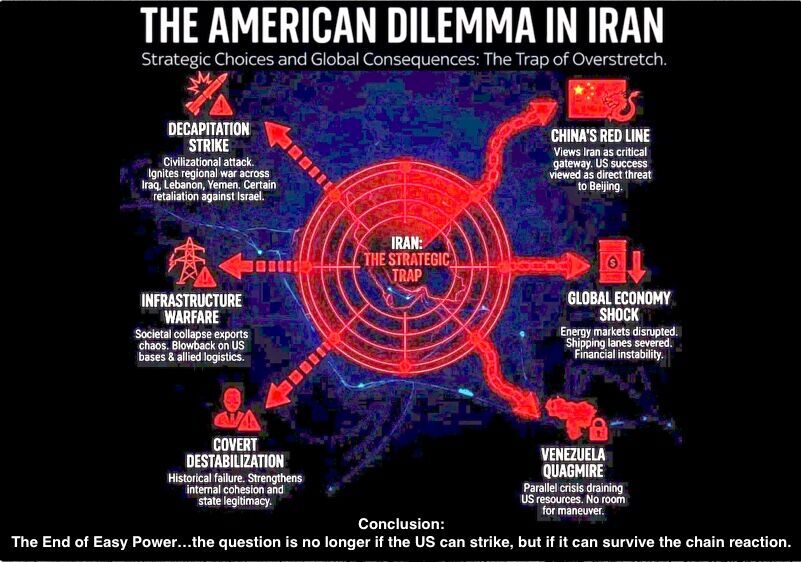
Decapitation Strike: A Shortcut to Regional War
One extreme option is a direct military strike against Iran, potentially including the assassination of Supreme Leader Ayatollah Seyyed Ali Khamenei and the destruction of key military and civilian infrastructure. Khamenei is not merely a political figure; he is a major Shiite religious authority. His assassination would likely be perceived as a civilizational attack, sparking mass mobilization, asymmetric warfare, and retaliation across Iraq, Lebanon, Yemen, the Gulf, and beyond. Rather than neutralizing Iran, such an action would almost certainly ignite a regional war with severe global consequences: energy market shocks, disrupted shipping lanes, and financial instability. Historical parallels, such as the U.S. invasion of Iraq in 2003 and the subsequent regional fallout, illustrate the scale of potential blowback.
Infrastructure Warfare: Exporting Chaos
Another option is targeting Iran's civilian and economic infrastructure, oil refineries, electricity grids, ports, pipelines, and transport networks, while encouraging internal unrest. This strategy treats societal collapse as a weapon. But societal collapse does not remain contained. These attacks would be perceived as collective punishment, legitimizing retaliation not only against Iran but against U.S. and allied interests across the region. American bases, embassies, logistics hubs, and corporate assets would become exposed targets. Rather than weakening Iran, this approach risks exporting instability directly onto American and allied interests, creating a cascade of crises far beyond Tehran.
Covert Destabilization: A Strategy That Fails
A third path has been covert destabilization: supporting armed groups, enabling sabotage, promoting assassinations, and amplifying internal violence. This strategy is on par with that which the U.S. unfurled during the Syrian Civil War, beginning in the Obama administration. This tactic led to an elongated conflict of asymmetrical warfare in which the U.S. eventually deposed the regime of Bashar al-Assad in late 2024. In the aftermath of Assad's overthrow, a new Syrian regime came to power, naming Ahmed Hussein al-Sharaa as its president. al-Sharaa had previously served as the emir of the ISIS-affiliated Al-Nusa Front front from 2012 to 2017 and Hay'at Tahrir al-Sham from 2017 until becoming de facto leader of the country in 2024 and then its president in 2025. Since taking over leadership of Syria, the country has remained in turmoil with persecution of religious minorities like the Alawites and Druze leading to escalated conflict with Israel. The resurgence of ISIS in Syria has also marred the rule of al-Sharaa. These ramifications foreshadow the chaos that a power vacuum in Iran would create.
So far (in Iran), this strategy has largely failed. Such groups have not generated mass support. On the contrary, attacks on security forces and civilians have often strengthened internal cohesion and reinforced state legitimacy. Rather than fragmenting Iran, covert destabilization has inadvertently reinforced the very structures it sought to weaken.
Iran's Red Lines: The Certainty of Retaliation
Iran has made its red lines explicit: any U.S. military action will trigger retaliation. Such retaliation would not be limited to American bases. Israel would likely bear the brunt, with military installations and infrastructure targeted alongside U.S. forces. From Tehran's perspective, Israel is not a bystander, it is a core participant in any anti-Iranian campaign. The 12-day conflict against Israel in June highlights how the U.S. has acted as a conduit of achieving Israel's mission of regime change in Iran. During the last meeting between Israeli Prime Minister and U.S. President Donald J. Trump in late December 2025, renewed strikes against Iran remained a central topic in their discussions. Unlike the limited strategic attacks against crucial Iranian nuclear development sites in June, any forthcoming large scale U.S. strike aimed at topping the current Iranian government risks triggering a multi-front war, dramatically raising the cost of escalation. A war with Iran is not bilateral, it is a regional, systemic conflict.
China's Strategic Red Lines
China views Iran less as a sentimental partner and more as a strategic hinge: a node in energy security, regional stability, and the land-sea corridors linking the Middle East to Central Asia and Europe. For Beijing, the core concern is not "loyalty to Tehran," but the systemic risk created by a destabilized Iran - disrupted energy flows, volatile shipping routes, and a precedent for coercive regime-fracture in a region central to global trade. Two outcomes, in particular, could sharpen Beijing's threat perception and raise the likelihood of a stronger Chinese response (not necessarily military, but meaningfully confrontational in economic, diplomatic, and geopolitical terms): - A durable weakening of Russia that removes a major counterweight and concentrates Western leverage across Eurasia. - A decisive dismantling of Iran's state capacity and regional network, producing either prolonged disorder or a strategic realignment that consolidates U.S. influence over critical energy and transit chokepoints. In either case, Beijing could read American "success" not as an endpoint, but as a rehearsal for intensified pressure on China itself. The implication is not that China will automatically enter a direct confrontation - but that preventing an Iran-collapse scenario may become, for Beijing, a matter of risk containment and self-preservation rather than ideological alignment.
Venezuela: A Parallel Predicament
Simultaneously, the U.S. faces a deteriorating crisis in Venezuela. The State Department has issued Level 4 travel warnings, urging Americans to leave due to kidnapping, civil unrest, and armed colectivos. Major American energy firms now consider Venezuela "uninvestable," citing security risks and political instability. This dynamic pressures Washington toward a direct, boots-on-the-ground response to protect lives and assets, further stretching U.S. military and political resources. Venezuela is no longer a peripheral problem; it is a quagmire demanding attention alongside Iran, Israel, and China, forcing Washington into parallel crises with little room for maneuver.
Strategic Overstretch: The Collapse of Control
The U.S. challenge is no longer choosing the "right" option but managing the cumulative consequences of too many unresolved conflicts. A strike on Iran triggers retaliation against U.S. and Israeli assets, draws regional allies into the conflict, disrupts energy markets, and escalates tensions with China. Meanwhile, Venezuela consumes attention and resources, reducing flexibility elsewhere. This produces a feedback loop: every move to solve one problem intensifies another. The U.S. appears active everywhere but in control nowhere. Power is no longer measured by the ability to strike, but by the ability to prevent chain reactions, and that is precisely what Washington increasingly cannot do. Strategic overstretch does not arrive suddenly; it arrives as incoherence: too many fronts, too many enemies, and too few options. In confronting Iran, the U.S. is not merely engaging a state, it is confronting an interlinked network that cannot be bombed into submission without setting the entire system on fire.
The End of Easy Power
The American dilemma in Iran is not a failure of force, but a failure of context. The world is too interconnected, reactive, and resilient for unilateral power to operate as it once did. A strike on Iran will not stay in Iran. It spreads, to Israel, U.S. forces, China's strategic calculations, energy markets, and global stability. The question is no longer whether the U.S. can strike Iran, it is whether it can survive the chain reaction such a strike would ignite.






Comment: Author provides a logical consolidation of motives, facts and potential results.