
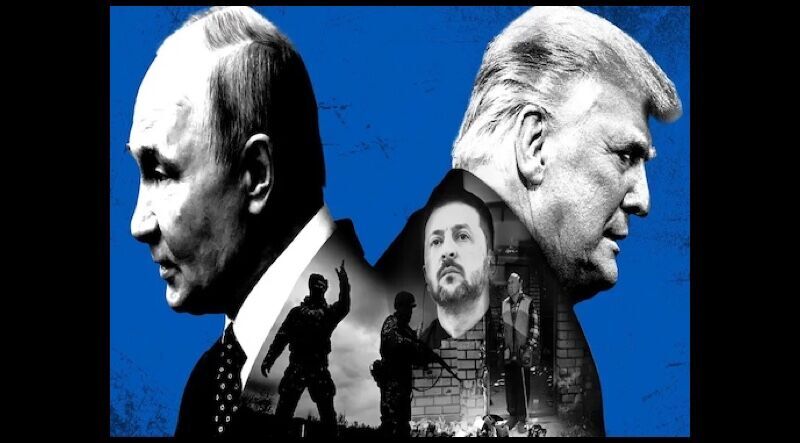
© UnknownPresidents Putin and Trump and the unending Ukraine saga
France and the UK recently committed to deploying troops to Ukraine in the event of a ceasefire as part of their latest proposed security guarantees to that country, the principle of which was praised for the first time ever by Steve Witkoff and Jared Kushner, the US' Special Envoys for talks with Russia. The Paris Declaration that France and the UK signed also pledged their support for "Participation in a proposed US-led ceasefire monitoring and verification mechanism". All of this certainly raises concern in Russia.
Secretary of War Pete Hegseth declared last February during his speech at NATO HQ that his country won't consider member states' troops in Ukraine to be covered by Article 5 and won't deploy any of its own there either as part of any security guarantee. In light of the Paris Declaration, however, some in Russia might wonder whether the US is soon planning to reverse both policies to protect its NATO allies' troops in Ukraine upon their deployment and deploy its own there too for monitoring a ceasefire.
Putin himself warned as recently as last September that Russia would deem Western troops in Ukraine "legitimate targets for destruction." It's therefore easy to see how their deployment en masse, unlike the minor unofficial French and UK troop presence in Odessa that Russian spies confirmed later that same month, could spiral out of control into World War III if Russia targets their forces. That might not happen, though, if the US' support for the latest security guarantees is just a negotiating tactic (at least for now).
To explain, Trump 2.0 could have continued pumping Ukraine with weapons for free and never initiated talks with Russia if it wasn't sincere about ending the conflict, all while gradually ramping up escalations against Russia as part of a "boiling the frog" approach for normalizing the path to World War III. Abstaining from those courses of action only to suddenly engage in the unprecedented escalation of extending Article 5 to NATO states' troops in Ukraine and even sending its own is possible but unlikely.
The "Trump Doctrine", which readers can learn more about here, relegates Russia as a junior partner in a US-led world order. All that the US wants is to deny China access to more of Russia's resources, which it requires for maintaining its growth and thus its superpower trajectory, by massively investing in some deposits as an incentive for compromising on its security-related goals in Ukraine and then outbidding China for access to others in the future. This quid pro quo, however, remains unacceptable to Putin.
Even if his position doesn't change and the conflict continues, achieving the above goal vis-à-vis Russia might become increasingly less important for the US if it soon obtains control over Iran's, Nigeria's, and other major BRI countries' resources after its astounding success in Venezuela. In that event, it's difficult to imagine Under Secretary of War for Policy Elbridge Colby, whose "Strategy of Denial" is at the center of the "Trump Doctrine", prioritizing the Russian front of the New Cold War over the Chinese one.
After all, the aforesaid complementary policies include radically ramped-up multilateral military pressure upon China in parallel with denying it access to the resources (and markets) that it requires, which doubling down on the Ukrainian Conflict would detract from. If the non-military aspects of Colby's "Strategy of Denial" are advanced in major BRI countries and among US partners in the Indo-Pacific, the EU, and the Gulf, then the cost of stubbornly trying to advance this with Russia wouldn't be justified.
Accordingly, the US would be less likely to extend Article 5 to NATO states' troops in Ukraine and naturally wouldn't deploy its own there either in that scenario, instead possibly suggesting a compromise whereby its allies would concentrate their troops in Poland and Romania instead while the US might monitor a ceasefire via remote means like satellites and drones. This proposed compromise would be necessitated by circumstances, but the context likely wouldn't be told to the Russians.
Rather, it could be presented as a pragmatic compromise for Russia scaling back its goals, particularly those related to demilitarization and territory. Putin is reluctant to do that, however, but he also might not want to risk upsetting the current arrangement within the US' permanent military, intelligence, and diplomatic bureaucracies ("deep state") whereby containing China now takes priority over containing Russia likely could happen if he rejects a compromise and/or presses forward after Donbass.
Given the US' eagerness to outsource Russia's containment in Europe to the Polish-led "Three Seas Initiative" in partnership with Germany after the Ukrainian Conflict ends, which would enable the US to fully prioritize China's containment, Russia's post-conflict security situation might relatively improve (albeit not to the extent envisaged when the special operation began) so long as it agrees to a compromise. This opportunity of sorts could be lost if Russia continues pursuing its maximalist goals.
Five questions therefore arise whose answers will determine what might come next:
1. How serious is the US about extending Article 5 to NATO states' troops in Ukraine and possibly deploying its own there too even at the expense of derailing plans to more muscularly contain China?There are more or less two ways for Putin to look at everything:
2. Does Putin believe that it's serious or does he think that it's bluffing? How might he react based on each assessment and what factors could change how he views its intentions?
3. What's the likelihood of the US' "deep state" dynamics reverting from prioritizing China's containment to Russia's if Putin rejects a compromise and/or presses forward after Donbass?
4. How might the US' success or lack thereof in denying China access to other states' resources (and markets) just like it did Venezuela's affect the above as well as its flexibility in compromising with Russia?
5. To what extent might Putin compromise on his maximalist goals? Could he be persuaded to accept NATO troops in Ukraine after the conflict ends if the US doesn't extend Article 5 to them?
1. The US' plans to more muscularly contain China will remain its priority, especially if it succeeds in denying China access to more energy and markets, so Russia can safely reject a compromise in favor of retaining its maximalist goals and pressing forward after Donbass without worrying that the US will redouble its military support for Ukraine and/or provoke a Cuban-like brinksmanship crisis by extending Article 5 to NATO states' troops in Ukraine who might then unilaterally deploy there alongside its own.
2. The US' "deep state" dynamics remain fluid so it's possible that rejecting a compromise and then pressing forward after Donbass could be manipulated by Russia's enemies to persuade Trump to reprioritize its containment over China's, which could greatly raise the chances of the US redoubling its military support for Ukraine and/or provoking a Cuban-like brinksmanship crisis by extending Article 5 to NATO states' troops in Ukraine who might then unilaterally deploy there alongside its own.
As for the US, it prefers a swift political end to the conflict so as to more muscularly contain China afterwards but not entirely on Russia's terms, so it'll likely apply more secondary sanctions upon Russia's partners in pursuit of that if Putin rejects a compromise. If there's a major Russian breakthrough, it might even threaten to extend Article 5 to NATO states' troops in Ukraine if Russia doesn't stop and then order their deployment to partition Ukraine if it still doesn't at the risk of World War III if they're attacked.
This approach could backfire if China and Russia become more dependent on each other due to the US denying the first access to more resources and the second its access to more of the markets in which it sells its resources (like India if there's more secondary sanctions pressure and India then replaces Russian oil with Venezuelan as part of a deal). China could then gain access to Russia's entire resource base on the cheap while Russia would receive the financing required for indefinitely perpetuating the conflict.
Such unprecedented mutual dependence on one another could backfire on them too, however, if it breeds resentment among one and/or if the US abruptly makes one of them a much better offer than before on the condition that they dump the other and thus indirectly help the US strategically defeat them. To be clear, Putin and Xi have repeatedly reaffirmed how deeply they trust one another so this dark scenario is unlikely, but it shouldn't be casually dismissed either since the possibility still exists.
Circling back to the subject of the US supporting European security guarantees to Ukraine for the first time ever, this is arguably just a negotiating tactic at this stage, but it also signals (whether sincerely or not) that the US' "deep state" isn't solidly behind prioritizing China's containment and could thus revert to prioritizing Russia's if Putin rejects a compromise and/or presses forward after Donbass.
That's all that can be assessed for now given the complexity of the global systemic transition at its latest stage.



Reader Comments
What would that mean? The EU and NATO must be reduced in power and military. That is happening, seen in the EU, Merz, Macron and Starmer introducing censorship and talking the "war narrative" as Russia advances. The Oreshnik display in the Western Ukraine was a message as to the destructive power of those missiles to the EU and NATO. There is no defense against them.
This also means that all of the Russian demands for the Ukraine will be met: no NATO membership, neutrality, the Donbass is Russian, buffer zone, and an independent executor of any peace agreement (who is independent?).
By not resolving the Ukraine conflict, Russia will continue to advance and reduce the Ukraine/NATO military to a shell. Russia should include Odesa in its planning because of the control it has over the Black Sea. Who holds the military power in Europe? Russia.
Adding to this regionalization (the Technates) is city states run by the oligarchs that are cropping up all over the place(here are 100s that already exist all over the world: [Link] ). Again see:
City-States Without Limits – Part 1 [Link]
City-States Without Limits – Part 2 [Link]
When you see that Open Zone Map (third link up) there are already City States in Russia and Ukraine. My guess is all of these Oligarch City States (run using technocracy as a government) would survive the "war" between Europe and Russia. I put war in quotes because the dividing up of real estate is already determined independent of national borders which mean less by the day.
Regarding the link with dots. Are you saying the dots represent oligarch owned and operate cities or areas? I read the Iain Davis article that you had linked before though I haven't followed it.
Iain Davis explains further; city states(Open Zones) though sovereign and supposedly decentralized, are actually highly consolidated(and centralized government) with a global unified ledger of all transactions(world wide) monitored increasingly in real time.
The host nation states tax payers are often hood winked into paying for them even when they aren't to their interests.
Also, Trumps "Freedom Cities" are examples of those technocracy city states(within the US), however, sanctuary cities(in the US) are a different concept...
'Why America is PLANNED For COLLAPSE (Here's Who's Behind It) | Prof Jiang & Simon Dixon' [Link]