
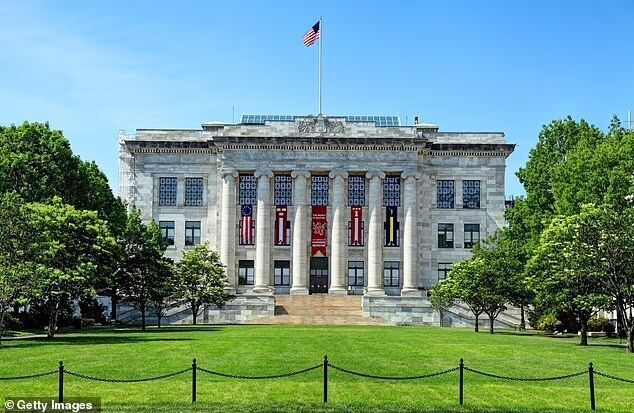
© Getty ImagesExplosion took place about 2.48AM • fourth floor • Goldenson Building Longwood Campus
Law enforcement said the blast appeared to be deliberate and that two people were seen fleeing as they arrived.
The explosion took place at about 2.48am in the fourth floor of the Goldenson building on the Longwood campus.
No injuries were reported.
'Upon arrival at the building, the officer observed two unidentified individuals fleeing the building,' the Harvard University Police Department said.
'The officer attempted to stop the individuals before proceeding to the floor where the alarm had been triggered.'
Boston police checked the building for additional explosives and did not find any.
The FBI was at the scene, according to the Harvard Crimson.
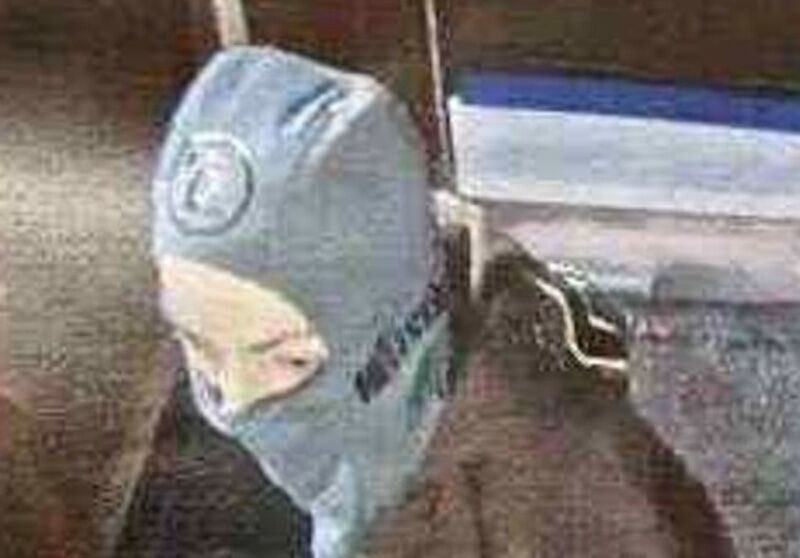
© APBomb suspect image released to public

© APSuspect with face cover
The university said a Harvard police officer was sent to the building for a 'fire alarm activation.'
Upon arriving, the officer spotted two people fleeing Goldenson.
They attempted to stop the individuals before proceeding to the floor where the alarm had been triggered.
The incident remained under investigation.
As of Saturday afternoon, officials had not provided additional details on the explosion or on whether the suspects had been identified.
Images of two unidentified individuals were captured on CCTV and have been released to the public.
The pair are seen in face coverings and wearing sweatshirts. One suspect has a dark blue hoodie and is wearing jeans.
University police has asked anyone with information about the explosion to contact them.




Grok: " Academics and Departments Using the Building The building is primarily occupied by faculty, researchers, and staff from the Department of Neurobiology at Harvard Medical School . This includes: Neurobiology laboratories and research spaces for professors and investigators (e.g., historical renovations for faculty like Dr. David Hubel, Dr. Lloyd Potter, and Dr. Susan Dymecki). Administrative offices for the Department of Neurobiology. Classrooms used for HMS courses, particularly in neuroscience and related biomedical fields. Additional support spaces, such as darkrooms, conference rooms, and committee areas (e.g., for the Committee on Neuroscience)."
"However, through deep interdisciplinary collaborations with Harvard's School of Engineering and Applied Sciences (SEAS), the Center for Brain Science (CBS), and affiliated programs like the Bertarelli Program in Translational Neuroscience and Neuroengineering, faculty and researchers affiliated with Neurobiology contribute to and benefit from pioneering efforts in these fields. These collaborations bridge basic neurobiology with neuroengineering, enabling applications like brain-machine interfaces (BMIs) and implantable neural devices. " [Link]
" Nanotechnology features prominently in these collaborative projects, such as nanowire-based meshes for neural interfaces and magnetoelectric materials for wireless neural stimulation."
Surprising because Lieber was arrested for receiving funding for a nanotech lab in Wuhan: " Charles Lieber (Chemistry and SEAS) leads efforts on syringe-injectable nanoscale electronic scaffolds that monitor and stimulate neural activity, promoting neuron regeneration post-injury"