

© Joseph Moon/Alaska National Guard via APAlaska Army National Guard evacuates displaced people from Kwigillingok, Alaska, on Thursday, Oct. 16, 2025, following Typhoon Halong that struck Alaska’s west coast.
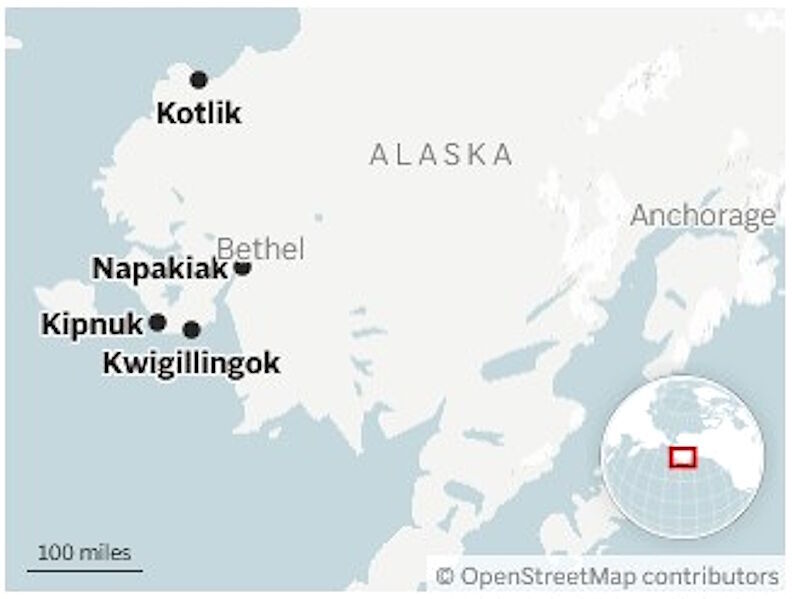
In one of the hardest hit villages, Kipnuk, an initial assessment showed that 121 homes — or 90% of the total — have been destroyed, Dunleavy wrote. In Kwigillingok, where three dozen homes floated away, slightly more than one-third of the residences are uninhabitable.
The remnants of Typhoon Halong struck the area with the ferocity of a Category 2 hurricane, Dunleavy said, sending a surge of high surf into the low-lying region. One person was killed, two remain missing, and rescue crews plucked dozens of people from their homes as they floated away.
© APTyphoon Halong's storm surge ravaged western Alaska towns with floodwaters, October 13, 20025
Anchorage leaders said Friday they expect as many as 1,600 evacuees to arrive. So far about 575 have been airlifted to the city by the Alaska National Guard, and have been staying at a sports arena or a convention center. Additional flights were expected Friday and Saturday.
Officials are working on figuring out how to move people out of shelters and into short-term accommodations, such as hotels, and then longer-term housing.

© Associated PressOfficials on Thursday said 121 homes were destroyed in Kipnuk (pictured after Typhoon Halong ), but all people have been accounted for, October 17, 2025
The federal government already has been assisting with search and rescue, damage assessments, environmental response and evacuation support. A major disaster declaration by President Donald Trump could provide federal assistance programs for individuals and public infrastructure, including money for emergency and permanent work.
The three members of Alaska's congressional delegation on Friday sent a letter to Trump, urging swift approval.
The storm surge pummeled a sparsely populated region off the state's main road system where communities are reachable only by air or water this time of year. The villages typically have just a few hundred residents, who hunt and fish for much of their food, and relocating to the state's major cities will bring a vastly different lifestyle.
Alexie Stone, of Kipnuk, arrived in Anchorage in a military jet with his brothers, children and mom, after his home was struck by the flooding. They've been staying at the Alaska Airlines Center at the University of Alaska, where the Red Cross provided evacuees with cots, blankets and hygiene supplies.
At least for the foreseeable future, he thinks he might try to find a job at a grocery store; he used to work in one in Bethel.
"It's going to be, try to look for a place and find a job," Stone said Friday. "We're starting a new life here in Anchorage."
Anchorage officials and business leaders said Friday they were eager to help the evacuees.
"Our neighbors in western Alaska have experienced tremendous loss, devastation and grief," Mayor Suzanne LaFrance said at a meeting of the Anchorage Assembly. "We will do everything we can here in Anchorage to welcome our neighbors and help them through these difficult times."
State Rep. Nellie Unangiq Jimmie, of Toksook Bay, on an island northwest of Kipnuk, described for the assembly how she rode out the storm's 100 mph (161 kmh) winds with her daughter and niece.
"We had no choice but to sit in our home and wait to see if our house is going to come off the foundation or if debris is going to bust open our windows," she said.
It didn't, but others weren't as fortunate. She thanked Anchorage for welcoming the evacuees.
"You are showing my people, my relatives, my constituents, even if they are far from home, this is still Alaska land and they're amongst families," Jimmie said.




In Port Protection they say they are - and really - self sufficiency makes good sense - in Alaska especially.
In fact, it makes sense everywhere - everywhere....be self sufficient.
Local communities can help each other out - but be self-sufficient - have stocks of food ready, be prepared to have no electricity - be ready for the shit to hit the fan cause if we all have learned anything lately - you can't trust the authorities to provide help and assistance. But you can trust your neighbors I reckon - private entities come to the rescue sometimes when FEMA effs it all up - and that is most telling. Us folks in Appalachia areas - we know this already - so bug off you buggers. Leave us alone.
When Helene passed by that was most telling and now we know - can't trust no gubmnet now can ya?
d
u
h