
"But sir, won't they remember me from earlier this week?"
"Of course not, they are stupid animals!"
"Of course not, they are stupid animals!"
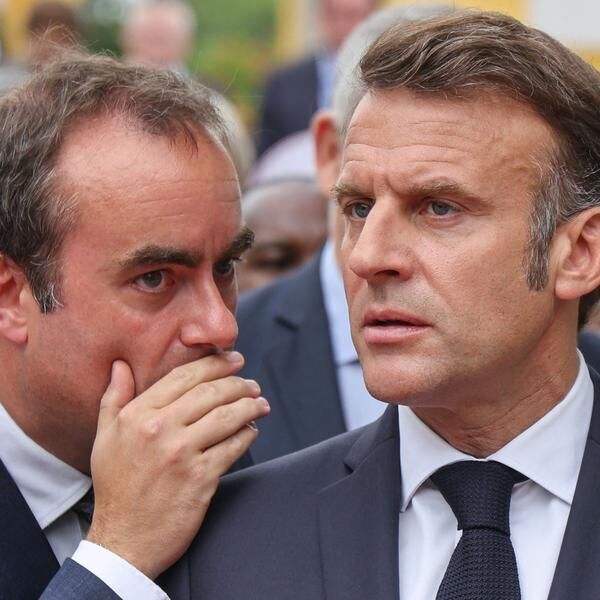
"The president of the Republic has appointed Mr. Sébastien Lecornu as prime minister and tasked him with forming a government," the Elysée Palace said without providing further details. The president "is giving the prime minister carte blanche," said Macron's entourage.
"I accept - out of duty - the mission entrusted to me by the president," Lecornu said, in a post on X. He said he would strive "to do everything possible to give France a budget for the end of the year." Lecornu said that the new government team would have to "embody renewal" and that all appointees "must commit to disconnecting themselves from presidential ambitions for 2027."
Lecornu, 39, threw in the towel on Monday just hours after forming a largely unchanged cabinet, after criticism from inside and outside his coalition over the lack of personnel renewal. He agreed to stay on for two extra days to talk to all political parties and told French television late Wednesday that he was optimistic that a new cabinet could get a spending bill through Parliament.
Leaders of the far-right Rassemblement National (RN) and the radical left La France Insoumise (LFI) promptly pledged to vote for a motion of no confidence against Lecornu's new government, but their combined votes would not be enough to topple it. A spokesperson for the Socialists, whose position could be crucial in a vote of no confidence, said the party had "no deal" with Lecornu.
Marine Le Pen, whose RN declined to take part in talks with Lecornu this week, said she would thwart all action by any new government and would "vote against everything." After Lecornu's re-appointment, she renewed her call for snap parliamentary elections.
Macron, facing the worst domestic crisis of his presidency since 2017, has yet to address the public. He met with leaders of all political parties apart from the RN and LFI on Friday at the presidential palace ahead of the nomination.
Budget deadline Monday
French politics have been deadlocked ever since Macron gambled last year on snap polls that he hoped would consolidate power - but ended instead in a hung Parliament and more seats for the far right. Parliament toppled Lecornu's two predecessors in a standoff over cost-cutting measures. Macron first appointed Lecornu a month ago, after François Bayrou lost a vote of confidence he had called himself.
Lecornu has said a revised draft budget for 2026 could be put forward on Monday, which would meet the deadline for its approval by the end of the year. But it was not immediately clear if this would require a fresh cabinet lineup to be announced by the weekend or not.
Lecornu's suggested list of ministers on Sunday sparked criticism that it contained too many of the same faces and did not break enough with the past. Lecornu on Wednesday suggested that a more technocratic government could be named, whose members should have no "ambitions" to stand in the 2027 presidential elections.
The escalating crisis has seen former allies criticize the president. In an unprecedented move, former premier Edouard Philippe, a contender in the next presidential elections, earlier this week said Macron himself should step down after a budget was passed. But Macron has always insisted he would stay until the end of his term.



Reader Comments