
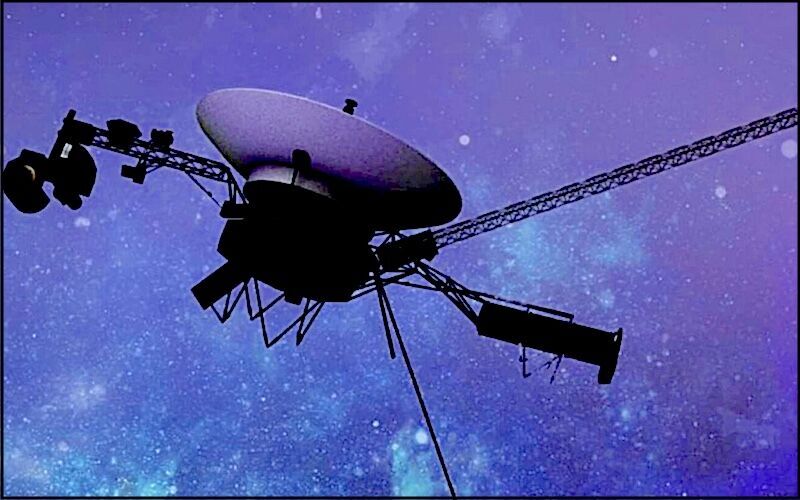
© NASAVoyager 1’s stunning new discovery at the outer limits of our solar system
Voyager 1, launched in 1977, has been journeying through space for over four decades, now more than 14.9 billion miles away from Earth. Recently, this legendary probe made headlines once again by crossing an invisible border that separates our solar system from the vast expanse of interstellar space. What it discovered there has left scientists astounded — a "wall of fire" where temperatures soar to an unimaginable 54,000 degrees Fahrenheit.
A new frontier: exploring the edge of the solar system
Since its launch, Voyager 1 has sent back breathtaking images of Jupiter, Saturn, and their moons. But its most daring journey began when it left the familiar territory of the planets behind and headed toward what is known as the heliopause. This is the vast boundary where the sun's influence fades and the realm of interstellar space begins.
At this boundary point, the pressure of the solar wind — the stream of charged particles flowing from the sun — meets the pressure of particles drifting through space beyond our solar system. Voyager's instruments detected a surprising rise in both temperature and particle density at this location, a phenomenon scientists now call the "wall of fire."
Understanding the heliopause and its cosmic significance
To grasp the importance of Voyager's discovery, it helps to understand what the heliopause really is. It marks the outer limit of our sun's domain, where its solar wind slows and pushes back against cosmic rays and particles originating from other stars. Think of it as a cosmic shield — a natural barrier protecting planets in our solar system from some of the harshest particles speeding through space.
The heliopause isn't just a boundary; it's an extraordinary laboratory in space. Because conditions there are impossible to replicate on Earth, studying this region offers unique insights into plasmas — ionized gases that are the most common state of matter in the universe. Plus, insights gleaned here help scientists better understand how stars like our sun influence the environment around them, including the habitability of planets orbiting those stars.
Voyager's confirmation of a "wall of fire" in this region demonstrates that even in areas with very few particles, collisions between stellar winds can generate extreme temperatures. Thankfully, this fiery zone doesn't harm Voyager; it's so sparse that the probe glides through unharmed.
The science behind the "wall of fire" and magnetic mysteries
NASA engineers explain that the intense temperature readings don't mean the probe is facing a flame that could burn metal — rather, the "heat" comes from the kinetic energy of particles moving at nearly the speed of light. The gas in this region is so thin that particles rarely collide, allowing Voyager 1 to slip through like a cosmic explorer without a scratch.
Something else that has puzzled scientists is the detection of similar magnetic fields on both sides of the heliopause. Initially, it was believed that the sun's magnetic influence and interstellar magnetic fields would differ greatly. However, Voyager's data suggests that the solar wind stretches magnetic field lines until they reconnect and convert kinetic energy into heat in this magnetic reconnection zone.
I remember the sense of awe when I first read about Voyager 1's discoveries. It's incredible to think of a spacecraft operating with about 4 watts per instrument — roughly the power of a nightlight — still delivering groundbreaking data almost 15 billion miles away. Despite the dwindling output of its plutonium batteries each year, NASA has been ingenious in prioritizing which instruments remain active to extend the mission's life.
With radio signals taking over 21 hours to reach Earth and growing fainter by the day, NASA relies on giant 230-foot-wide antennas and ultra-sensitive receivers to keep communicating. The hope is to extend Voyager's mission until at least 2030, pushing the limits of exploration further than ever before.
What's next? Voyager will continue gathering precious information about the density of particles and magnetic fields in interstellar space. This data will help refine our models of the heliosphere — the protective bubble around our solar system — and pave the way for future human missions into the deep cosmos.
Have you ever wondered what lies beyond our solar system? Voyager 1's journey beyond the "wall of fire" marks just the beginning of humanity's interstellar voyage.








Perhaps the Earth is in a very minor backwater of a Birkeland current.? That would make sense.