
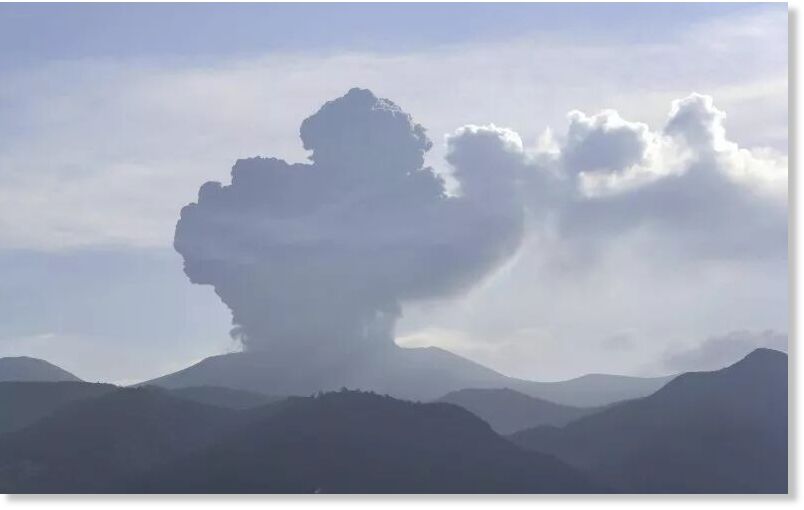
Photo taken on the morning of Aug. 28, 2025, from an unmanned fixed-point camera in Kirishima in Kagoshima Prefecture, southwestern Japan, shows the Shinmoedake volcano erupting. The height of its eruption column reached 5,500 meters earlier in the day, the Kagoshima Meteorological Office said.
Officials warned of large cinders falling across a near-2 mile radius from the volcano, which sits in the Kirishima mountain range on Kyushu, a large southern island of Japan.
They urged people to be vigilant in Kobayashi City, Kogen Town, and Kirishima City, issuing eruption warnings across the affected area.
The eruption was recorded by the Fukuoka Regional Meteorological Observatory and Kagoshima Local Meteorological Observatory at 4:53 a.m. local time on Thursday. They said the eruption appeared to have ended at 14:50 p.m. local time.
During field surveys, authorities recorded that ash fall had been heavy enough to obscure road markings.
Ash fall was recorded in Kirishima City, Soo City, and Kanoya City in Kagoshima Prefecture, as well as Miyakonojo City in Miyazaki Prefecture.
The observatories said Shinmoedake remains active. "Caution is advised within approximately 3 km of the crater due to the risk of large volcanic rocks," the alert said, originally in Japanese.
"Large volcanic rocks ejected on ballistic trajectories may reach up to about 3 km from Shinmoedake's crater. Pyroclastic flows may reach about 2 km. Therefore, remain on alert within roughly 3 km of the crater."
They also noted that, in 2011, strong air blasts from explosive eruptions had shattered glass windows nearby, and urged caution in case it happened again during this period of volcanic activity.
At the end of July, the Klyuchevskoy volcano on Russia's Kamchatka peninsula—the largest active volcano in the northern hemisphere—began erupting following a powerful earthquake off Russia's far eastern coast.
Lava flows and explosions were observed.
Klyuchevskoy stands at 4,750 meters (15,584 feet) and last erupted in 2023. The volcano is situated approximately 280 miles, or 450 kilometers, north of the regional capital of Petropavlovsk-Kamchatsky.
Scientists had been predicting the eruption for weeks, noting that the volcano's crater had been gradually filling with lava and the mountain had been emitting ash plumes.
The volcano sent ash plumes as high as about 1.9 miles (3 kilometers) above sea level.
The Klyuchevskoy eruption occurred just hours after a huge 8.8 magnitude earthquake triggered a tsunami that sent waves across the Pacific, prompting evacuations and emergency declarations from Russia to Hawaii and alerts as far south as New Zealand.
The quake is tied for the sixth strongest ever recorded and was upgraded from an initial 8.0 reading.



Reader Comments
to our Newsletter