

Earth's layers of rock are typically superimposed, or laid one on top of another, meaning that the oldest layers tend to be buried beneath the youngest layers. But researchers recently confirmed that this isn't always the case, as strange bodies of sand can cause stratigraphic inversion — the interruption of the ordinary order of rock layers — at the bottom of the sea.
Revealing their results in Communications Earth and Environment, the researchers say that these bodies of sand, or "sinkites," appear beneath the North Sea and date back to the Miocene and Pliocene epochs, between around 20 million and 2.6 million years ago. Though stratigraphic inversions have been detected in layers of rock in the past, they haven't been detected at this scale or size, as there are hundreds of North Sea sinkholes that measure around a kilometer (over half a mile) across or more.
"This discovery reveals a geological process we haven't seen before on this scale," said Mads Huuse, a researcher and professor from the University of Manchester who was involved in the research, according to a press release. "What we've found are structures where dense sand has sunk into lighter sediments that floated to the top of the sand, effectively flipping the conventional layers we'd expect to see and creating huge mounds beneath the sea."
Detecting Sinkites in the Sea
The laws of stratigraphy are a set of fundamental rules that reveal the history of Earth. Geologists use these laws to understand the relationships and relative ages of Earth's rocks, although the rules themselves aren't without their limitations. In fact, the first and most fundamental of these laws is the law of superposition, which holds that the oldest layers of rock tend to be the farthest from the surface, while the youngest layers of rock are typically the closest to the surface.
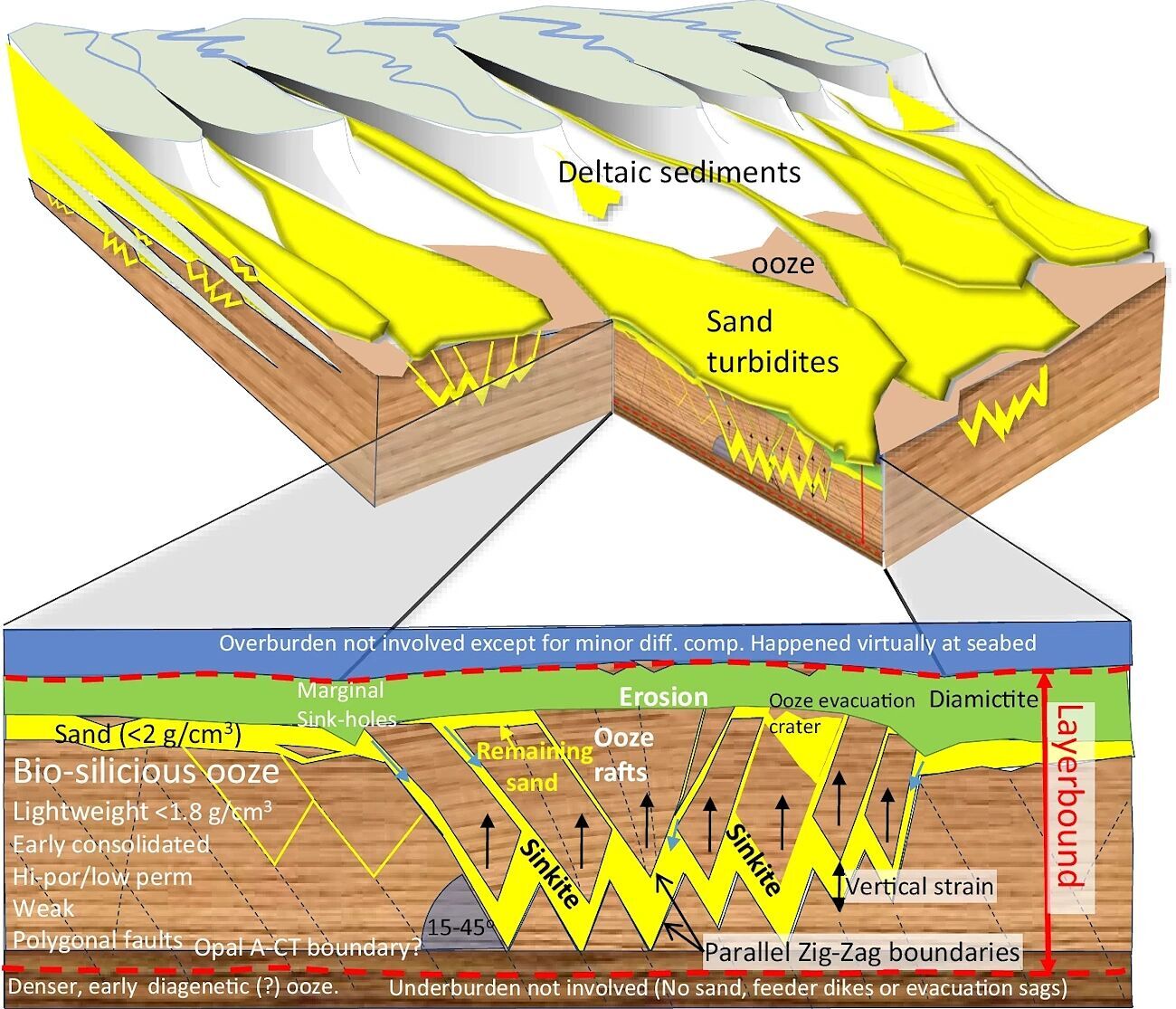
© Jan Erik Rudjork & Mads HuuseSand eroded from the East-Shetland Platform delta during periods of low sea-level is transported as turbidites into the basin58. It partly erodes and deposits onto early consolidated low-density bio-silicious ooze, is liquefied by earthquakes or upward water expulsion from contracting ooze, sinks down polygonal faults, and displaces large, rigid ooze blocks upward due to buoyancy. The characteristic “shark’s mouth“ zig-zag pattern is mainly a fracture fill along the polygonal fault planes, which intersect any vertical section at a variety of angles.
Sinkites and Floatites
According to the researchers, the most likely explanation is that earthquakes in the Miocene or Pliocene epochs caused these sinkites to form, flipping the positions of the younger sand and the older sediment, which was mostly made of ooze, or microscopic marine fossils. While blobs of the sunken, denser sands became sinkites, the bodies of the lifted, lighter sediments were dubbed "floatites" by the team.
The results of the research could provide important insights into the laws of stratigraphy and could have future implications for finding oil and gas and for storing carbon dioxide within Earth's layers.
"This research shows how fluids and sediments can move around in the Earth's crust in unexpected ways," Huuse said in the release. "Understanding how these sinkites formed could significantly change how we assess underground reservoirs, sealing, and fluid migration — all of which are vital for carbon capture and storage."
To solidify their findings, the researchers are already searching for other areas where sinkites and floatites have formed. Their hope is to learn more about the formation of these sandy and sedimentary blobs and to tease out their implications for the fundamental laws of geology.
"As with many scientific discoveries, there are many [skeptical] voices, but also many who voice their support for the new model," Huuse said in the release. "Time and yet more research will tell just how widely applicable the model is."
Sources:
- Communications Earth & Environment. Km-Scale Mounds and Sinkites Formed by Buoyancy Driven Stratigraphic Inversion
- Encyclopedia Britannica. Stratigraphy
- Encyclopedia Britannica. Law of Superposition
- U.S. Geological Survey. What is Carbon Sequestration?






When it appears that way, it's because the "Law" is incorrect.
It's become comical, the pratings of these scientistic parrots... they invent vast ages of time and unjustified processes to explain the illegal behaviors of Mother Nature.
I seem to hear quacking.