
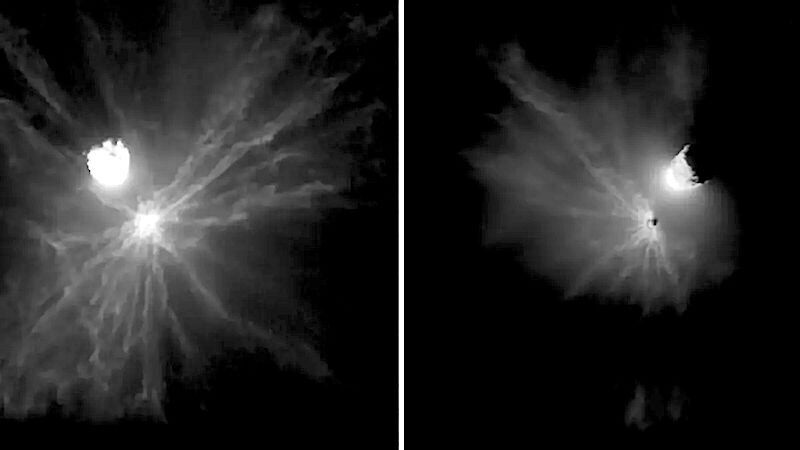
© NASA DART team and LICIACubeESA's LICIACube spacecraft captured images of the debris field shortly after the DART-Dimorphos collision. Analysis of these images has now revealed some surprising results.
Three years ago, NASA made history by deliberately smashing a spacecraft into a large asteroid, altering its course and demonstrating humankind's ability to protect our planet from "potentially hazardous" space rocks in the future.
But a new analysis hints that the debris from this monumental collision is not behaving as expected, raising doubts about the success of future asteroid-deflecting missions.
On Sept. 26, 2022, NASA's Double Asteroid Redirection Test (DART) spacecraft purposefully collided with the asteroid Dimorphos, crashing directly into the middle of the space rock at around 15,000 mph (24,000 km/h). The mission was a smashing success: Not only did DART alter Dimorphos' trajectory — shortening its trip around its partner asteroid Didymos by around 30 minutes — it also completely changed the shape of the asteroid.
The collision, which occurred more than 7 million miles (11 million kilometers) from Earth, demonstrated that this type of action, known as the "kinetic impactor" method, was a conceivably viable option for protecting our planet from potentially hazardous asteroids.
However, a new study, published July 4 in The Planetary Science Journal, has revealed a hidden complication: Dozens of large "boulders," which were knocked loose from the asteroid by the spacecraft are apparently traveling with greater momentum than predicted and have configured into surprisingly non-random patterns.
The researchers analyzed images from the European Space Agency's (ESA) Light Italian Cubesat for Imaging of Asteroids (LICIACube), which flew alongside DART to monitor the collision. This allowed them to track 104 boulders — each between 0.7 and 11.8 feet (0.2 to 3.6 meters) across — as they shot away from the asteroid.
The big takeaway was that these boulders had around three times more momentum than predicted, likely as the result of "an additional kick" the boulders received as they were pushed away from the asteroid's surface, study lead author Tony Farnham, an astronomer at the University of Maryland, said in a statement. "That additional factor changes the physics we need to consider when planning these types of missions," he added.
The team also noted that the boulders were arranged into unexpected patterns: "We saw that the boulders weren't scattered randomly in space," Farnham said. "Instead, they were clustered in two pretty distinct groups, with an absence of material elsewhere, which means that something unknown is at work here."
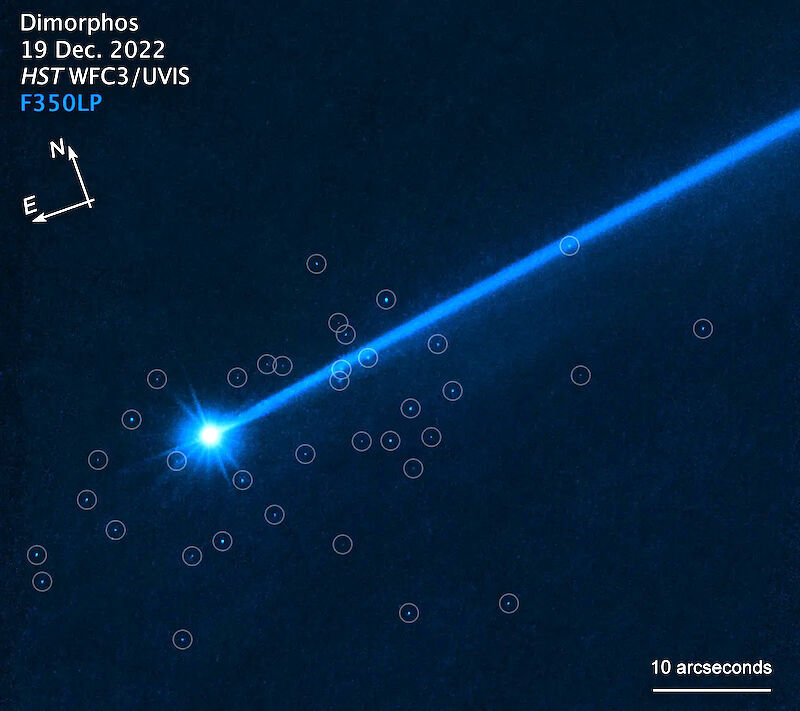
© NASA, ESA, David Jewitt (UCLA))Dozens of larger rock fragments (circled) were spotted in the aftermath of the DART-Dimorphos collision.
Study co-author Jessica Sunshine, an astronomer at the University of Maryland, said:
"If an asteroid was tumbling toward us, and we knew we had to move it a specific amount to prevent it from hitting Earth, then all these subtleties become very, very important. You can think of it as a cosmic pool game. We might miss the pocket if we don't consider all the variables."Unpredictable fragments
This is not the first time scientists have noticed something unexpected about the fallout from the DART mission.
In April 2024, researchers noted that some of the largest boulders might have been set on a collision course with Mars and could smash into the Red Planet in around 6,000 years, potentially endangering any future human colonies that may live there.
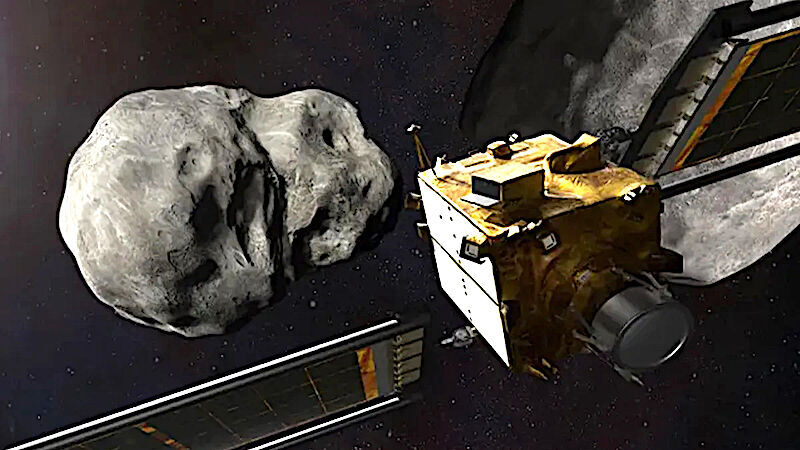
© NASA/Johns Hopkins APLAstronomers still believe a kinetic impactor is the best way to redirect potentially hazardous asteroids, despite recent revelations.
However, despite all these uncertainties, the kinetic impactor method is still the most viable option to protect ourselves from any real threat of being hit by an asteroid.
This topic was discussed earlier this year when the "city killer" asteroid 2024 YR4 was temporarily believed to have a roughly 3% chance of hitting Earth in 2032. The odds of a collision are now zero, but experts are keen to keep the conversation going, especially as the severe cuts to NASA's budget proposed by the Trump administration could limit our ability to spot dangerous space rocks.
Researchers will get a better idea of what is happening with the Dimorphos debris next year, when ESA's Hera spacecraft arrives at the asteroid to properly study the fallout from the DART collision.



Reader Comments
in other news, thought you might find this interesting [Link] are you hearing similar things in Austria ?
But it's obvious, it has already started. Slovakia and Hungary are both in Eastern Europe, bordering the Ukraine. And even Poland feels increasing pressure, both from Ukrainian refugees and border issues.
And the poverty argument is obviously true as well, none of those countries has a very strong industrial base.
Which, by the way, applies to East Germany vs. West Germany as well. Many East Germans remember what dictatorship feels like (and know we are in another one right now ), they are poorer than their Western compatriots because the German government (Kohl) deliberately de-industrialized them in the '90.
In general, the old adage applies : empires start to rot from the core, and begin to fall apart on the periphery.
The Alternating Currents will always organize objects.
(snicker snicker)