
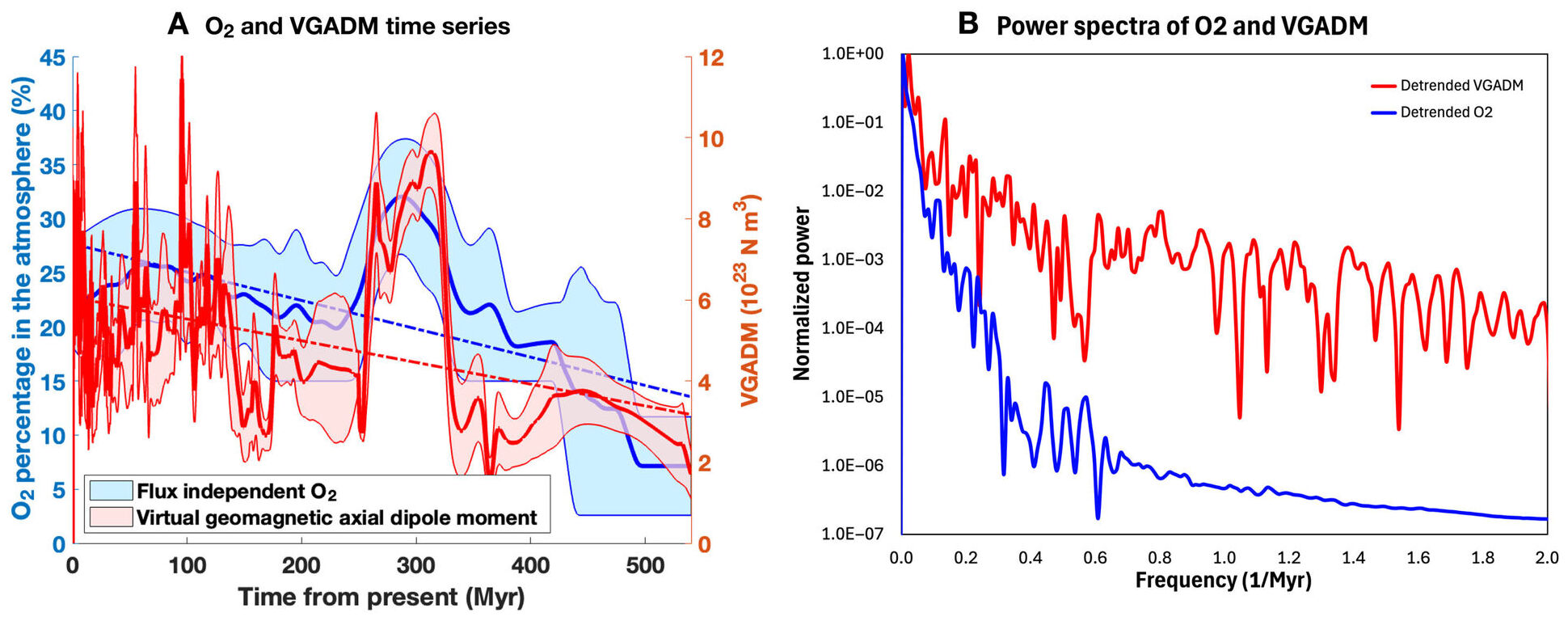
© Sci. Adv. (2025). DOI:10.1126/sciadv.adu8826Time variations of the oxygen (O2) content and the VGADM in the past 540 million years.
A joint venture between NASA Goddard Space Flight Center and the University of Leeds discovered that the Earth's magnetic field strength and atmospheric oxygen levels over the past 540 years have seemed to spike and dip at the same time, showing a strong, statistically significant correlation between the two.
This correlation could arise from unexpected connections between geophysical processes in Earth's deep interior, redox reactions on Earth's surface, and biogeochemical cycling.
According to findings published in Science Advances, both magnetic field strength and atmospheric oxygen levels reached their peak intensities between 330 and 220 million years ago.
Scientists have long speculated that Earth's magnetic field may play a role in making the planet habitable, a hypothesis reinforced by paleomagnetic records that show that the existence of a geomagnetic field overlaps with the timeline of life's emergence. However, there has been little direct evidence of a long-term connection, as most Earth system models don't even include the geomagnetic field when studying how oxygen levels in the atmosphere have changed over time.
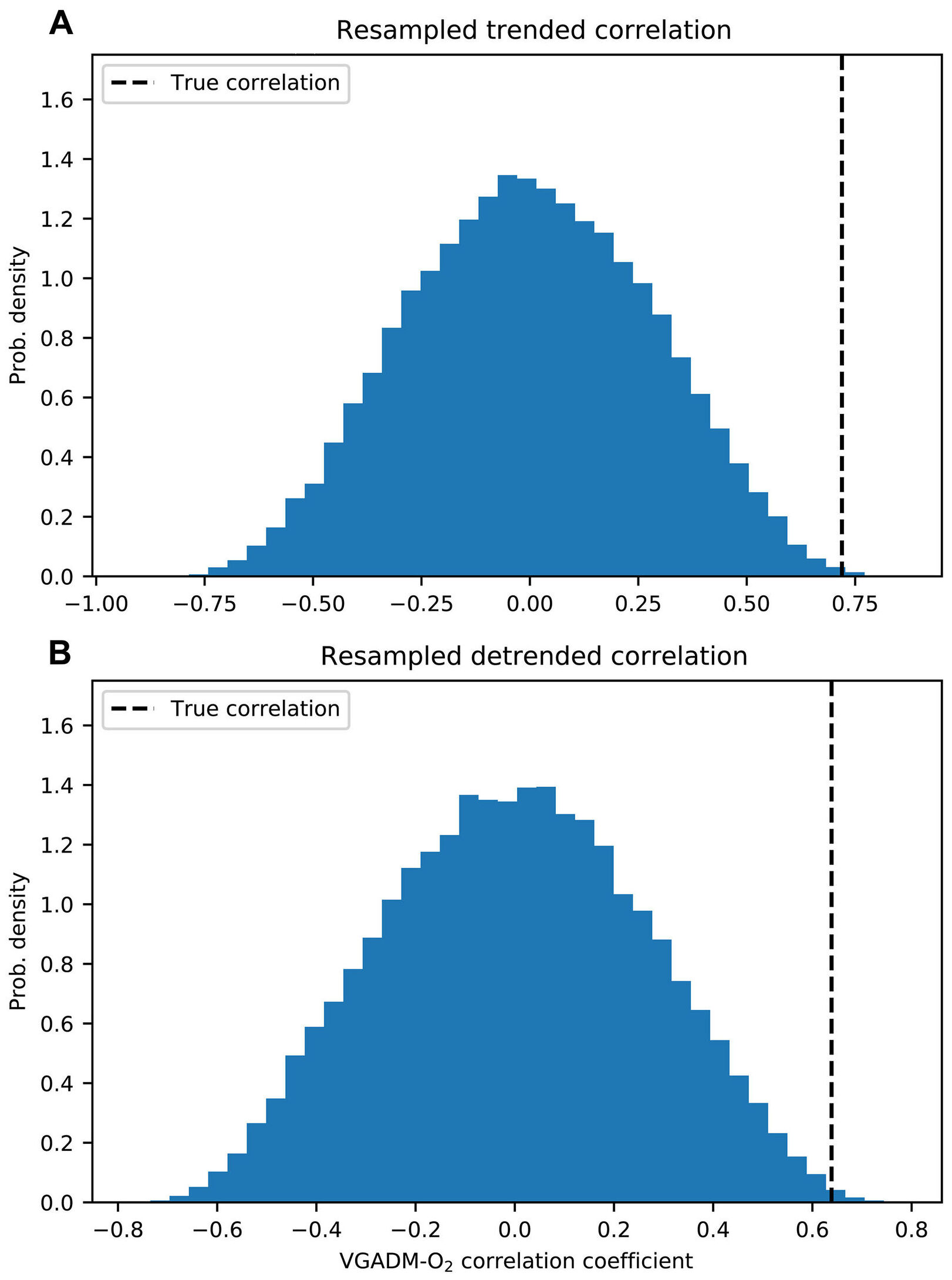
© Sci. Adv. (2025). DOI:10.1126/sciadv.adu8826Correlation between oxygen and geomagnetic field proxies is statistically significant.
This study set out to uncover the statistically significant link between both factors by analyzing two completely independent data sets: paleomagnetic records or geomagnetic data preserved in rocks and minerals for virtual geomagnetic axial dipole moment (VGADM) and various geochemical proxies for atmospheric oxygen, such as fossilized charcoal in sediments and ocean anoxia data.
The findings reveal the highest correlation, 0.72, between Earth's geomagnetic dipole and atmospheric oxygen levels over the last 540 million years. The highest value occurred when there was no time gap between the two, and even after removing long-term trends, the connection remained strong, with only a slight lag of about 1 million years, which is considered negligible on a colossal geological timescale.
This link suggests a deep, previously unrecognized connection between Earth's interior and the surface environment that supports life.
These findings enhance our understanding of Earth's evolutionary history and provide deeper insight into what makes our planet habitable, offering valuable clues in the search for life beyond Earth.



I find this article stating the obvious, but dressed up in such professional tones, it makes me question my understanding as if I'm being gaslighted... The assumption (wrongful at that) imbedded in the arricle is that the world of oxygen atoms is a world apart from the world of planet earth... as if all the scientists should be scratching their heads as to why magnetic oxygen in Earth's sphere should be reacting to Earth's magnetic field, as if all those atoms within Earth collectively form a part of the planetary order... Just as there is 'the order of man' where every breath he takes brings oxygen into his sphere, so every thing in Earth's sphere is a part of that Earthly order. The surprise for me is not that magnetic oxygen is related to magnetic fields surrounding it, but that this should even be considered a surprise.