

© Piqui DiazThe new nova in Lupus, formally named V462 Lupi, shines here at around magnitude 8.5 on June 15.2 UT. Photo taken through 8×42 binoculars with a smartphone. The nova's coordinates (J2000) are RA 15h 08m 03.3s, Dec. –40° 08″ 29.6′. North is up.
The nova went through a slew of temporary names — AT 2025nlr, ASASSN-25cm, and N Lup 2025 — until receiving its official designation V462 Lupi on June 16th. Since discovery, the nova has brightened rapidly. As of 8 p.m. Eastern Time June 16th, it's at magnitude 6.4 and flirting with naked-eye visibility. The magnitude rise has been phenomenal when you consider that prior to the explosion, the progenitor star was approximately magnitude 22.3 (in the blue band) according to American Association for Variable Stars (AAVSO) observer Sebastián Otero, who dug up an older image from a photographic plate.
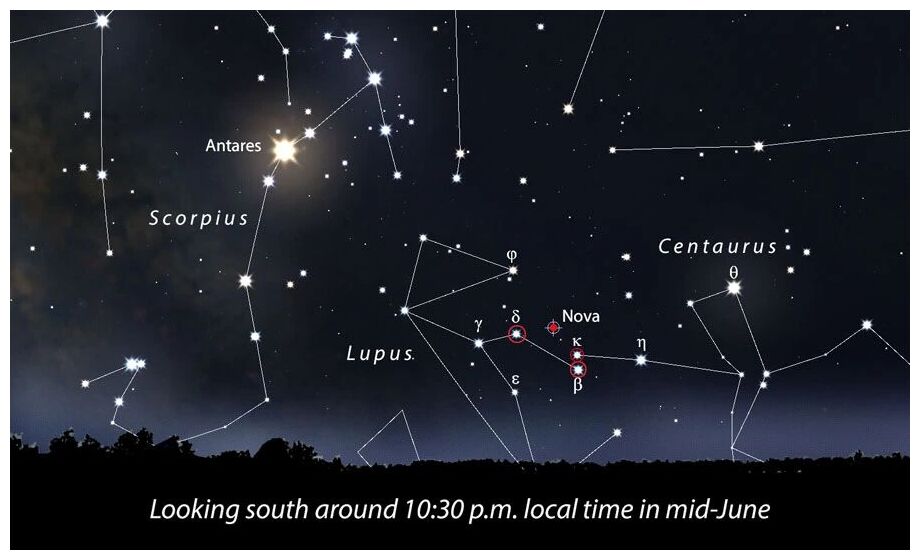
© Stellarium with additions by Bob KingThe new nova in Lupus is near a trio of naked-eye stars — Delta (δ) Beta (β) Lupi and Kappa (κ) Centauri. I've circled them here and on the more detailed AAVSO chart below.
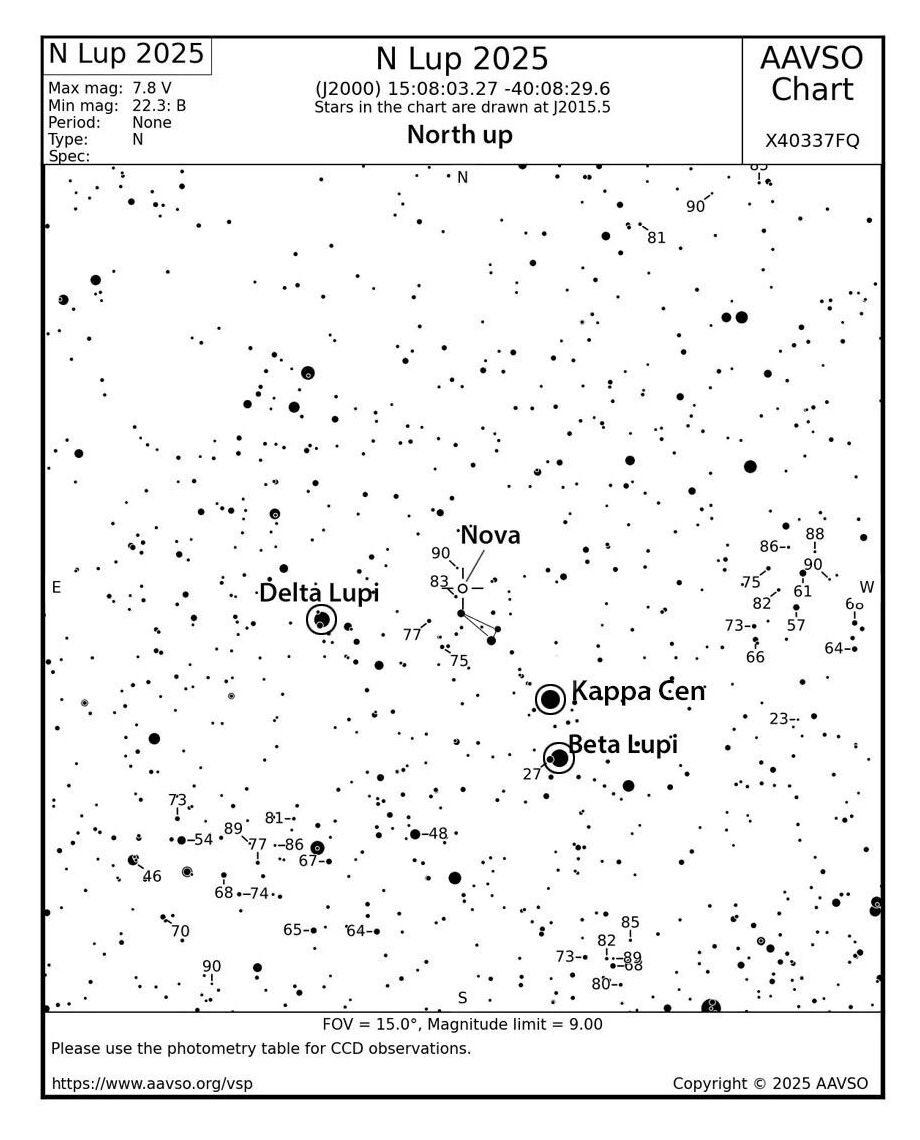
© Courtesy of the AAVSO with additions by Bob KingUse this AAVSO chart to exactly locate the new nova as well as to estimate its brightness using the comparison stars provided. I've outlined a small triangle of 5th and 6th magnitude stars that will also be helpful in finding the nova. Stars are shown with decimals omitted; for example, 27 is magnitude 2.7.
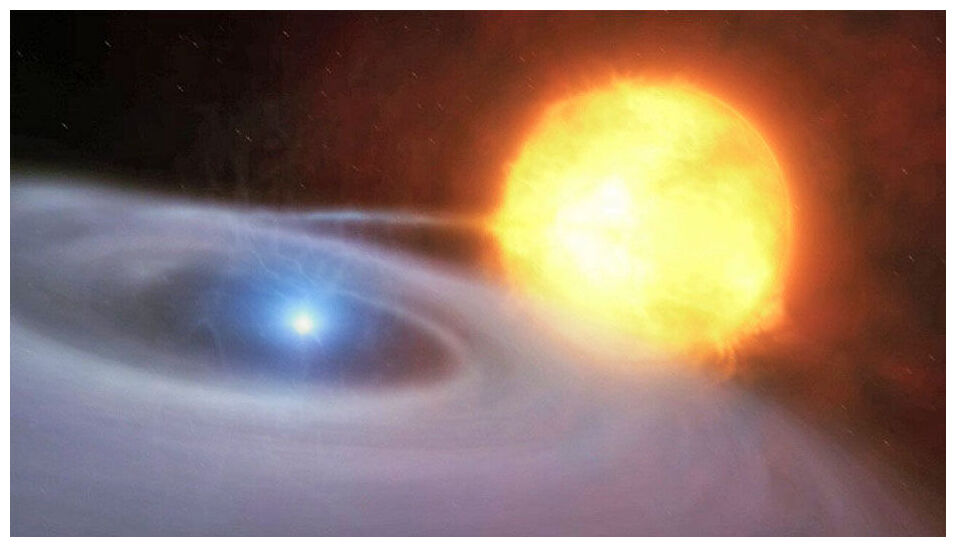
© ESO / M. KornmesserA nova always involves two closely-orbiting stars — a white dwarf and a companion star. In this artist view, the white dwarf (at left) robs gas from its companion (at right). The material forms an accretion disk around the dwarf before spiraling down to the surface, where it's heated and compressed until it ignites in a thermonuclear blast. The explosion causes the system to brighten by many millions of times — as much as 15 magnitudes!
To keep up on its brightness changes, head over to the AAVSO. Scroll up, type the name V462 Lup in the Pick a Star box, and select the Check Recent Observations link. You can also make additional charts as well as create a light curve for the nova at the site.
Happy hunting!


Reader Comments