
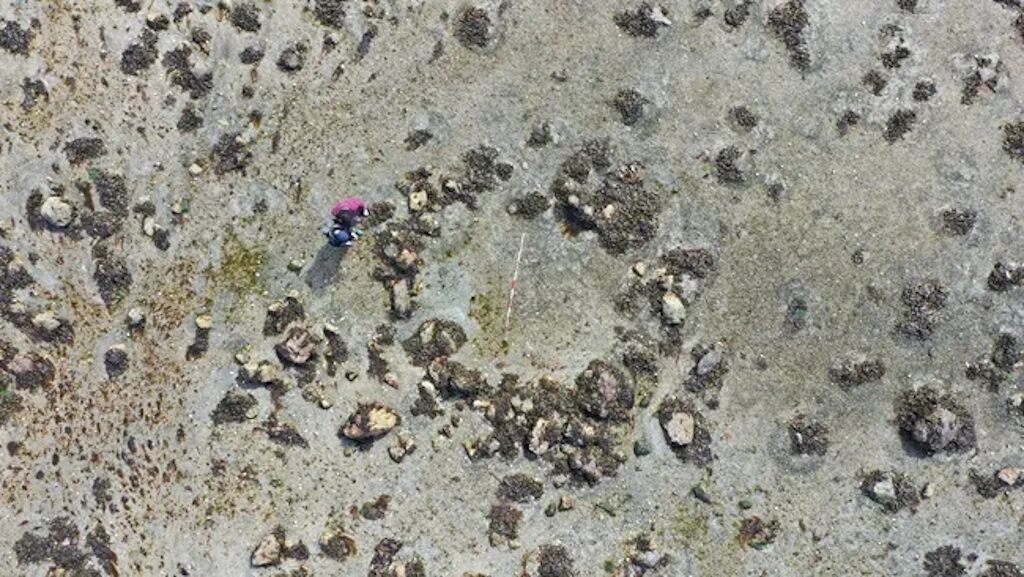
© Jamie BoothA circular alignment of stones discovered on the Isle of Skye
The discovery of submerged stone circles and Stone Age tools on the Isle of Skye reveals that humans occupied what is now northern Scotland about 11,000 years ago.
The finding indicates that these people braved a volatile landscape of glaciers and fluctuating coastlines in northern Scotland, venturing much farther north than experts once believed.
"This is a hugely significant discovery which offers a new perspective on the earliest human occupation yet known, of north-west Scotland," Karen Hardy, a prehistoric archaeologist at the University of Glasgow, said in a statement. Hardy and colleagues published a study of two archaeological sites on the Isle of Skye in the Journal of Quaternary Science in April.
Until recently, little was known about the earliest settlements in Scotland, due to factors such as sea-level rise and the lack of organic remains to radiocarbon-date archaeological sites there, the researchers noted in the study.
But Hardy and colleagues' discovery of numerous stone tools shaped into points, blades and scrapers in a style called Ahrensburgian — which was in use across north-central Europe during the Late Upper Paleolithic — has provided evidence that hunter-gatherers made their way across the forbidding Isle of Skye coastline more than

© Karen HardySeveral stone tools were discovered on the Isle of Skye dated to the Paleolithic.
Because of sea-level rise, these stone circles "are only visible at the extreme spring tides and are exposed around 2-3 hours per year," they wrote in the study, but the circles were likely terrestrial features when they were constructed.
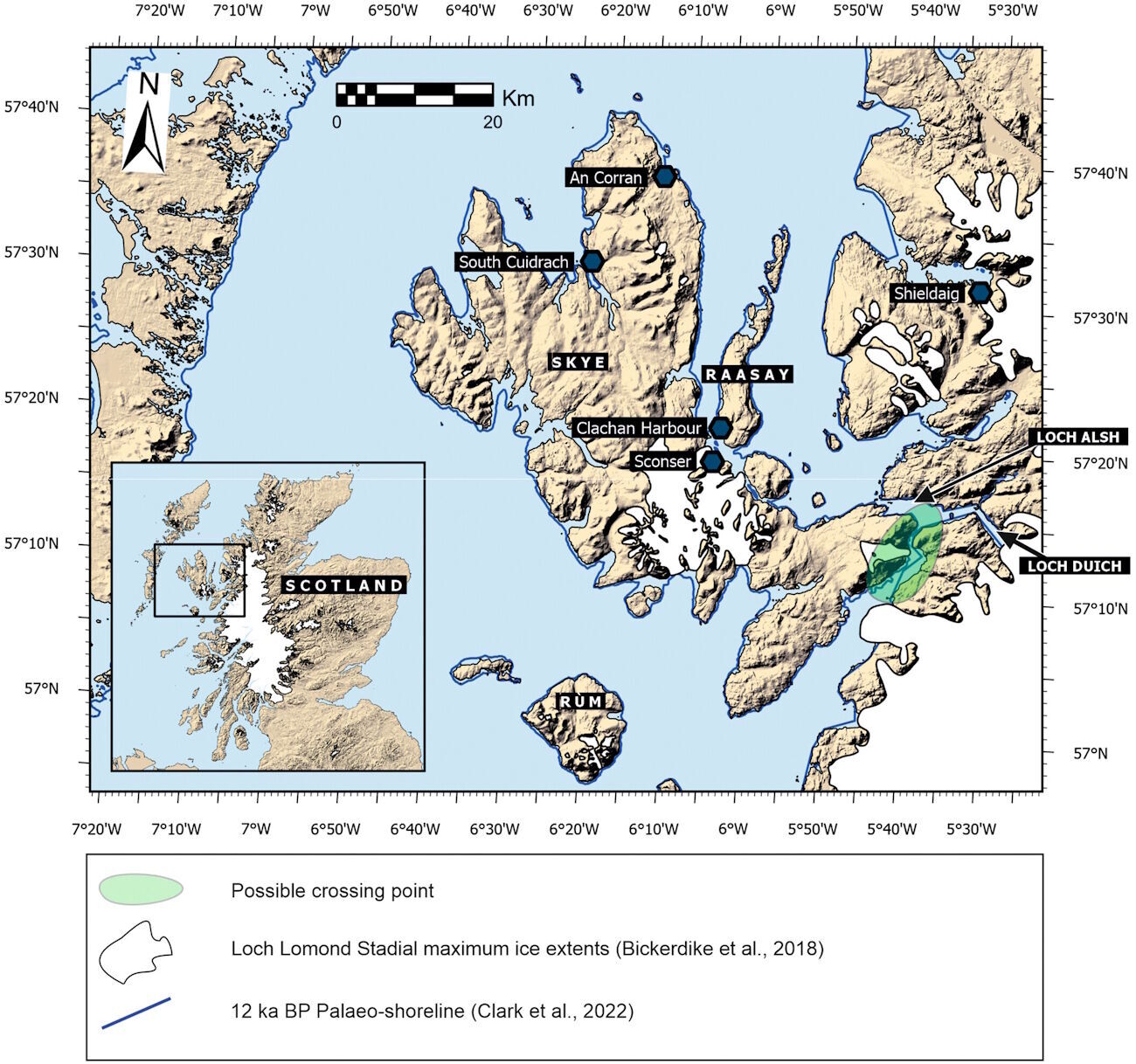
© Karen Hardy, Natasha L.M. Barlow, et al.Map of Isle of Skye showing the Loch Lomond Stadial (LLS) ice extent (in white) during the Younger Dryas period (from Bickerdike et al., 2018) and the 12 000 a bp shoreline estimated using glacial isostatic adjustment modelling by Clark et al. (2022) (in blue), which highlights the exposed lowland terrestrial routes and the site of a potential land bridge during the lowest tides that likely existed at this time due to the relative sea level being lower than present. Topography hill-shaded to highlight relief.
Around the same time, the lower sea level also would have opened up a land bridge or terrestrial corridor between the southern part of the Isle of Skye and mainland Scotland. Ancient people likely would have used this passageway when migrating northwest from what are today Germany and Belgium. Today, this swath of land connecting Great Britain to continental Europe is known as Doggerland, but it's now under the North Sea.
"To reach north-west Scotland would have involved complex travel across unfamiliar terrain, comprising steep mountains and large bodies of water," the researchers wrote, possibly in pursuit of deer and other large mammals.
Living in Skye 11,000 years ago required ancient people to adapt quickly to a rapidly changing climate and environment, according to the researchers. But the abundant stone tools and curious circles suggest a decent-sized group of people stuck it out for the long term and settled into their new coastal life.
"The journey made by these pioneering people who left their lowland territories in mainland Europe to travel northwards into the unknown is the ultimate adventure story," Hardy said.




Reader Comments
These 'science writers" will make a drama out of anything.