
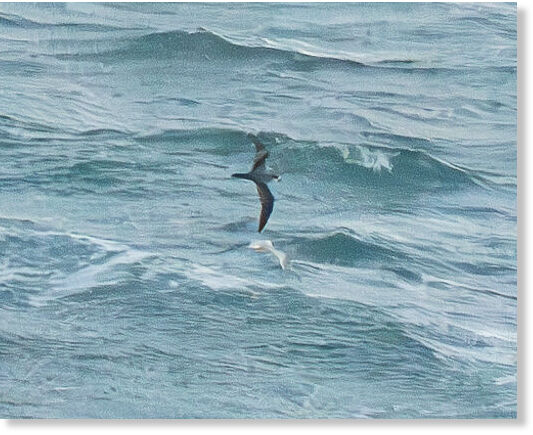
© Guillaume ReyBarau's Petrel reeds only on Réunion in the Indian Ocean
At 8.20 am I picked up a very interesting-looking, long-winged seabird among a group of Sandwich Terns, heading north at about 300 m offshore. I could see that it was a Pterodroma petrel but was uncertain about its identification. The most likely species is Desertas Petrel, but it has a largely dark underwing and the bird in front of me had extensive white in the underwings. The other likely candidate was Zino's Petrel and some of them have quite a lot of white in the underwings, though nothing like this bird.
Despite the distance, I decided to take some record photographs and, as it turned out, this proved to be critical to clinching identification of a wholly unexpected species. The petrel continued northwards and was lost to view.

© Guillaume ReyBarau's Petrel, Lège-Cap-Ferret, Gironde, 10 October 2024
Mega seabird
The photographs showed a bird much larger than a Sandwich Tern. They confirmed that the upperparts were a more or less slate grey marked with a dark cap, a dark 'M' pattern across the upperwings and a darkish uppertail coverts and tail. The underwings were largely white with a dark leading edge to the hand, and the forehead, face and underbody were white. These were natural colours given extensive cloud cover and no direct sunlight.
When back home, I double-checked the possibility of Zino's Petrel because of the white in the underwings, but the amount of white shown in the photographs was far too extensive. I considered Bermuda Petrel, but the bird was capped, not hooded. I did briefly think about species from outside the Atlantic Ocean though such an idea felt too far-fetched.
I decided to send photographs of the bird to Hadoram Shirihai. He had already been alerted to it by Vincent Bretagnolle, who had seen my posting about the petrel on social media. Hadoram replied with the shocking identification that I had seen a Barau's Petrel, the first record for the Western Palearctic.
Photo confirmation
I also sent the photographs to Bob Flood and Dani López-Velasco. They both agreed with the identification.
Barau's Petrel is endemic as a breeding bird to Réunion Island in the south-west Indian Ocean. It ranges across the Indian Ocean as far east as Australia. The species has been recorded off South Africa and Namibia. Intriguingly, one was observed just north of Ascension Island in the equatorial Atlantic Ocean on 22 April 2023.
I knew that I had observed a very interesting bird that morning, but I did not think that it had come from so far and be so exceptional. I feel incredibly privileged to be the person to record this beautiful species for the first time in the Western Palearctic!



Reader Comments
to our Newsletter