
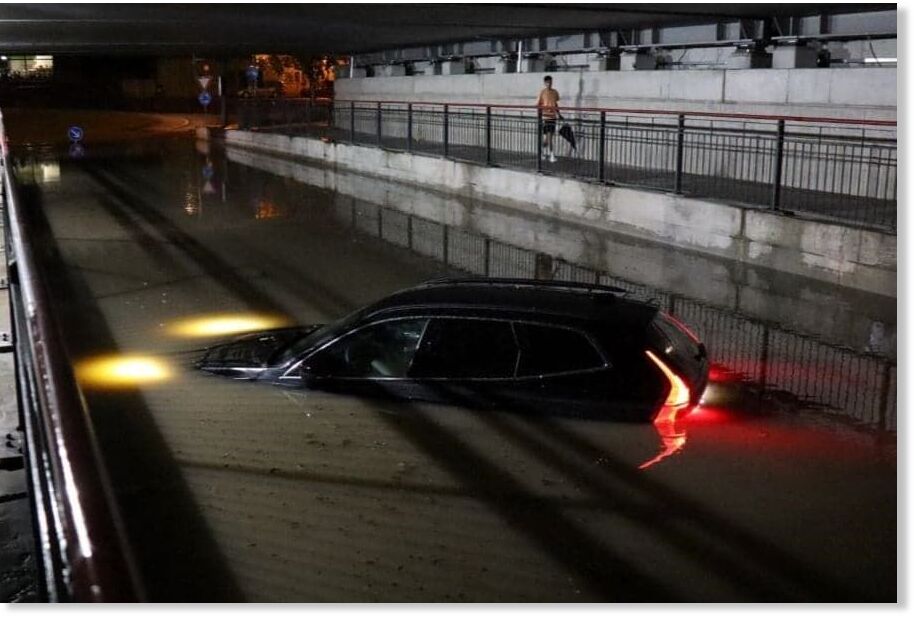
© René PriebeIn the so-called Siemens underpass, a car is up to its hood in water in an underpass after a heavy thunderstorm.
Violent storms with heavy rain and hail plagued parts of North Rhine-Westphalia, Lower Saxony, Bavaria and Baden-Württemberg on Tuesday night.
In Bruchsal, a river overflowed its banks and spread through the old town.
In other states, emergency services reported flooded cellars and streets.
The storms followed a heat wave that brought Germany's hottest day of the year so far, according to preliminary data from the German Weather Service.
Temperatures peaked at 36.5C in Bad Neuenahr-Ahrweiler in Rhineland-Palatinate.
Around Karlsruhe - especially in Heidelsheim, Gondelsheim and Bruchsal - flooding was particularly severe.
The local fire department reported flood waters up to 1.5 metres deep in city streets that swept cars through city streets.
In Bruchsal, the population was alerted by a warning app to clear basements and ground floors in certain areas and to go to higher floors. The Karlsruhe police also asked people to refrain from making non-urgent trips.
The fire department reported that two volunteer rescue workers were injured.
There were also flooded underpasses and streets in the greater region. By midnight firefighters had reportedly carried out more than 500 operations.
Water levels in the most affected areas have since fallen.
100-year flood' in Bruchsal
According to the flood control centre, the Saalbach river reached its highest level at the Bruchsal gauge at 2.30 am at 2.13 metres.
The centre also warned that sharp rises in water levels on some streams and small rivers are still possible throughout the course of Wednesday.
Having exceeded a water-level of 2.10 metres, the event qualifies as a '100-year flood'.
One hundred year floods earn their name because historically floods of this magnitude would take place roughly once in 100 years. But human-caused climate change is making severe rain and flood events more common as warmer weather allows more water to be held in the atmosphere.
Southern and western parts of Germany have experienced recurring flooding events this year, and the German weather service recently announced that the country has experienced its wettest 12 months on record.
Other impacts in Bavaria, Lower Saxony, East Frisia and Duisburg
Heavy rainfall also fell trees and flooded underpasses in other federal states.
In Bavaria, a Eurocity train hit a tree that had fallen across the tracks and was stopped near Bad Endorf around 7pm.
Around 260 passengers were then brought to Prien by minibuses, according to Deutsche Bahn. Police confirmed to DPA that there were no injuries.
Due to damages to the overhead line, the railway there was closed until early Wednesday morning.
Videos collected by a Southern German storm-chasing collective, Unwetter Freaks, show heavy rain and lightning storms as they were seen in parts of Bavaria.
"Since the storm cell was moving very slowly, enormous amounts of rain accumulated within a half hour," they wrote in a post on X.
Heavy rain of up to 40 litres per square metre and strong gusts of wind up to 100 kilometres per hour are said to be possible in some places throughout Wednesday, with the greatest risk in Swabia and Upper Bavaria.
Another fallen tree disrupted rail traffic in the Lower Saxony district of Ammerland.
Train traffic at Augustfehn station in Apen came to a complete standstill late Tuesday evening after a tree fell on an overhead line. A passenger train that was on the track was stopped.
In the East Frisian city of Aurich, 25 residents had to be evacuated from a nursing home due to heavy rainfall. The storm had caused ceiling tiles to come loose in the home, so the residents were temporarily moved to a sports hall.
Also in an Aurich hospital, the fire brigade and the Federal Agency for Technical Relief worked to prevent an evacuation.
Duisburg in North Rhine-Westphalia also suffered a hectic night.
Flooded cellars and underpasses were spread across nearly the entire city area, and the police reported several flooded spots on the A59 and A42.
"All available emergency services are in action," a spokesman for the Duisburg fire department told DPA on Tuesday evening.



Reader Comments
to our Newsletter