
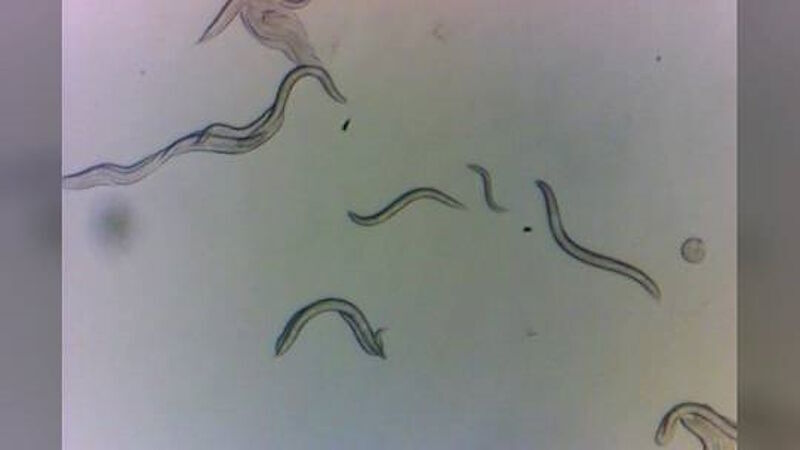
© NYU/Sophia TintoriNematode worms collected in the Chernobyl Exclusion Zone, seen under a microscope.
A team of American researchers has found that the DNA of a common worm species appears to be immune to damage from chronic radiation in the Chernobyl Exclusion Zone. The area has been off-limits to humans since the 1986 nuclear power plant meltdown.
New York University (NYU) biology Professor Matthew Rockman and postdoctoral associate Sophia Tintori visited the Chernobyl Exclusion Zone (CEZ) in 2019 and gathered samples of a nematode worm species called Oscheius tipulae.
"These worms live everywhere, and they live quickly, so they go through dozens of generations of evolution while a typical vertebrate is still putting on its shoes," Rockman said in the press release announcing the results of the study this week.
Armed with Geiger counters and dressed in protective gear, they collected samples of soil, rotting fruits and other organic material that contained the worms, choosing locations with different amounts of radiation.
Rockman and Tintori sequenced the genomes of 15 worms they collected from Chernobyl and compared them to five lineages of nematodes collected elsewhere. While the worm lineages differed in how they tolerated DNA damage, these differences did not correspond to levels of radiation at collection sites.
The researchers "could not detect a signature of radiation damage" in the Chernobyl worms, they said. While careful not to jump to conclusions, Tintori and Rockman expressed hope this research could be useful in treating cancer, for example. Their study has been published in the journal Proceedings of the National Academy of Sciences (PNAS).
A recent Princeton study has also found wolves living in the CEZ to have high resistance to cancer.
One of the four reactors at the Chernobyl Nuclear Power Plant exploded in April 1986, releasing 400 times more radiation than the atomic bomb dropped on Hiroshima, Japan during World War II. Over 100,000 people were evacuated from the nearby city of Pripyat. The entire area, about 100 km north of Kiev, has been considered unsafe for human habitation ever since.



Reader Comments
Business Insider: "Photos show what daily life is really like inside Chernobyl's exclusion zone, one of the most polluted areas in the world" [Link]
BBC: "The people who moved to Chernobyl" [Link]
Wikipedia: "Chernobyl exclusion zone/Population" [Link]
the Wikipedia article contains this map: "Chernobyl radiation map 1996.svg" (cesium-137) [Link] ... all the discussion is about people in the Ukrainian section of contamination, which the map shows to be only about 15% of the total... with about 70% of the affected area in Byelorus, and another 15% in Russia.
bfs.de: "36 years of Chernobyl: the BfS publishes the new radioactivity maps" [Link]
if you look at the (cesium-137 & gamma-ray) maps (of just the Ukrainian Exclusion zone) in this article, you can clearly see radiation plumes to the North and West (due to wind at the time).
I've watched several documentaries showing wildlife flourishing near Chernobyl (wolves, deer, przewalski-horses, etc). The area is contaminated but Life goes on.
I've had this nagging suspicion lately, that the PTB have been watching Chernobyl bounce back (despite the radiation), and have concluded that maybe nuclear war isn't such an unsurvivable option. They seem eager to rid themselves of the "Useless Eaters" and to "Save the Climate!". With all the nuclear sabre-rattling they are doing at Russia, I fear they think they can survive a decade or two in their private bunkers, to reclaim a depopulated and only-slightly-smoldering planet later.
Reports just recently state that a good proportion of online research papers making it passed the pier groups are fraudulent and full of NWO misinfo.
It pays to be vigilant.
" I don't know mum, I fed the worms last night, when I woke up they had legs." Not.