
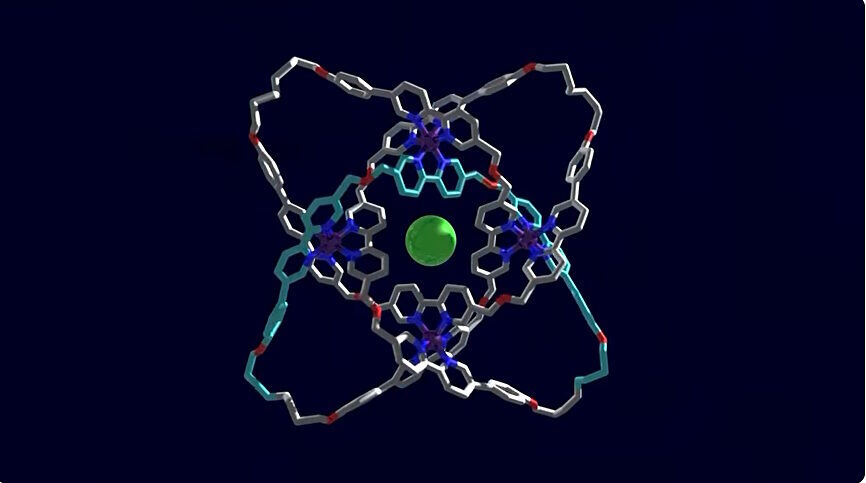
© Zhiwen Li, et al.Scientists have broken the record for the smallest and tightest molecular knot
The way a molecule affects others depends not just on the elements it's composed of, but on the shape these take on. Complex molecules can be folded in vast numbers of ways, and sometimes only one of these will produce the desired biological effects. Predicting and controlling such folding is considered one of the hardest problems in science, and one where computers are only just starting to displace humans.
Knots represent the extreme end of this. It's not easy to tie even long thin strands of atoms into knots because you can't just grab the ends like pieces of rope on a sailboat. Finding ways to make molecules knot can help develop humanity's capacity for more practical knotting. Since DNA, RNA, and many proteins knot without human intervention, performing knotting of our own helps us understand these vital molecules' behavior.
Knots are categorized by the number of crossings. Au6 forms the simplest kind of non-trivial knot, with three crossings, and is known as a trefoil.
Chemists cannot measure the tightness of molecular knots in a physical sense, so they use the number of atoms in the knotted strand, dividing by the number of crossings, as a proxy. The fewer atoms per crossing, the tighter a knot is.
Au6, produced by a team including Professor Richard Puddephatt of the University of Western Ontario, has just 54 atoms in its backbone. This compares with the previous record for a metallaknot of 69, while no organic trefoil knot has been achieved with fewer than 76 atoms. Much larger knots, with far more crossings, have achieved tightness scores as low as 24, but Au6's 54 atoms and tightness score of 18 easily beats all. Theoretical models suggest that 50 atoms may be a minimum for a knot.
Most molecular knot-making involves creating ever more complex knots, but there is a niche subfield in producing ever-tighter knots, as the below video accompanying an earlier record proves.
Small knots have generally been made by using metal ions to draw helical chains into a targeted shape and then pulling the metals out to leave a knot behind. It's a stepping stone to stronger and lighter plastics, among other things.
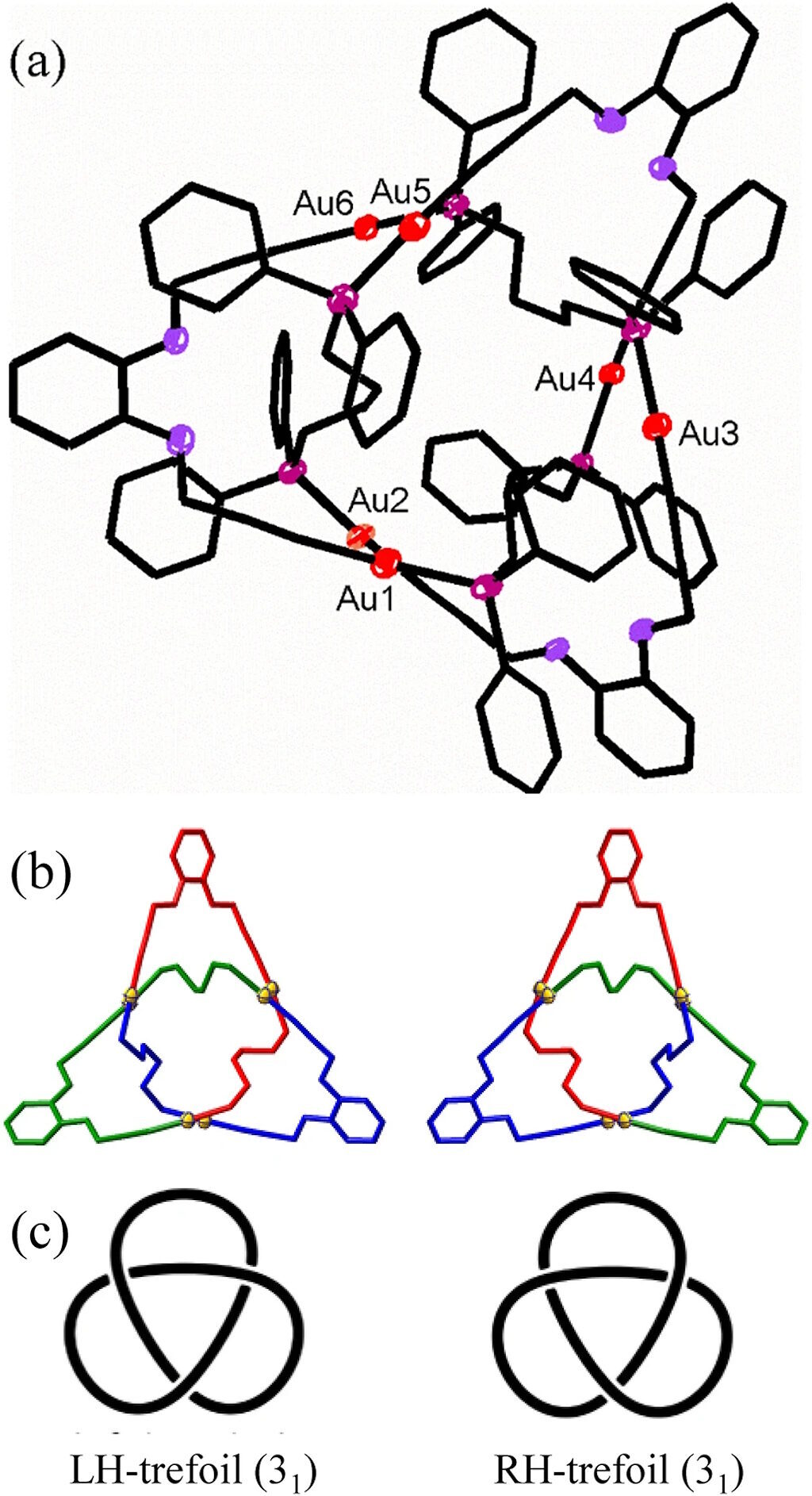
© Zhiwen Li, et al.Separate sections are a the structure (color code: Au, red; P, purple; O, mauve); b the core structures of enantiomers (H atoms and dppb phenyl groups omitted for clarity); c the ideal left- and right-handed trefoil knots.
"We've made many combinations of gold acetylides and phosphine ligands and they've never before given a trefoil knot," said Puddephatt. "We hadn't predicted that this would happen in this case, so it was serendipity." He also acknowledged the process was not fully understood, although it is repeatable and has potential for use in more complex situations.
The study is published in Nature Communications.



"We've made many combinations of gold acetylides and phosphine ligands and they've never before given a trefoil knot," said Puddephatt. "We hadn't predicted that this would happen in this case, so it was serendipity." He also acknowledged the process was not fully understood, although it is repeatable and has potential for use in more complex situations.”
Complete bravo sierra.
It’s not an accident. It;s a discovery.
It’s a discovery of how NATURE’s intelligence naturally works. It’s a discovery in a code that we as humans are still trying to ‘hack‘ to’ understand & figure out. While gubMINTS create the fake convention & science to give us more bravo Sierra answers to the greatest discoveries of how nature & it’s intelligent design actually work. 🤡💩🎪
Think Plato’s Cave vs. Demiurge …