
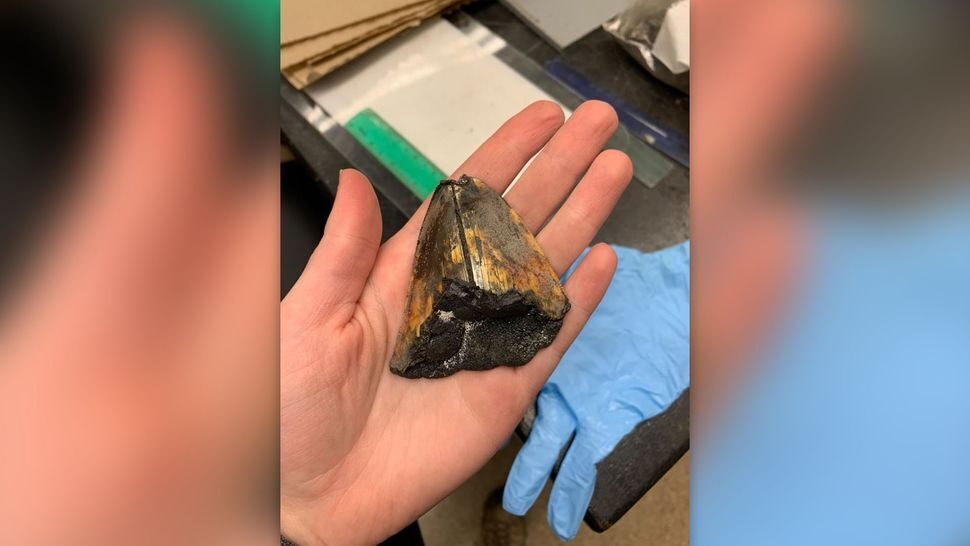
© Katherine KelleyThe tooth after researchers scraped off a ferromanganese layer it was encased in.
The gold-colored tooth, which is 2.7 inches (6.8 centimeters) long, was discovered more than 10,000 feet (3,090 meters) below the surface near the Johnston Atoll in the Pacific Remote Islands Marine National Monument, around 800 miles (1,300 kilometers) south of the Hawaiian Islands.
Researchers described the find in a study published Dec. 14 in the journal Historical Biology. The Ocean Exploration Trust, which led the 2022 expedition that found the tooth, has now released video detailing the events.
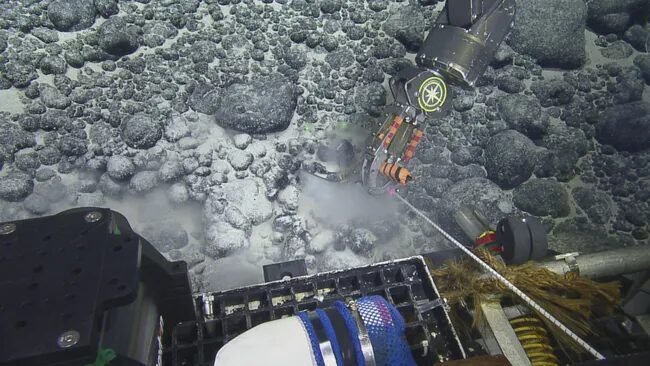
© Ocean Exploration TrustA remotely operated vehicle (ROV) collecting the megalodon tooth from a seamount.
Study co-author Nicolas Straube, an associate professor at the University Museum of Bergen in Norway, described it in the statement as an "amazing find."
"The fossil was discovered at a very remote deep-sea locality from which megalodon fossils are rarely documented," Straube said.
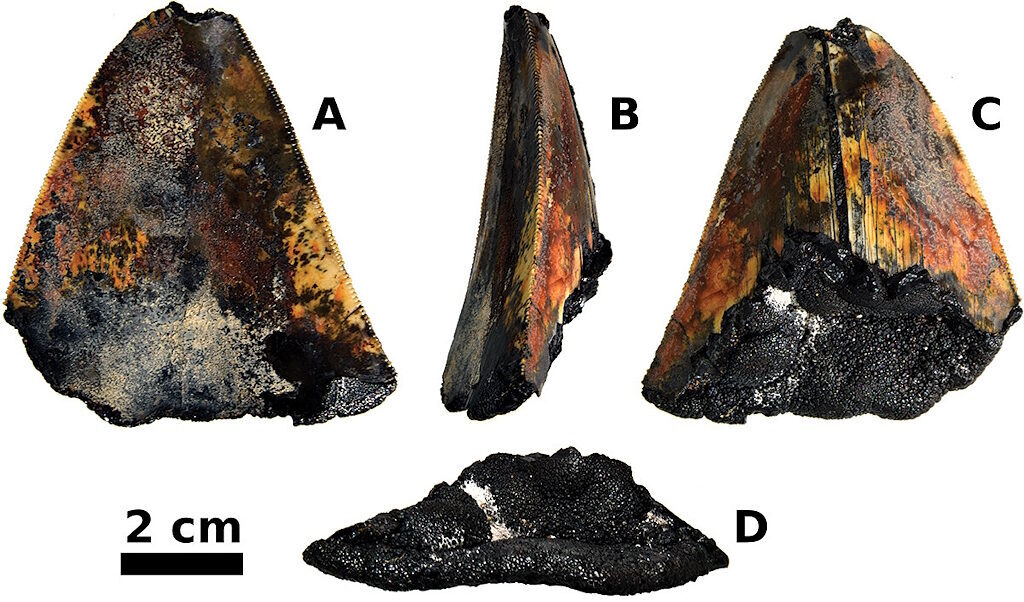
© Jürgen Pollerspöck, Danielle Care, et al.Otodus megalodon tooth NA141-006-01-MT. A, labial view; B, profile view; C, lingual view; D, basal view. Scale bar 2 cm.
Megalodon teeth are relatively common fossils — each megalodon had around 276 teeth, and they lived in oceans around the world. However, most of these fossils are discovered on land near shorelines or rivers rather than in the deep sea, which is rarely explored, according to the statement.
Researchers aboard the Ocean Exploration Trust's Nautilus exploration vessel were collecting samples around the Johnston Atoll in June 2022 to study its deep-sea geology and biology. They deployed a remotely operated vehicle (ROV) called Hercules to film and collect the samples, which were then sent to the University of Rhode Island for processing.
There, researchers found the tooth in one of the samples and suspected it came from a megalodon. Study co-author Dave Ebert, a researcher at the Moss Landing Marine Laboratories in California, later confirmed the tooth came from a megalodon.
Upon reviewing the video recorded by Hercules, the researchers also realized the tooth was visibly sticking out of the sand on the seamount before the ROV shoveled it up. Discovering an in-situ tooth on a deep-ocean mountain, or seamount, helps researchers learn more about the gigantic shark's ocean habits.
"This fossil provides us with important insights into the distribution of megalodon," study first author Jürgen Pollerspöck, a researcher at the Bavarian State Collection of Zoology in Germany, said in the statement.
"The sample indicates that megalodon was not a purely coastal species and that this species migrated across ocean basins similar to many modern-day species such as the great white shark."



Reader Comments
two thirty.
🤦♂️