
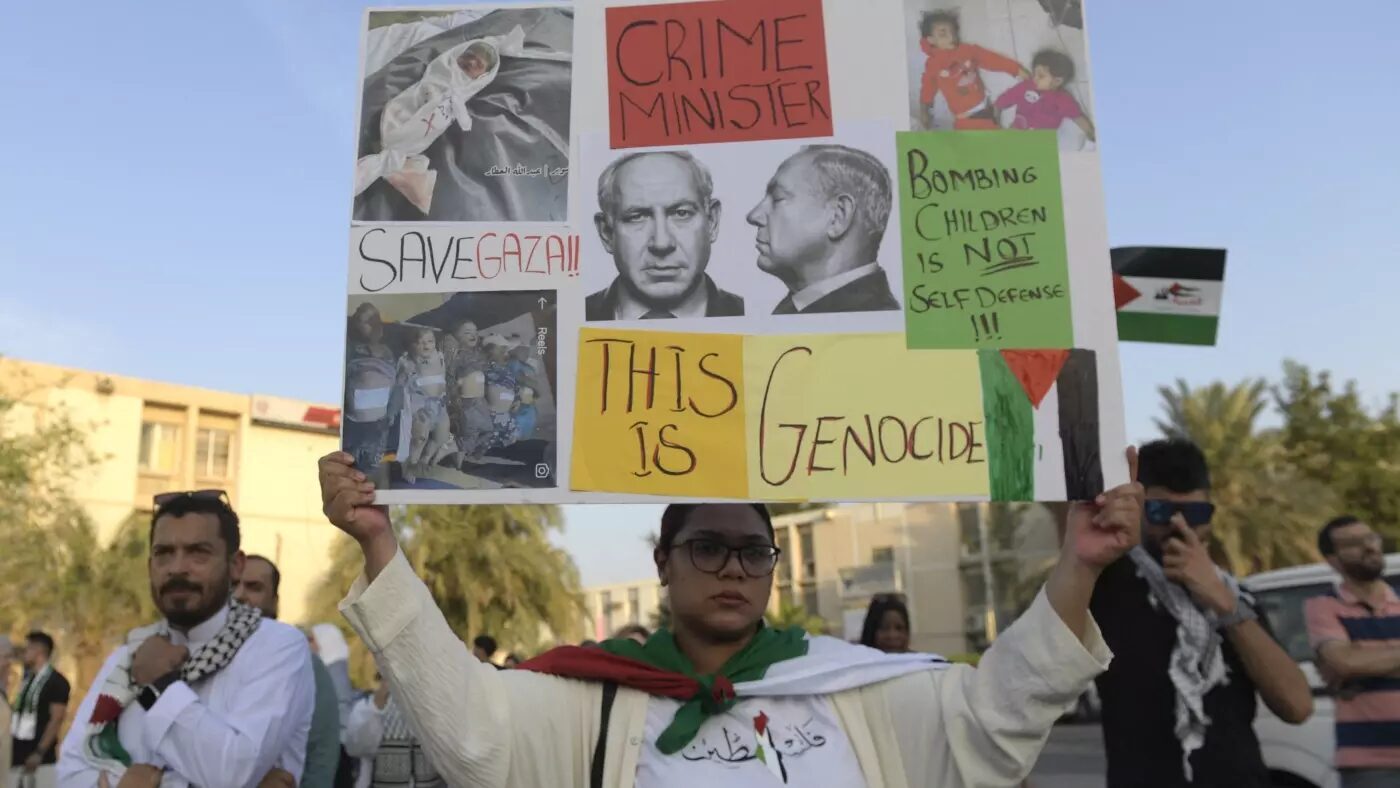
© AFP/Mazen MahdiA protester holds up a banner during a pro-Palestinian demonstration in Bahrain's capital, Manama. Israel-Palestine war: It is not yet clear whether Bahrain's envoy would in fact be leaving, with media reports refuting the suggestion.
Comment: What with Israel being so righteous, surely they should recall their ambassador themselves? Israel to refuse visas to UN officials after Guterres' Gaza speech highlighting Palestine's '56 years suffering occupation'
A spokesman for the Council of Representatives, the country's lower legislative house, said economic cooperation with Israel would also be put on hold amid its bombardment of Gaza.
Comment: The aims of Israel and its allies would be significantly more difficult if, as Iran's leader has suggested, trade and energy supplies to were restricted to all complicit nations: Iran calls for oil and food embargo on Israel
"This is a confirmation of the historic Bahraini position in support of the Palestinian cause and the legitimate rights of the fraternal Palestinian people, which has been previously declared by His Majesty the King at conferences and events," the statement read, referring to Bahrain's King Hamad Al Khalifa.
The statement also condemned Israel's "lack of respect for international humanitarian law" in its military operations in Gaza and affirmed Bahrain's support for an independent Palestinian state.
Comment: A fact confirmed by the UN, its representatives, and former representatives themselves: UN NY director of human rights quits over 'text book case of genocide' of Palestinians, says US, UK, EU 'wholly complicit'
It is not clear whether the move would be temporary and Bahrain's foreign ministry has not commented on the matter.
However, later on Thursday, Axios reporter Barak Ravid said Bahrain would not be recalling its envoy to Israel, citing an official Bahraini source.
A small island country situated in the Gulf, Bahrain's internal politics have long been dominated by its larger neighbour Saudi Arabia.
According to a report by Axios, Riyadh is still interested in continuing to develop ties with Israel despite the latter's ongoing war in Gaza.
Bahrain signed a normalisation deal with Israel in September 2020 alongside its Gulf neighbour, the UAE.
Morocco and Sudan also signed deals with Israel that same year.



Comment: The position of Middle East nations towards the US (and therefore Israel) on the genocide in Gaza was made rather clear on a recent US tour of the Middle East whereby they were made to wait, or not given a hearing at all.
Since the 2020 normalisation deals were made, the geopolitical landscape has changed rather significantly, and it seems that the burgeoning multipolar polar, and the threat it poses to US hegemony, is partly what has compelled Israel-US to take such a risk in Gaza.
Meanwhile, in part thanks to the abominable and irrefutable images of Israel's war crimes being published on social media outlets like X/Twitter, increasing numbers of people across the planet are in uproar over Israel's ethnic cleansing, and leaders in the Middle East risk unrest at home if they're found to be going easy on Tel Aviv.
Moreover, these same leaders will also be well aware that the US and Israel don't intend to keep these war crimes confined to just Palestine; because another prime target for their chaos creation seems to be Syria and its leader Assad: Israel rushes warships to Red Sea after attacks by Yemen's Houthis, raises possibility conflict will spill over into Syria