
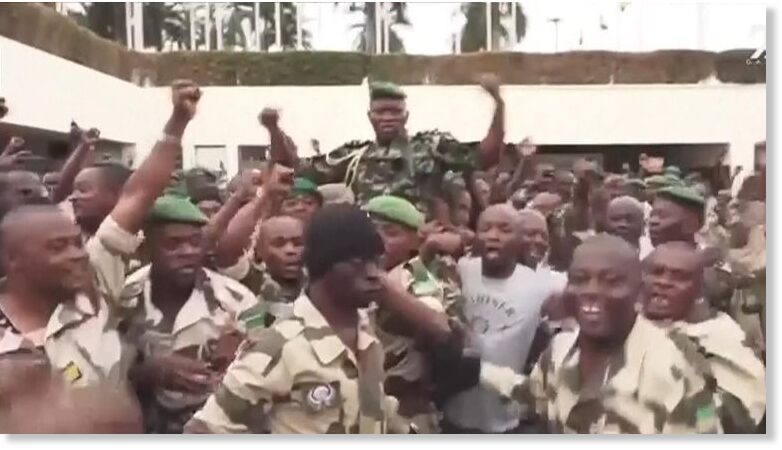
Gabon: hundreds celebrate while president pleads for help after coup declared
A group of military personnel appeared on state television to announce they were seizing power to overturn the results of a presidential election, seeking to remove a president whose family has held power for nearly 56 years. The officers introduced themselves as members of the Committee of Transition and the Restoration of Institutions.
If successful, the coup would be the eighth in west and central Africa since 2020. The most recent one, in Niger, was in July, while the military has also seized power in Mali, Guinea, Burkina Faso and Chad.
In a video apparently from detention in his residence, Bongo Ondimba called on people to "make noise" to support him.
Crowds instead took to the streets of the capital and sang the national anthem to celebrate the coup attempt against a dynasty accused of getting rich on the country's resource wealth while many of its citizens struggle to scrape by.
The officers said they represented all Gabonese security and defence forces and announced the election results were cancelled, all borders were closed until further notice and state institutions dissolved.
"Today the country is undergoing a severe institutional, political, economic, and social crisis," the officers said in a statement, saying the 26 August election lacked transparency and credibility. "In the name of the Gabonese people ... we have decided to defend the peace by putting an end to the current regime."
A Gabon army officer, Brice Oligui Nguema, told French newspaper Le Monde that generals would meet on Wednesday to decide who would lead a transition.
The coup attempt came hours after Bongo, 64, was declared winner of an election marred by fears of violence. He was last seen in public casting his vote on Saturday.
Gabon is a member of the Opec oil cartel, with a production of 181,000 barrels of crude a day, making it the eighth-largest producer of oil in sub-Saharan Africa. It is home to more than 2 million people, and is slightly smaller than the US state of Colorado.
Unlike Niger and two other west African countries run by military juntas, Gabon has not been afflicted by jihadi violence and had been seen as relatively stable. But nearly 40% of Gabonese aged 15-24 were out of work in 2020, according to the World Bank.
The president of Nigeria, Bola Tinubu, who is also chair of the West African regional bloc Ecowas that has threatened to intervene military in Niger to restore constitutional order, was said by a spokesman to be "watching developments in Gabon very closely with deep concern for the country's socio-political stability and the seeming autocratic contagion apparently spreading across different regions of our beloved continent."
White House national security spokesman John Kirby said the the US was "following this very, very closely." China called for a peaceful resolution and Russia said it hoped for a swift return to stability.
The political demise of Bongo fits a pattern of coups in French-speaking Africa in recent years. The French-educated Bongo met the French president, Emmanuel Macron, in Paris in late June and shared photos of them shaking hands.
The French prime minister, Élisabeth Borne, said France, Gabon's former colonial ruler, was following the situation closely.
France has around 400 soldiers permanently deployed in the country for training and military support, including at a base in the capital, and has extensive economic ties to the country in the mining and oil sectors.
Before Wednesday's dramatic announcement, Bongo's spell in office was marked by disputed elections and a stroke that spurred rumours about his fitness for office and fuelled a minor attempted coup.
Niger and other Sahel countries have been fighting Islamist insurgencies that have eroded faith in democratic governments. Gabon, which lies further south on the Atlantic coast, is not facing the same challenges, but a coup would suggest another sign of democratic backsliding in a volatile region.
Viviane Mbou, a shopkeeper, offered the soldiers juice, which they declined. And Jordy Dikaba, a young man walking with his friends on a street lined with armoured policemen, said: "Long live our army."
The French mining company Eramet said it was ceasing all operations in Gabon, and was implementing procedures to ensure the safety of its staff and facilities. The company's subsidiaries in Gabon operate the world's largest manganese mine and a rail transport company.
The private intelligence firm Ambrey said all operations at Gabon's main port in Libreville had been halted, with authorities refusing to grant permission for vessels to leave.
One morning flight at Libreville's Léon-Mba international airport had already been delayed early on Wednesday morning. A man who answered a number listed for the airport told Associated Press that flights were cancelled on Wednesday.
The coup attempt came about a month after mutinous soldiers in Niger seized power from the democratically elected government, and is the latest in a series of coups that have challenged governments with ties to France.
Bongo, in his annual Independence Day speech on 17 August, said: "While our continent has been shaken in recent weeks by violent crises, rest assured that I will never allow you and our country, Gabon, to be hostages to attempts at destabilisation. Never."
In his speech, Bongo acknowledged the widespread frustration over rising costs of living, and listed measures his government was taking to contain fuel prices, make education more affordable, and stabilise the price of baguettes.
The EU's top diplomat, Josep Borrell, asked about Gabon on Wednesday, said European ministers would discuss the situation this week. "If this is confirmed, it's another military coup, which increases instability in the whole region," he said.




Got to love the way 'western' media portrays 'sovereign' nations that put up a fight. Western media appears incredulous that 'the colonies' have a back bone.
Russia will be blamed and the Bill and Melinda Gates foundation will be armed.