
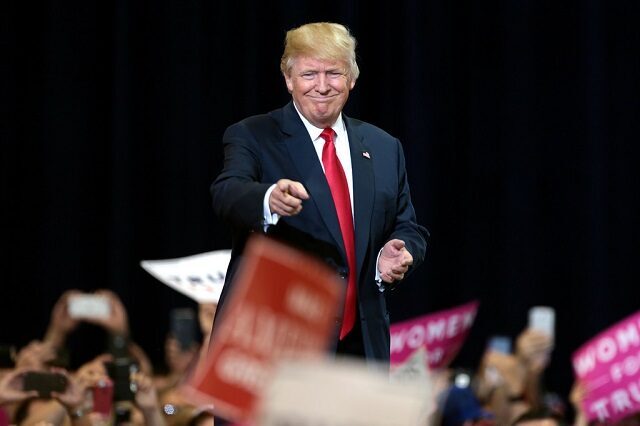
© Gage Skidmore/Creative CommonsPresident Donald Trump
From Yahoo News, "Poll: Trump voters say racism against white Americans is a bigger problem than racism against Black Americans":
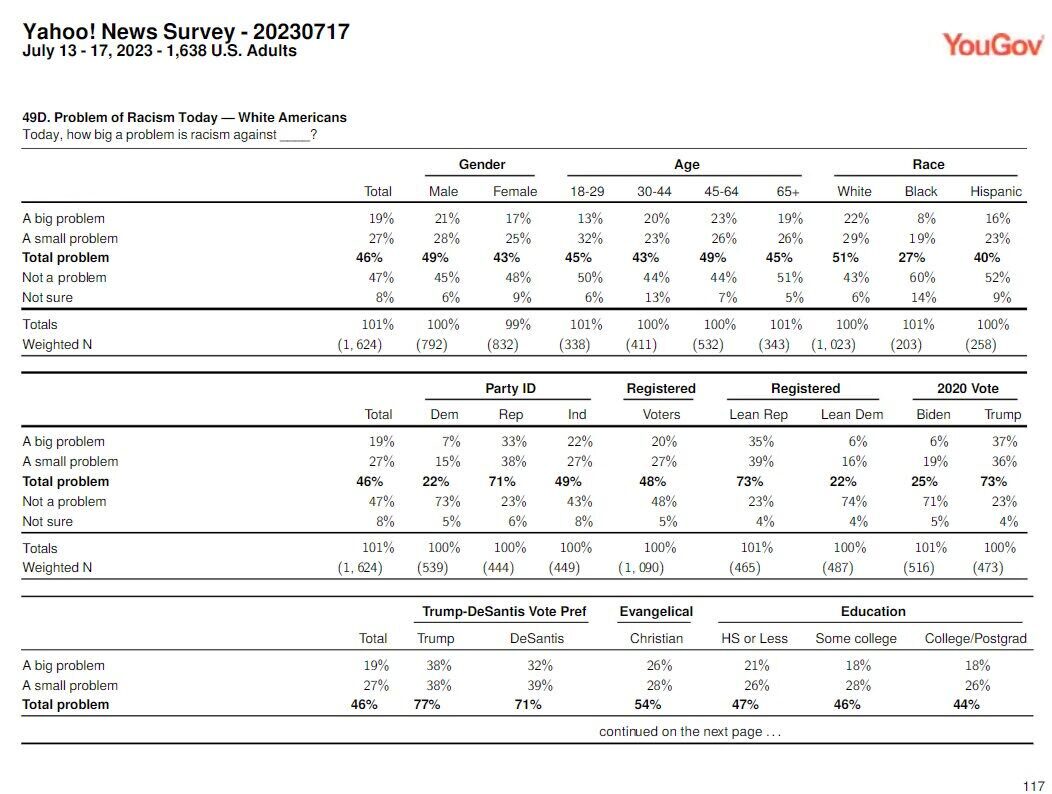
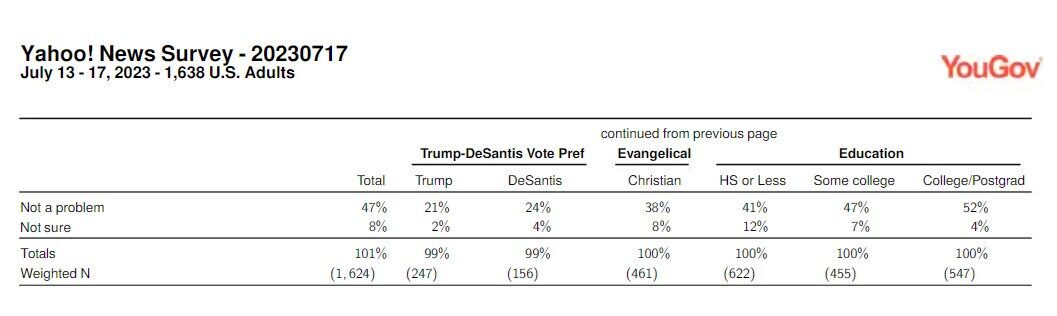
The survey of 1,638 U.S. adults, which was conducted from July 13-17, shows that among 2020 Trump voters, 62% say that racism against Black Americans is a problem today -- while 73% say that racism against white Americans is a problem.The poll found 77% of those who prefer Trump for 2024 view racism against whites as a problem. Among independents, 49% said racism against whites was a problem vs 43% who said it was not.
Asked how much of a problem racism currently is, just 19% of Trump voters describe racism against Black Americans as a "big problem." Twice as many (37%) say racism against white Americans is a big problem.
Trump voters and self-identified Republicans — overlapping but not identical cohorts -- are the only demographic groups identified by Yahoo News and YouGov who are more likely to say racism against white Americans is a problem than to say the same about racism against Black Americans. A majority (51%) of white Americans, for instance, think racism against people who look like them is a problem -- but overall, far more white Americans (72%) say racism against Black Americans is a problem.
© YouGov
© YouGov
For his part, Trump managed to stack the Supreme Court and gut affirmative action. In part as a result of that ruling, a Trump-appointed district judge in Tennessee struck down the Department of Agriculture and Small Business Administration's race-based contracting schemes favoring minority-owned businesses.





According to the Encyclopedia Brittanica
“ “Race” as a mechanism of social division
Table of Contents
North America
Racial classifications appeared in North America, and in many other parts of the world, as a form of social division predicated on what were thought to be natural differences between human groups. Analysis of the folk beliefs, social policies, and practices of North Americans about race from the 18th to the 20th century reveals the development of a unique and fundamental ideology about human differences. This ideology or “racial worldview” is a systematic, institutionalized set of beliefs and attitudes that includes the following components:
All the world’s peoples can be divided into biologically separate, discrete, and exclusive populations called races. A person can belong to only one race.
Phenotypic features, or visible physical differences, are markers or symbols of race identity and status. Because an individual may belong to a racial category and not have any or all of the associated physical features, racial scientists early in the 20th century invented an invisible internal element, “racial essence,” to explain such anomalies.
Each race has distinct qualities of temperament, morality, disposition, and intellectual ability. Consequently, in the popular imagination each race has distinct behavioral traits that are linked to its phenotype.
Races are unequal. They can, and should, be ranked on a gradient of inferiority and superiority. As the 19th-century biologist Louis Agassiz observed, since races exist, we must “settle the relative rank among [them].”
The behavioral and physical attributes of each race are inherited and innate—therefore fixed, permanent, and unalterable.
Distinct races should be segregated and allowed to develop their own institutions, communities, and lifestyles, separate from those of other races.
These are the beliefs that wax and wane but never entirely disappear from the core of the American version of race differences. From its inception, racial ideology accorded inferior social status to people of African or Native American ancestry. This ideology was institutionalized in law and social practice, and social mechanisms were developed for enforcing the status differences.”