
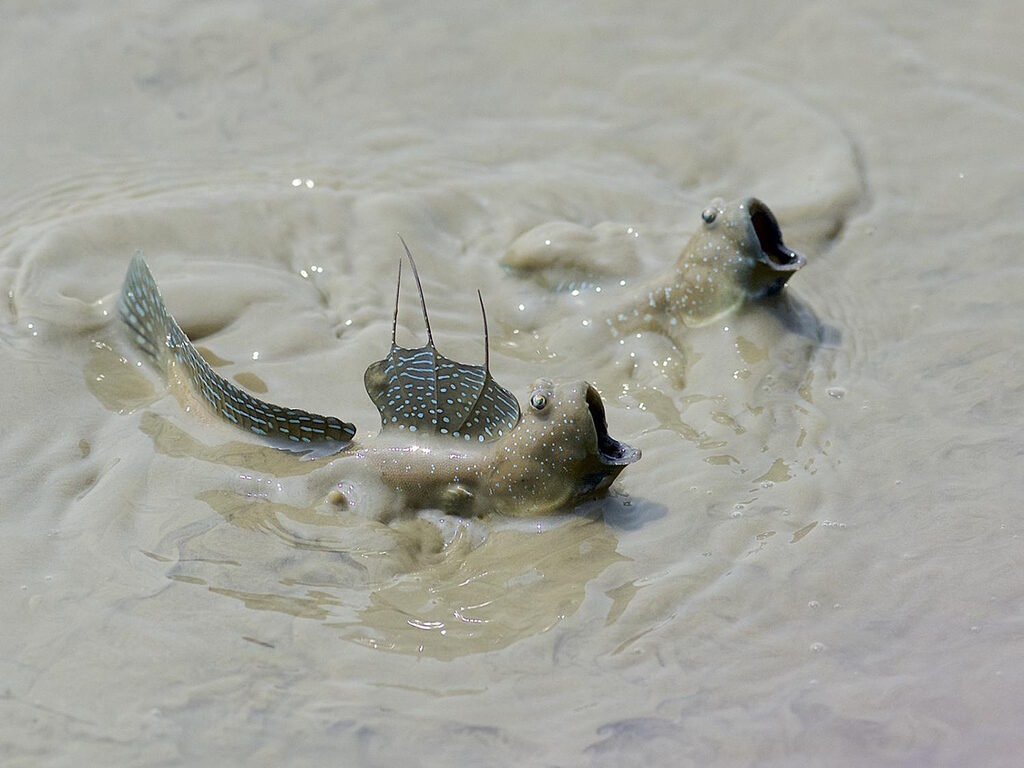
© Daniel J. FieldTwo mudskippers (Boleophthalmus caeruleomaculatus) fighting in shallow waters, taken at Mai Po Nature Reserve, Hong Kong.
The study appears the week of April 24 in the Proceedings of the National Academy of Sciences and was led by Thomas Stewart, assistant professor of biology at Penn State, and Brett Aiello, assistant professor of biology at Seton Hill University.
"Animals blink for many reasons," said Stewart. "It helps us keep our eyes wet and clean, it helps us protect our eyes from injury, and we even use blinking for communication. Studying how this behavior first evolved has been challenging because the anatomical changes that allow blinking are mostly in soft tissues, which don't preserve well in the fossil record. The mudskipper, which evolved its blinking behavior independently, gives us the opportunity to test how and why blinking might have evolved in a living fish that regularly leaves the water to spend time on land."
To understand how mudskippers evolved the ability to blink, the researchers analyzed the behavior with high-speed videos and compared the anatomy of mudskippers with that of a closely related water-bound fish that doesn't blink. The mudskipper's eyes bulge out of the top of their heads, like a frog's eyes. To blink, the fish momentarily retract the eyes down into sockets, where they are covered by a stretchy membrane called a "dermal cup." The mudskipper's blink lasts about the same length of time as a human blink.
An unusual blinking fish, the mudskipper, spends much of the day out of the water and is providing clues as to how and why blinking might have evolved during the transition to life on land in our own ancestors. New Penn State research shows that these amphibious fish have evolved a blinking behavior that serves many of the same purposes of our blinking.
"Blinking in mudskippers appears to have evolved through a rearrangement of existing muscles that changed their line of action and also by the evolution of a novel tissue, the dermal cup," said Aiello. "This is a very interesting result because it shows that a very rudimentary, or basic, system can be used to conduct a complex behavior. You don't need to evolve a lot of new stuff to evolve this new behavior — mudskippers just started using what they already had in a different way."
To uncover why mudskippers blink on land, the team considered the roles that blinking plays in humans and other tetrapods. In humans, tears are critical to keep cells in the eye healthy and oxygenated, so the researchers analyzed whether mudskippers also blink to keep their eyes wet.
"We found that, just like humans, mudskippers blink more frequently when confronted with dry eyes," said Aiello. "What's incredible is that they can use their blinks to wet the eyes, even though these fish haven't evolved any tear glands or ducts. Whereas our tears are made by glands around our eyes and on our eyelids, mudskippers seem to be mixing mucus from the skin with water from their environment to produce a tear film."
The research team also tested whether blinking in mudskippers could be triggered to protect the eye from possible injury and if blinking cleaned the fish's eyes of dust or debris. In both cases the answer was "yes." Therefore, blinking in the mudskippers seems to fulfill three of the main functions of blinking — protecting, cleaning, and maintaining moisture — in humans and other tetrapods.
"Our study, which considered the behavior and anatomy of a living fish that underwent a transition to life on land, similar to the earliest tetrapods, helps us to reimagine how and why these early tetrapods might have been blinking," said Aiello. "Having the opportunity to study how and why this behavior first evolved provides an amazing opportunity to learn more about the way humans came to be as they are and gives us insight into changes associated with major transitions in the history of animals — like inhabiting land."
Blinking is something that humans and other tetrapods are constantly doing throughout the day, often without even noticing it happens, Aiello explained. Despite being a subtle action, blinking is actually quite complex and fascinating, because it is a single behavior that can perform multiple functions, which are all critical to the health and safety of the vertebrate eye, he said.
"The transition to life on land required many anatomical changes, including changes for feeding, locomotion and breathing air," said Stewart. "Based on the fact that mudskipper blinking, which evolved completely independently from our own fishy ancestors, serves many of the same functions as blinking in our own lineage, we think that it was likely part of the suite of traits that evolved when tetrapods were adapting to live on land."
In addition to Stewart and Aiello, the research team includes M. Saad Bhamla, Jeff Gau, Kenji Bomar, Shashwati da Cunha, Harrison Fu, Julia Laws, Hajime Minoguchi, Manognya Sripathi, Kendra Washington, Gabriella Wong and Simon Sponberg at the Georgia Institute of Technology; John G.L. Morris at Westmead Hospital in Sydney, Australia; and Neil H. Shubin at the University of Chicago.



Reader Comments
Why have we never seen ANY animal or plant or mineral or human transform itself to another creature? With so many animals and species in the world, one would think that we would actually have seen this “missing link” in ANY of the animals or lifeforms... Why are we solely looking for the “missing link” between apes and humans? Why is no attention given to all the other supposed “missing links”?... In fact, there are so many missing links, it is not even a chain, but a pile of individual rings.
If evolution really is real, why then do humans have some of the worst senses among the animals?... According to the theory of evolution, one would assume that humans are the most evolved, and yet dogs have better smell, eagles and even some frogs have better sight, horses have better legs and muscles, cows have better stomachs, lions and cats have better respiration, monkeys have equal hands (albeit no the internal intellect to make use of them to the extent of humans) ... In short, ALL the individual animal species are specialised in their particular department, whilst humans just seem to be a hot-pot of all the various animal instincts, which requires us to raise our children for 15 to 20 years, in order to INTERNALLY develop these impulses and instincts... No animal in the world does that, and according to the “belief of evolution” (it is just a belief, at the end of the day, one believes in evolution, just as one believes in God, or believes there is no God, it is just a fabricated intellectual invention, with the human beast-like intellect speaking marvels and hyponotising the whole world) some how the human being DE-evolved from its superior animal faculties, to become the most mediocre animal of the lot... even rabbits beat us with their ears, bats with their sonar skills... every animal is a master of some type... and yet humans have near to no mastery, expect that of thinking, which we are now quickly losing, as well as our senses (wearing a face mask is to voluntarily lose one's senses)...
If evolution is truly true, then we should maintain the right to QUESTION the theory, to think about it and doubt it... To just blindly believe the belief of evolution, is to renounce the only supposed “evolved” quality which humans have - to think, question, inquire, study, investigate, observe... Such intelligent impulses were the original causes of the scientific movement... and such impulses are now the biggest hurdles the same know-it-all scientists who the sheeple believe without question.
May Allah/God/YHVH(whichever name you prefer for The Most High) bless you eternally, forgive all your sins, and grant you the highest level of paradise for your efforts.
Sincerely and respectfully, thank you. Probably better not to reply to me, as it brings out the minions of iblis in full force. Just know you are a real one, and actually thinking. Truly a blessing in these times. SubhanaantaAllah.
We're all in this together, as Bob Marley says “help the weak if you are strong now”... I've been down and out, and I may well need a hand to get back on my feet in the future, in the meantime and always, we can do something to help. “No one lights a candle and places under a bed”, so this forum helps me share the midnight lamp. Whatever we can learn from our own experiences and pain, it turns into the oil that feeds the flame. I used to be close to insanity and have had lengthy times of madness in my life, times where I thought I would never get back to the surface to breathe and see the light of day again, but for whatever miracle, I am currently on my feet, and inspired to share: there is no night that lasts forever, it never rains for 100 years, and for all the troubles and torments we go through, there is always the dawn of a new day... The harder the battle, the sweeter God's victory... and we are in a tremendous battle and living in very hard times... but how much will be the joy and triumph when this is all over, brother?? Let's never forget that, because the triumph is with God, He has already triumphed, and likewise we have to share that triumph before the battle has even started, we have to be triumphant before we begin the journey.
Ok, I thought I was just going to write a few words, but more came out. Thanks for expressing yourself and sharing your gratitude, everyone dies through ingratitude, and gratitude towards all things divine is what can keep us on our feet in amidst so much tribulation where our knees tremble.
“Don't tell God how big your problems are... Tell your problems how big God is.”
God bless you, fam. Truly an honour and privilege to have this interaction.
They can take our lives, but never our light.
All Glory is with God(as you already stated), and He is truly Greater than any of our problems and opinions(as you also already stated).
Salaam/Peace/Shalom
That's really just a modern thing
The evolutionists did not even manage this feat in a simulation, much less in reality.
And I suppose everybody knows how easily algorithmic (computer) simulations are tweaked - cue "climate simulation" ...
Like the eye, for example, a very complex and delicate organ. It must have taken millions of individual mutations to arrive at a properly "working level" like mammal eyes, while none of the half-baked intermediate organs were of any use to the species equipped with them.
I'm surely gonna believe that ...
Darwinists respond with "it started with primitive versions like light-sensitive cells, and improved over millions of years".
But there is no proof of that. If that was the case, one should find such "intermediate versions" in remains of animals. And there are still many species around which supposedly have not changed over millions of years. So it should be observable in living animals.
Have we heard of that ?!?