
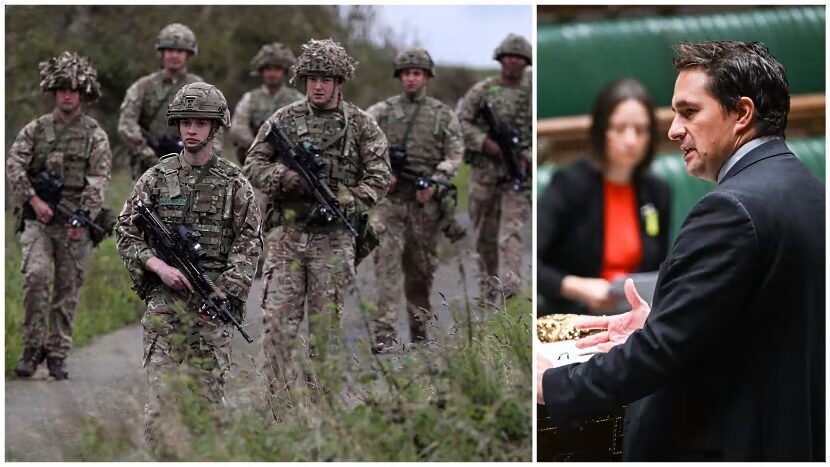
© Press Associations(L) British recruits in training (R) Veterans’ affairs minister Johnny Mercer
However, the Ministry of Defence-funded project, which looked at more than 458,000 veterans, found they generally do not have higher suicide rates than the rest of society.
Leaving service before the age of 35, leaving before a decade of service, or being untrained were all linked to a greater chance of dying by suicide.
Speaking to ITV News Mr Mercer said: "I think access to an understanding of the mental health provision that is available in this country remains the biggest challenge."
Veterans' affairs minister Johnny Mercer said the suicide rates among younger former service personnel are a 'concern'
The University of Manchester study, which is yet to be peer-reviewed, linked data from the NHS and MoD to investigate suicide risk factors for service personnel who left the forces between 1996 and 2018.
Of the 458,058 personnel, 1,086 died by suicide, a rate of 0.2%.
The researchers said this is "very slightly" lower than in the general population.
Mr Mercer added: "We will always continue to relentlessly drive this rate down because anybody who takes their own life, as I've said, is an absolute tragedy for them and their family, but again, for us as an institution in the military, we don't want anyone to end up in that position."
Contrary to perceptions, deployment on combat operations was found to be linked to a reduced risk, as was marriage and being of a higher rank.
But the suicide risk was two to four times higher in both men and women under 25 who had left the forces.
Being discharged between the ages of 16 and 34, being untrained on discharge, or leaving service involuntarily, such as for disciplinary or medical reasons, were linked to a higher risk.
Mr Mercer, a long-term campaigner against veterans' suicide, said the results are broadly what he was "expecting", adding: "Nothing changes, really, for me, because clearly rates are generally comparable, if not lower.
"This is a very difficult phenomenon. We won't stop trying until we reach a zero-suicide place, because I think that's what we owe these people."
Asked by journalists about the greater risk among younger veterans, Mr Mercer suggested it is linked to the "challenges or the childhood experiences" of recruits."
Speaking to ITV News he said: "I don't wanna sort of just say that and stand back and say we've done it. I want people to actually feel that. And I want veterans to feel like this is the best country in the world to be a veteran."
Researcher Nav Kapur said he cannot be "definitive" as to the reason behind the higher risks for younger veterans but that the "short lengths of service and the fact that deployment is protective suggests that it possibly isn't in service exposures".
"Pre-service vulnerabilities will of course be important, as will the offer when veterans leave service," he said, adding that the rate has not changed since the last study in 2008.
The research also suggested there is a lower suicide risk for those serving in the Royal Navy and the RAF compared with the Army, which Professor Kapur said supports previous studies.





Concern to whom ? A corrupt, deceitful, evil, terrorist, dying system of government management (that already held Brexit votes several times & yet refuses to acknowledge the will of it’s people) could careless who it sacrifices per it’s cremation of care dogma. America’s suicide rate is even higher & yet concern has produced what result to curtain that despicable metric ?
Lip service to zombies who are oblivious to anything & everything outside of Plato’s Cave.