
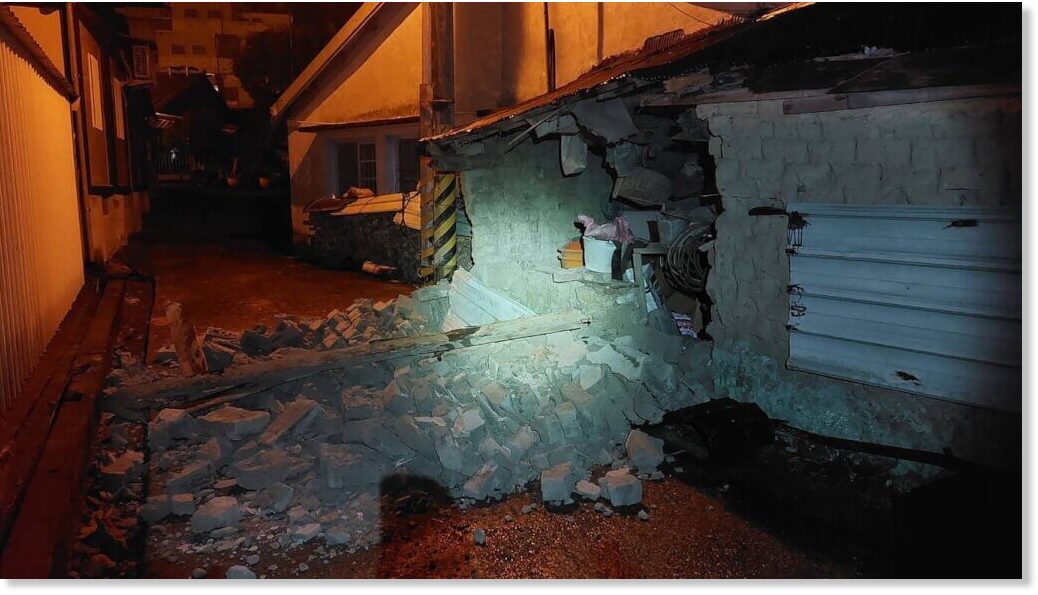
The side wall of an uninhabited 70-year-old home in Hualien's Fuli Township collapsed due to the earthquake Saturday evening.
There were reports of objects falling from store shelves in Taitung, Kaohsiung's metro system was temporarily suspended and there were at least five aftershocks.
The epicenter of the temblor was located about 35.8 kilometers north of Taitung County Hall, at a depth of 7.3 km, the bureau's Seismology Center said.
The earthquake's intensity, which gauges the actual effect of a quake, reached a 6 on Taiwan's 7-tier intensity scale in Taitung's Chishang Township, indicating intense shaking of buildings and movements of unsecured objects indoors.
An intensity of 5 was recorded in Hualien's Fuli Township, Taitung City and Kaohsiung's Nanzih District, while an intensity of 4 was recorded in parts of Kaohsiung, Tainan and Chiayi cities and Pingtung, Chiayi, Yunlin and Hualien counties
Coastal areas in eastern Taiwan experienced intensity levels of 3 to 4, the bureau said.
The quake was also felt in New Taipei with a recorded intensity of 3, and in Taipei with an intensity of 2.

© CNA



Reader Comments
And yes the CCP does indeed possess tectonic weaponry:
"China and Russia have modified an important layer of the atmosphere above Europe to test a controversial technology for possible military application, according to Chinese scientists involved in the project.A total of five experiments were carried out in June. One, on June 7, caused physical disturbance over an area as large as 126,000 sq km (49,000 square miles), or about half the size of Britain.The modified zone, looming more than 500km (310 miles) high over Vasilsursk, a small Russian town in eastern Europe, experienced an electric spike with 10 times more negatively charged subatomic particles than surrounding regions.In another experiment on June 12, the temperature of thin, ionised gas in high altitude increased more than 100 degrees Celsius (212 degrees Fahrenheit) because of the particle flux.The particles, or electrons, were pumped into the sky by Sura, an atmospheric heating facility in Vasilsursk built by the former Soviet Union’s military during the cold war.The Sura base fired up an array of high-power antennas and injected a large amount of microwaves into the high atmosphere. The peak power of the high frequency radio waves could reach 260 megawatts, enough to light up a small city.Zhangheng-1, a Chinese electromagnetic surveillance satellite, collected the data from orbit with cutting-edge sensors. The pumping and fly-by required precise coordination to achieve effective measurement.When Zhangheng approached the target zone, for instance, the sensors would switch to burst mode to analyse samples every half a second, much faster than usual, to increase data resolution…..The High Frequency Active Auroral Research Program, or HAARP, was established in Gakona, Alaska, in the 1990s with funding from the US military and the Defence Advanced Research Projects Agency.The HAARP facility could generate a maximum 1 gigawatt of power, nearly four times that of Sura.China is now building an even larger and more advanced facility in Sanya, Hainan, with capability to manipulate the ionosphere over the entire South China Sea, according to an earlier report by the South China Morning Post.There have been concerns that such facilities could be used to modify weather and even create natural disasters including hurricanes, cyclones and earthquakes…...The Sura facility has also conducted joint research with France and the United States, according to papers published in academic journals.The National Centre for Space Studies, a French government agency under the supervision of the ministries of defence and research, has deployed the micro satellite DEMETER to monitor Sura’s radio emissions.The Defence Meteorological Satellite Programme run by the US Department of Defence has also contributed fly-by data in several heating experiments conducted at the Russian site before 2012…South China Morning Post via NZ Herald 2018