RTThu, 10 Mar 2022 15:00 UTC
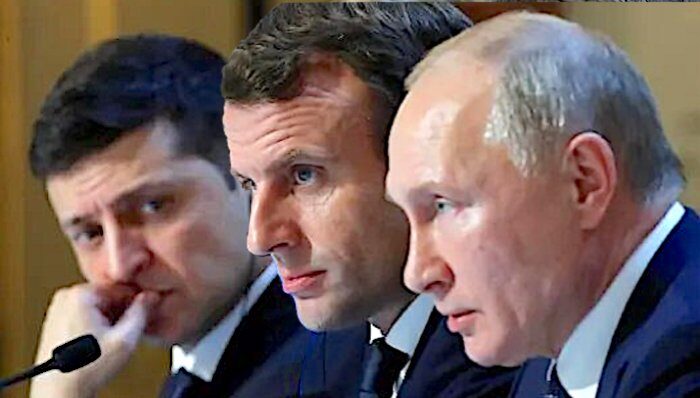
© Charles Platiau/AFP/Getty Images/KJNUkranian President Volodymyr Zelensky • French President Emmanuel Macron
Russian President Vladimir Putin
Talks between the Russian and Ukrainian leaders shouldn't be "a meeting for the sake of meeting," Russian FM Sergey Lavrov has said
There may be a need for direct talks between Vladimir Putin and Ukrainian leader Volodymyr Zelensky, and the Russian president is ready to take part in such negotiations, but it would require some preparation, Russia's foreign minister, Sergey Lavrov, has said.
"We've confirmed today that President Putin isn't rejecting the idea of a meeting with President Zelensky," Lavrov said after "difficult" talks with Ukrainian FM Dmytro Kuleba in Turkey's Antalya on Thursday.
He said he reminded his Ukrainian counterpart that
Putin and Russia are "always ready to meet if we can achieve some added value and solve the problem."
"Moscow sees no use in meeting simply for the sake of meeting. Possibly at some point, such necessity will hopefully arise. But for this to happen preparatory work must be done along the Belarusian track.
"Our very specific proposals were heard out by the Ukrainian side, and they promised that there would be very specific answers. We're waiting."
The delegations from Moscow and Kiev have already held three rounds of talks in Minsk since the start of the conflict on February 24. However, they haven't delivered any significant results yet.
Moscow attacked its neighbor in late February, following a seven-year standoff over Ukraine's failure to implement the terms of the Minsk agreements, and Russia's eventual recognition of the Donbass republics in Donetsk and Lugansk. The German- and French-brokered protocols had been designed to regularize the status of those regions within the Ukrainian state.
Russia has now demanded that Ukraine officially declare itself a neutral country that will never join the US-led NATO military bloc. Kiev insists the Russian offensive was completely unprovoked and has denied claims it was planning to retake the two republics by force.
Comment: Talks: A little bit of 'give' and not a bit of 'take':
Ukrainian Foreign Minister Dmytro Kuleba says a meeting with his Russian counterpart, Sergei Lavrov, the first high-level talks between the two countries since Moscow launch an unprovoked invasion of its neighbor last month, failed to make progress on a cease-fire.
Kuleba said after the meeting in the Turkish resort city of Antalya on March 10, 15 days into the war, that Lavrov did not commit to ensuring a humanitarian corridor in the besieged city of Mariupol.
He added that Ukraine was ready to continue to engage with Russia on finding a path to stop the war.
For his part, Lavrov said Russia was also willing to continue talks, noting that there had been some progress in three rounds of discussions between Kyiv and Moscow at the border with Belarus.
Lavrov said Moscow has presented Ukraine with its proposals on how to end the conflict and expects a reply.
Kuleba characterized Russia's demands as nothing short of a full surrender.
When in stalemate, enlist
a new negotiator:
Gerhard Schroeder, who served as German chancellor from 1998 until 2005, has arrived in Moscow and is expected to meet with Russian President Vladimir Putin, Politico claimed on Thursday, citing unnamed sources familiar with the matter.
If the report is anything to go by, the German politician is going to try to negotiate an end to the war in Ukraine. Schroeder's visit, if confirmed, would come off the back of a meeting between the Russian and Ukrainian foreign ministers in Antalya on Thursday.
Meanwhile, a criminal complaint has been filed in Germany against the former chancellor in connection with possible "crimes against humanity," Badische Neueste Nachrichten newspaper reported on Tuesday.
Kathrin Soefker, a spokesperson for Hanover's prosecutor's office, told journalists that the criminal complaint against the former chancellor and several other individuals had come in last week. The official also said that Hanover prosecutors "forwarded the files to the Federal Public Prosecutor" on Monday.
Among the cases the German authority is currently looking into are possible war crimes allegedly committed in Ukraine. German Justice Minister Marco Buschmann earlier confirmed to the media that prosecutors were going to "collect and secure all evidence of war crimes." The official also described Russia's military offensive in the Eastern European country as a "serious violation of international law that cannot be justified by anything."
Responding to journalists' requests for comment on the Schroeder case, a representative for Germany's Federal Public Prosecutor said she could not disclose any details. The Federal Public Prosecutor "does not, as a matter of course, reveal if it is or was looking into a case."
Since the start of Russia's military offensive against Ukraine on February 24, Schroeder has been under growing pressure over his refusal to step down from his posts at several major Russian energy companies. The politician serves as the chair of Nord Stream 2 AG's administrative board, as well as the chief of the supervisory board at Russia's Rosneft oil company. Moreover, in early February, the former German chancellor was nominated to join the supervisory board at Russia's Gazprom - a major supplier of natural gas to Europe.
Schroeder has never made a secret of his friendship with President Vladimir Putin.
While the ex-chancellor denounced the Russian military offensive in Ukraine, and called for an end to the war, he also noted that NATO, too, had made mistakes in the way it had treated Russia.
Schroeder's closeness to the Russian leadership and businesses saw his entire staff of four walk out on him last week, with some in Germany calling for the politician to be stripped of the benefits and pension he enjoys as an ex-chancellor.




Comment: Talks: A little bit of 'give' and not a bit of 'take': When in stalemate, enlist a new negotiator: