
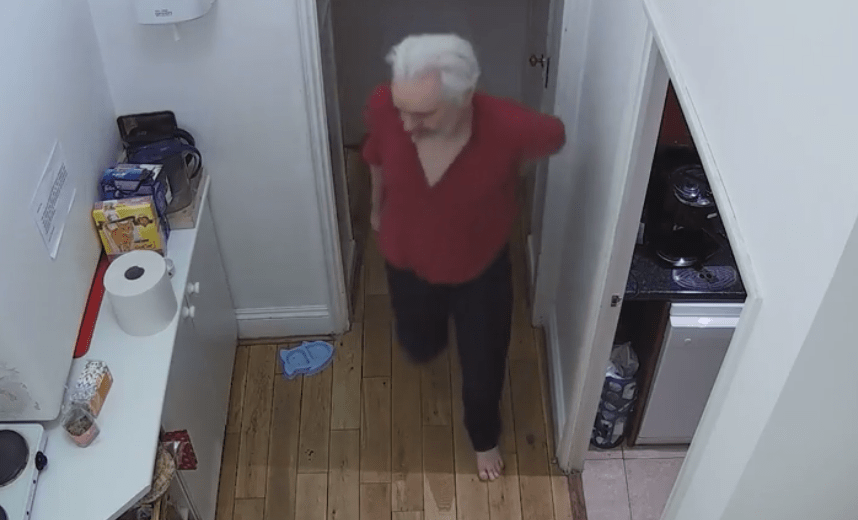
'Operation Hotel': Surveillance captured by Spanish security firm UC Global shows Julian Assange walking in the Ecuadorean embassy in London.
Vast details of the U.S.-backed surveillance operation had already been made public after whistleblowers from the Spanish security firm UC Global had approached Assange's lawyers and charges were henceforth brought in the Spanish High Court, however, previously unreported information on the extent of the operation has now been brought forward.
The two whistleblowers - who have been anonymised to protect them out of fear of repercussions - both joined the Spanish contractor in 2015 when it had been a "meagre" start-up launched by David Morales, watching as the firm became embroiled in one of the most high-profile assaults on a political prisoner in recent history.
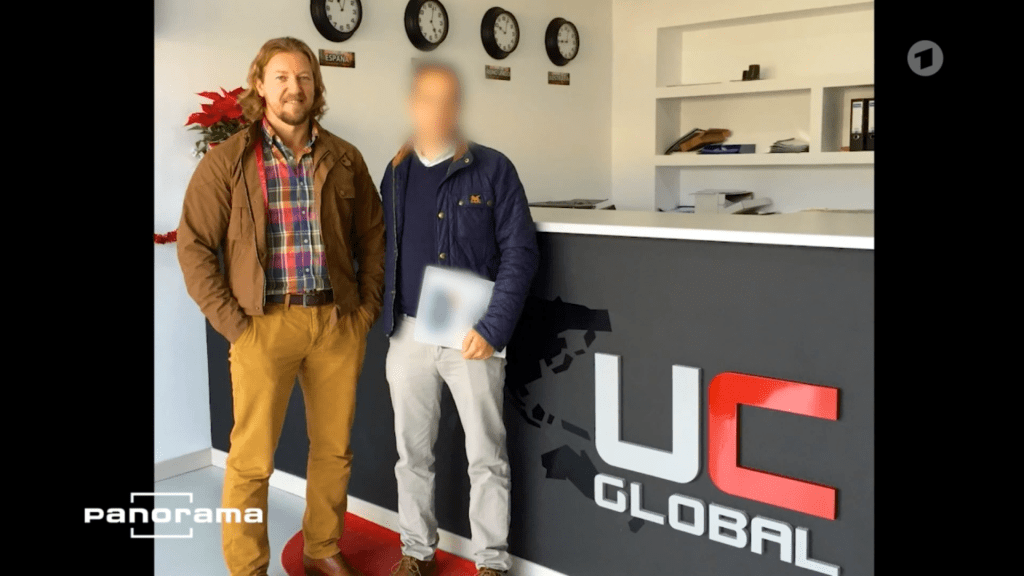
© Panorama/Screen captureDavid Morales, director and owner of Spanish security contractor UC Global, pictured at one of the company's offices with a colleague.
Witness 2, an IT expert with the security firm, detailed how Morales had tasked him with replacing the CCTV cameras in the Knightsbridge-located embassy in May of 2017, instructing him to source cameras that allowed for clandestine audio-recording capabilities.
His statement, which was produced at the Old Bailey in the fourth and final week of Assange's U.S. extradition proceedings, reads:
"In early December 2017, I was instructed by David Morales to travel with a colleague to install the new security cameras. I carried out the new installation over the course of several days.
"I was instructed by Morales not to share information about the specifications of the recording system, and if asked to deny that the cameras were recording audio. I was told that it was imperative that these instructions be carried out as they came, supposedly, from the highest spheres.
"In fact, I was asked on several occasions by Mr. Assange and the Political Counsellor Maria Eugenia whether the new cameras recorded sound, to which I replied that they did not, as my boss had instructed me to do. Thus, from that moment on the cameras began to record sound regularly, so every meeting that the asylee held was captured. At our offices in UC Global it was mentioned that the cameras had been paid for twice, by Ecuador and the United States, although I have no documentary evidence to corroborate this assertion."
Witness 2 also detailed how Morales had asked for him to arrange for the cameras to contemporaneously transmit the recordings so that UC Global's "American friends" could have instant access. The whistleblower invented a number of excuses however, stating: "I did this because I did not want to collaborate in an illegal act of this magnitude."
Instead, the UC Global employee was instructed to travel to London every 15 days in order to collect the hard-drives, passing them to Morales who travelled to the U.S. just as frequently - often with his wife - in order to pass the recordings to contacts within the CIA.
Morales was rumoured among staff to have been paid €200,000 EUR a month for carrying out the eavesdropping - colleagues noted how his spending had become lavish and noticeable, buying himself a new house and a number of flashy sports cars during the span of two years.
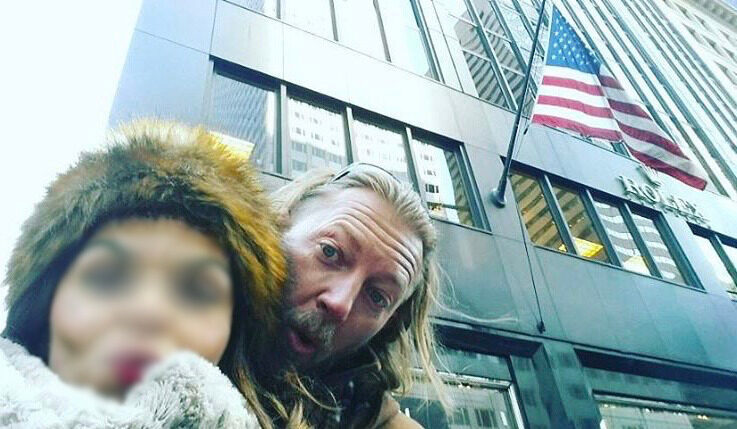
David Morales, the director and founder of UC Global, pictured with his wife (anonymised) on 5th Avenue, New York City on December 15, 2016.
Back in London however, the surveillance had intensified. Morales instructed staff to hide microphones in the plastic bases of all fire extinguishers - the reason being that one was located in every room of the embassy.
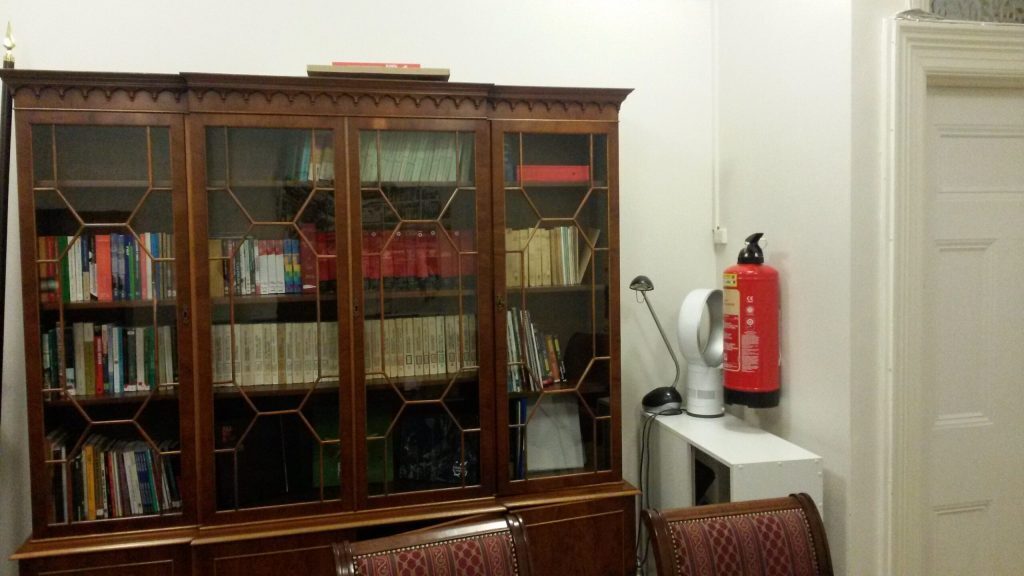
UC Global bugged fire extinguishers in the Ecuadorean embassy in order to spy on Julian Assange and his legal team.
That was in addition to the airport-like screening equipment that was put in place, where every visitor into the Ecuadorean embassy had a photo of their passport taken, their belongings taken off them and sophisticated devices swiped data contained on their digital devices - all forwarded to a secure server somewhere in the United States.
Surveillance-savvy Assange quickly cottoned-on to the eavesdropping, prompting him to use a radio that blared white noise during important conversations. Certain meetings were conducted in the confines of the women's bathroom.
This led to a cat-and-mouse game of increasing counter-measures. Not only were microphones then installed in the porcelain of the stall, but intelligence agents outside the embassy deployed laser-technology microphones that intercepted conversations through the windows. Witness 2 was tasked with another job relating to this.
The job was detailed in length in his testimony that was read to the court:
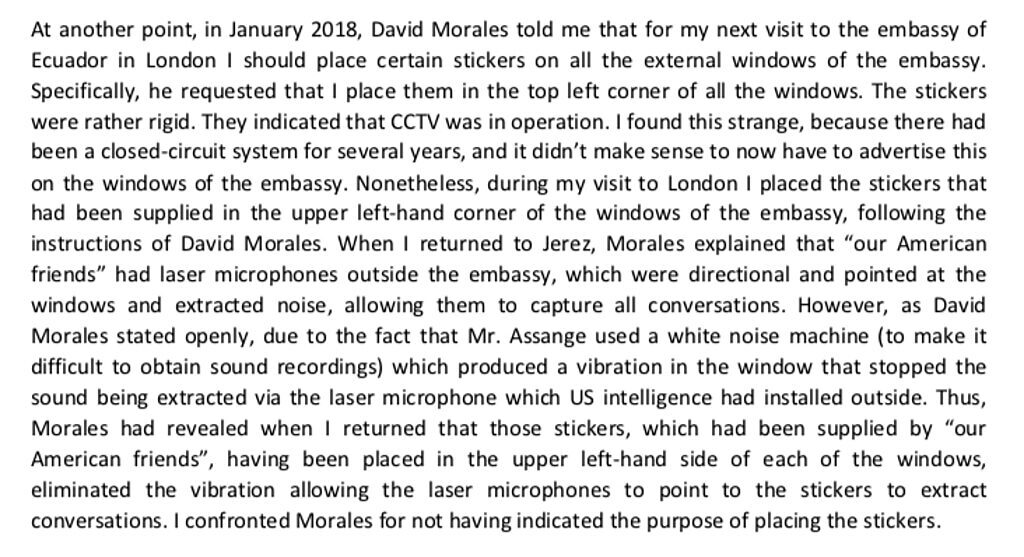
An extract of Witness 2's statement that was provided as evidence in Julian Assange's U.S. extradition hearings on September 30, 2020.
The case continues.
Read the whistleblowers' full written statements here (scroll to bottom of page).
Tareq Haddad is a London-based writer and investigative journalist. He is the founder and editor of The Watchdog - an emerging media platform focused on geo-politics, civil liberties and International Humanitarian Law. Follow him on Twitter: @Tareq_Haddad



A surprise would be if 'they' had let him be . . . that though would have so out of character for them that we'd've thought they were losing their edge.