
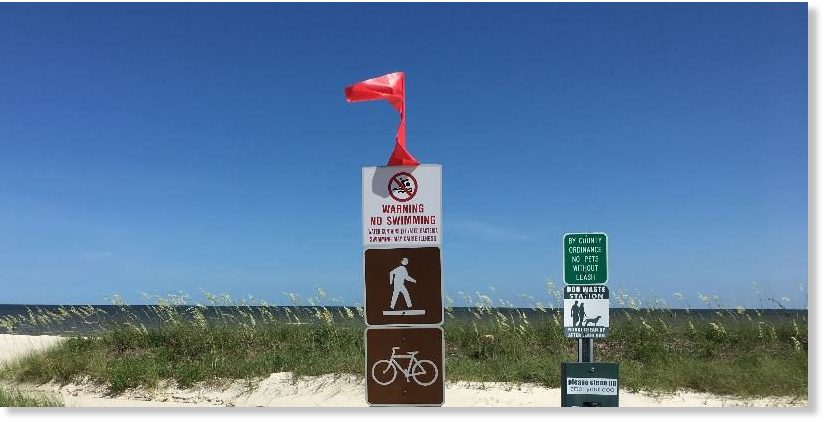
© WLOX/Gray NewsBeach signs and flags in Hancock County, Miss., warn residents and visitors which areas of the beach are off limits to swimming and fishing.
The dangerous condition is called a Harmful Algal Bloom, or HAB, which is when algae grows quickly on the surface of the water.
According to the Centers for Disease Control and Prevention, an algal bloom can look like foam, scum, or mats on the surface of water and can be different colors. The blooms can produce toxins that have caused a variety of illnesses in people and animals.
The overgrown of harmful algae can occur in warm fresh, marine, or brackish waters with abundant nutrients and are becoming more frequent with climate change.
A water contact advisory from the Mississippi Department of Environmental Quality remains in effect for a segment of the Jourdan River in Hancock County from the I-10 bridge to the mouth of the river into St. Louis Bay. The toxic algae has also been found in samplings taken at the Pass Christian Harbor, the Bay St. Louis Harbor, and the Long Beach Harbor.
The sand portions of the beaches remain open. But if you swim in the water or eat fish caught from the near shore waters, it could make you sick.
Beaches affected include:
Station 1 - Lakeshore Beach
Station 2 - Buccaneer State Park Beach
Station 3 - Waveland Beach
Station 4 - Bay St. Louis Beach
Station 5 - Pass Christian West Beach
Station 6 - Pass Christian Central Beach
Station 7 - Pass Christian East Beach
Station 7A - Long Beach Beach
Station 8 - Gulfport West Beach
Station 9 - Gulfport Harbor Beach
Station 10 - Gulfport Central Beach
Station 10B - East Courthouse Road Beach
Station 11 - Gulfport East Beach
Station 11A - Edgewater Beach (Biloxi)
Station 12A - Biloxi West Central Beach (Biloxi)
Station 12B - Biloxi East Central Beach
Station 13A - Gulfport Harbor Beach
Station 14 - Front Beach (Ocean Springs)
Station 15 - Shearwater Beach (East Beach-Ocean Springs)
Station 19 -- Pascagoula Beach West
Station 20 -- Pascagoula Beach East



Reader Comments