
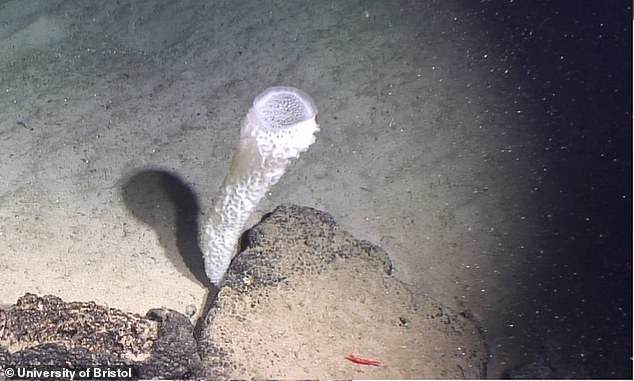
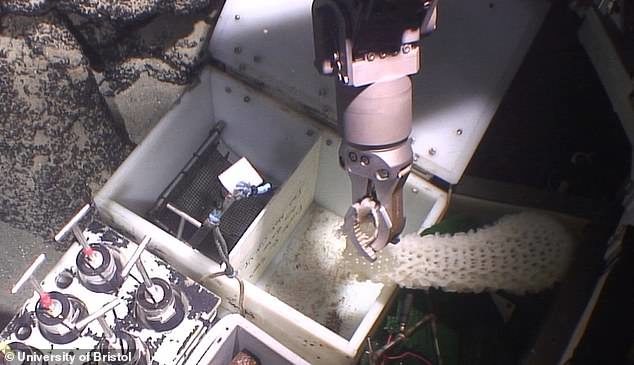
Experts from the University of Bristol took sponges from five mid-Atlantic locations and froze them in liquid nitrogen. Pictured is the team collecting one of the sponges
Experts found the molecule after placing bacteria from the sponge on petri dishes coated with bacteria from the human intestine, as well as antibiotic-resistant MRSA.
The bacteria around it died, suggesting the presence of an antibiotic that bacteria found in humans do not have a defence against.
Cases of antibiotic-resistant infections in the UK have risen continuously over the last three years.
The researchers who uncovered it said it could 'herald a new golden age of antibiotic discovery'.
However, they also cautioned that it may not be available to doctors for another decade.
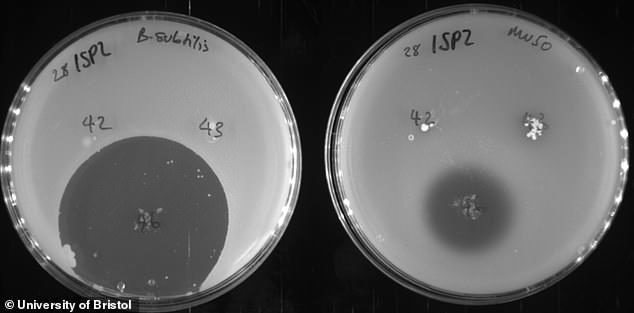
© University of BristolExperiments revealed that one bacteria, known as bacteria 46, could kill MRSA. It was then grown in the lab, producing a bright red colour
Experiments revealed that one bacteria, known as bacteria 46, could kill MRSA. It was then grown in the lab, producing a bright red colour.
It is now in preclinical trials to test the possible antibiotic's toxicity to human cells and how it works during infections.
'You do not want to give a patient a molecule that will fix their infection but cause other issues such as liver damage,' lead research Dr Paul Race told MailOnline.
'Also, it's no good if your molecule works great on a petri dish but is broken down by the human body and doesn't hang around long enough to be of any use.
'Finally, if your molecule makes it through you then need to undertake a cost analysis to see if it's actually financially viable to make and sell the drug.'
Sponges evolved before the dinosaurs around 570 million years ago.
They feed by pushing sea water through their bodies and taking out nutrients.
The new antibiotic is now in preclinical trials to test its toxicity to human cells and how it works during infections

Pictured is a map of the route taken by the team, with the five locations they collected sponges from highlighted by stars
Methicillin-resistant Staphylococcus aureus (MRSA) is a type of bacteria that is resistant to several widely-used antibiotics, which makes it particularly hard to treat.
Approximately 30 per cent of people carry the Staphylococcus aureus bacteria even in their nose, armpits, groin or buttocks without realising it.
This can invade the body's bloodstream and release poisonous toxins that kill up to one-fifth of infected patients.
MRSA is most commonly associated with hospitals.
The World Health Organisation identified E. coli and bacteria causing pneumonia and sepsis as being most likely to become antibiotic resistant in the future, in a report published earlier this year.
WHAT IS MRSA?
Methicillin-resistant Staphylococcus aureus (MRSA) is a type of bacteria that is resistant to several widely-used antibiotics, which makes it particularly hard to treat.
Catching the infection early could prevent it spreading and infecting others.
Approximately 30 per cent of people carry the Staphylococcus aureus bacteria even in their nose, armpits, groin or buttocks without realising it.
This can invade the body's bloodstream and release poisonous toxins that kill up to one-fifth of infected patients.
MRSA is most commonly associated with hospitals.
As well as being highly drug resistant, current screening methods are fairly inaccurate, which allows the infection to spread as a patient moves around both within and outside hospitals.
Even when the infection is successfully treated, it doubles the average length of a patient's hospital stay, as well as increasing healthcare costs.
The WHO recently classified MRSA as high priority on its list for the Research and Development of new drugs.




Comment: It seems that alongside the alarming rise in virulent infections, are the recurring discoveries in the natural world that hold the possible cure. However this would not be necessary if health guidelines and medicine were holistic and hadn't suffered decades of corruption by ideology and finance:
- Common weed found to disarm MRSA superbug
- Los Angeles sees outbreak of flea-borne typhus among homeless
- MRSA Deaths in the US Exceed AIDS Deaths: Circumcision is a Culprit
- Study finds: Hundreds of bacteria found in the gut can generate electricity
- Russian scientists isolate bacteria which neutralizes nuclear waste
- What mysterious stratospheric biology tells us about the possibility of life on other worlds
Also check out: The Health & Wellness Show: What have we done? Antibiotic resistance in the age of superbugs