
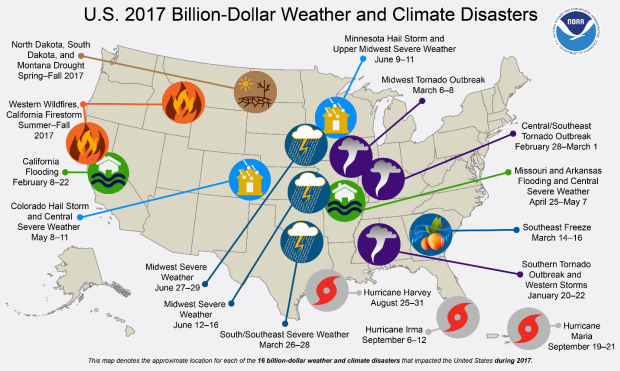
This map depicts the general location of the sixteen weather and climate disasters assessed to cause at least one billion dollars in direct damages during 2017.
During 2017, the U.S. experienced a historic year of weather and climate disasters. In total, the U.S. was impacted by 16 separate billion-dollar disaster events including: three tropical cyclones, eight severe storms, two inland floods, a crop freeze, drought and wildfire.
2017 ties 2011 for the highest number of billion-dollar disasters for a single year. 2017 arguably has more events than 2011 given that our analysis traditionally counts all U.S. billion-dollar wildfires, as regional-scale, seasonal events, not as multiple isolated events. In 2017, the U.S. experienced several wildfire episodes that each exceeded $1 billion in losses in central and southern California (i.e., the Tubbs, Atlas and Thomas Fires). The only other year - again, since 1980 - in which the U.S. experienced multiple, separate billion-dollar wildfires was 2003: the Cedar and Old Fires, also in California.
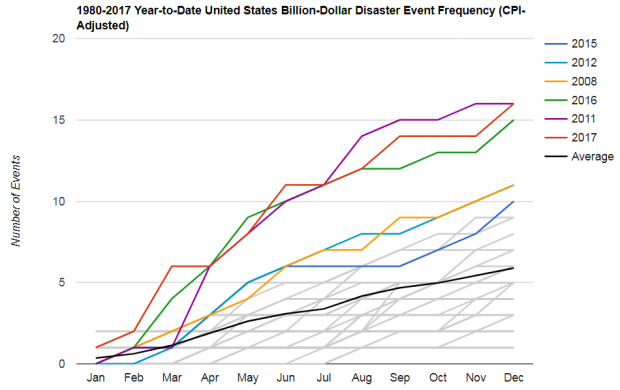
This graphic, sometimes called a "Haywood Plot" shows the month-by-month accumulation of billion dollar disasters for each year on record. The value for a given year for a given month shows the total number of billion-dollar events that had occurred by that month. Note that there is considerable overlap, and some years' traces are obscured.
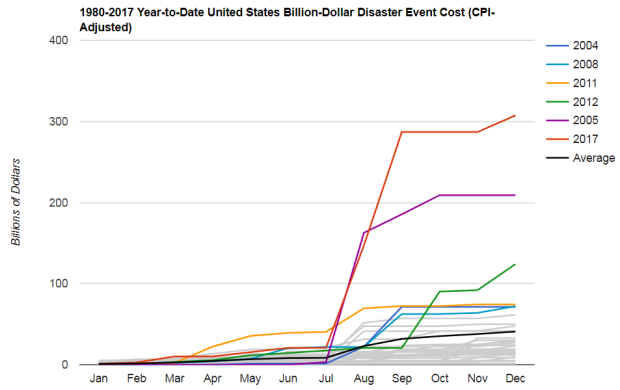
This graphic depicts the accumulation in the estimated cost of billion dollar weather and climate disasters on a monthly basis, for each year since 1980.
The following U.S. billion-dollar disaster events left an indelible impact among the disasters to affect to U.S. in 2017.
Hurricane Harvey:
In late-August, Hurricane Harvey caused unprecedented amounts of rainfall (up to 60 inches) over Houston one of America's largest cities. Harvey is the closest modern disaster comparison we have in relation to Katrina in terms of damage costs. Harvey's costs exceed $125 billion, only second to Hurricane Katrina's level of damage. Harvey was a category 4 hurricane making landfall near Rockport, Texas and causing widespread damage.
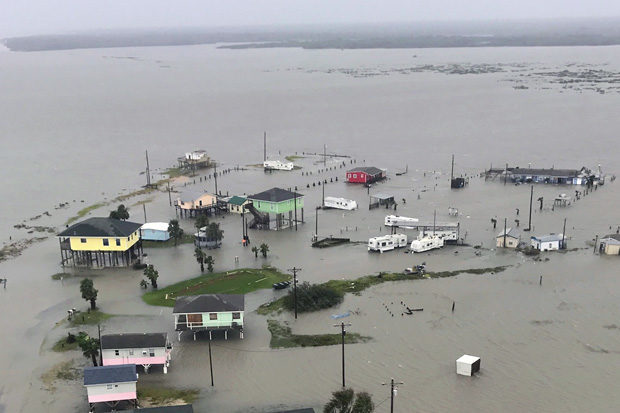
A flooded neighborhood on the Texas coast on August 27, 2017, during Hurricane Harvey. Aerial photo by the Texas National Guard during aerial search and rescue mission in the Rockport, Holiday Beach, and Port Aransas area.
Hurricane Irma:
In early September, Hurricane Irma devastated the Florida Keys with its high winds and storm surge, after flattening the U.S. Virgin Islands - St John and St Thomas - among other Caribbean islands. Irma was another category 4 hurricane when it made landfall at Cudjoe Key, Florida after devastating the U.S. Virgin Islands - St John and St Thomas - as a category 5 storm. The Florida Keys were heavily impacted, as 25% of buildings were destroyed while 65% were significantly damaged. Severe wind and storm surge damage also occurred along the coasts of Florida and South Carolina. Jacksonville, FL and Charleston, SC received near-historic levels of storm surge causing significant coastal flooding. Irma maintained a maximum sustained wind of 185 mph for 37 hours, the longest in the satellite era. Irma also was a category 5 storm for longer than all other Atlantic hurricanes except Ivan in 2004. The costs for Irma are approximately $50 billion, which excludes additional severe damage to non-US territories.
Hurricane Maria:
In mid-September, Hurricane Maria barreled through the southern Caribbean on a path toward Puerto Rico. Maria was comparable to Irma in its maximum wind damage, but also similar to Harvey in the feet of rain it dumped across Puerto Rico. Maria made landfall in southeastern Puerto Rico as a category 4 hurricane, after striking the U.S. Virgin Island of St. Croix. Maria's extreme winds caused widespread devastation to Puerto Rico's transportation, agriculture, communication and energy infrastructure. This damage was made more severe by the tremendous rainfall up to 37 inches, which caused widespread flooding and mudslides across the island. The interruption to commerce and standard living conditions will be the case for years, as much of Puerto Rico's infrastructure has to be entirely rebuilt. Maria tied Hurricane Wilma (2005) for the most rapid intensification, strengthening from tropical depression to a category 5 storm in 54 hours. Maria's landfall at Category 4 strength gives the U.S. a record three Category 4+ landfalls this year (Maria, Harvey, and Irma). The costs for Maria are approximately $90 billion.
Western Wildfires, California Firestorm:
In addition to the historic hurricanes, the U.S. had an extraordinarily damaging wildfire season burning more than 9.8 million acres. The cumulative costs approach $18 billion, which triples the previous U.S. annual wildfire season cost record of $6 billion (CPI-adjusted) that occurred in 1991. The historic U.S. wildfire season of 2017 began as numerous wildfires burned across many western and northwestern states. Montana in particular was affected by wildfires that burned in excess of 1 million acres. These wildfire conditions were enhanced by the preceding drought conditions. However, the height of the wildfire season occurred in October, as a historic firestorm damaged or destroyed over 15,000 homes, businesses and other structures across central California and caused 44 deaths.
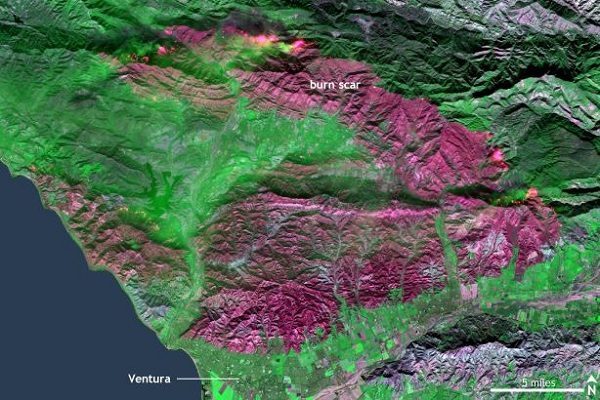
The Thomas fire was one of several California blazes that could have qualified as a billion-dollar disaster on its own. This infrared-enhanced satellite image shows the large burn scar (rapsberry color) north of Los Angeles. Ongoing fires can be seen along the edge of the burn scar in the northern part of the figure. Image taken by the European Space Agencies (ESA) satellite, Sentinel 2 on December 8, 2017. NOAA Climate.gov image based on data from the ESA.
Looking at the bigger picture
The years 2017 and 2016 each had a historically high number of billion-dollar disasters that impacted the U.S. (16 and 15 events, respectively). However, in 2017, the U.S. experienced a rare combination of high disaster frequency, disaster cost and diversity of weather and climate extreme events, as billion-dollar disasters occurred in 6 of the 7 disaster event categories we analyze. A winter storm with billion-dollar impacts was the only missing event type during 2017.
Another similarity between 2017 and 2016 is the continuation of billion-dollar (non-tropical) inland flood events. During 2017, the U.S. experienced two billion-dollar inland flood events (i.e., California and Midwest regional flooding). In 2016, the U.S. experienced 4 billion-dollar inland flood events during 2016, doubling the previous annual record since our records began in 1980. The last two years continue the trend of multiple, billion-dollar inland flood event impacts, as have observed more frequently in the U.S. over the last decade. 2016 and 2017 also each had U.S. hurricane impacts exceeding $10 billion, as a reminder that hurricanes are historically the most damaging and costly weather events to affect the United States.
Distribution of costs and fatalities by disaster type
The distribution of damage from U.S. Billion-dollar disaster events from 1980 to 2017 (as of January 8, 2018) is dominated by tropical cyclone losses. Tropical cyclones have caused the most damage ($850.5 billion, CPI-adjusted) and also have the highest average event cost ($22.4 billion per event, CPI-adjusted). Hurricanes are responsible for slightly more than half (55.3%) of the total losses for all the U.S. billion-dollar disasters but represent less than one-fifth (17.4%) of all the billion-dollar events we have assessed since 1980. This total now includes the initial cost estimates for Hurricanes Harvey, Irma and Maria, which are continually being assessed and will be updated during our 4th quarter release. Drought ($236.6 billion, CPI-adjusted), severe storms ($206.1 billion, CPI-adjusted) and inland flooding ($119.9 billion, CPI-adjusted) have also caused considerable damage based on the list of billion-dollar events. Severe storms have caused the highest number of billion-dollar disaster events (91), while the average event cost is the lowest ($2.3 billion, CPI-adjusted). Tropical cyclones and flooding represent the second and third most frequent event types (38 and 28), respectively. Tropical cyclones are responsible for the highest number of deaths (3,461), followed by drought/heatwave events (2,993) and severe storms (1,578).
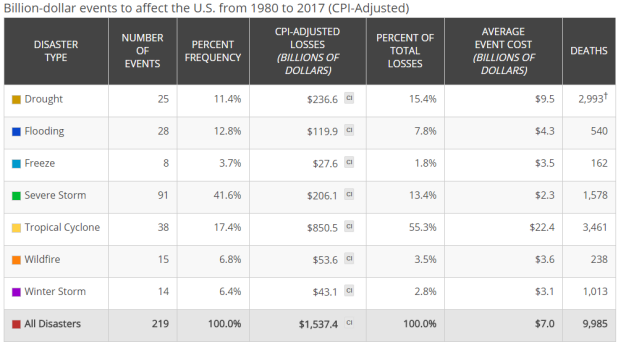
This table depicts the breakdown, by hazard type, of the 219 billion dollar weather and climate disasters assessed since 1980.
The U.S. has experienced a rising number of events that cause significant amounts of damage. From 1980-2016, the annual average number of billion-dollar events is 5.8 (CPI-adjusted). For the most recent 5 years (2013-2017), the annual average is 11.6 events (CPI-adjusted). 2017 ties 2011 for the highest number of billion-dollar disasters (16 events). The increase in population and material wealth over the last several decades are an important factor for the increased damage potential. These trends are further complicated by the fact that many population centers and infrastructure exist in vulnerable areas like coasts and river floodplains, while building codes are often insufficient in reducing damage from extreme events.
Climate change is also paying an increasing role in the increasing frequency of some types of extreme weather that lead to billion-dollar disasters. Most notably the rise in vulnerability to drought, lengthening wildfire seasons and the potential for extremely heavy rainfall and inland flooding events are most acutely related to the influence of climate change (NCA 2014).
The geography of billion-dollar disaster events by type
The U.S. is weather and climate conscious for good reason, as each geographic region faces a unique combination of persistent hazards. The maps below reflect the frequency with which each state has been part of a billion-dollar disaster event (i.e., the totals do not mean that each state alone suffered $1 billion in losses for each event).
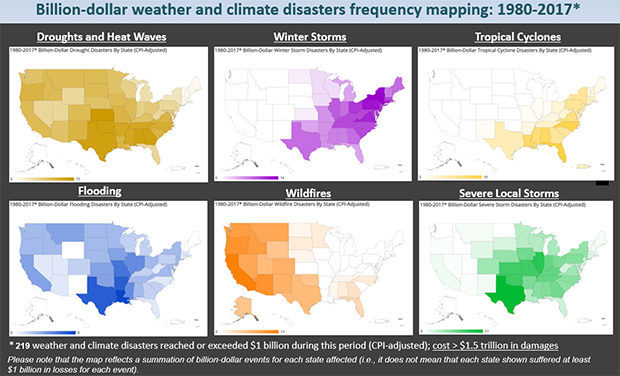
These maps depict the number of times each state has been affected by each of six types of billion dollar weather and climate disasters. Note that each state did not necessarily experience a full billion-dollar cost for an event to be counted; it only needed to be part of a regional event that caused one billion dollars or more in direct damages.
Crop freeze events have become more sporadic since the early 1990s, but these events can still cause considerable damage in the fruit-producing states of California, Florida and other Southeastern states such as Georgia and South Carolina. In 2017, the U.S. was impacted by its first billion-dollar crop freeze event since 2007. Severe freeze heavily damaged fruit crops across several southeastern states, as many crops were blooming 3+ weeks early due to unusually warm temperatures during the preceding weeks. Damage was most severe in Georgia and South Carolina.
Severe local storm events are common in the Plains and into the Ohio River Valley states. Winter storm impacts are concentrated in the Northeast, not surprising given the propensity for Nor'easters, while tropical cyclone impacts range from Texas to New England, but also include many inland states.
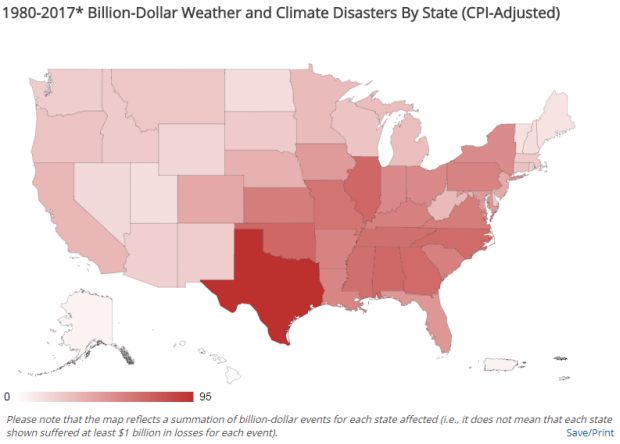
This map depicts the number of billion dollar weather and climate disasters affecting each state, since 1980, regardless of hazard type. Note that each disaster did not necessarily cause one billion dollars in damages in an individual state to be included in this total.
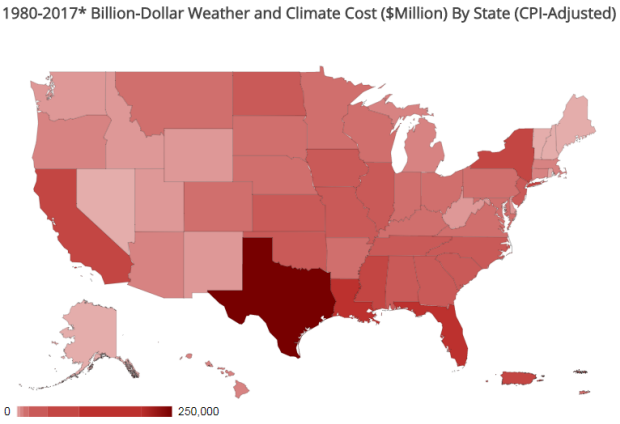
This map depicts the total estimated cost borne by each state, from billion dollar weather and climate events.



Reader Comments