
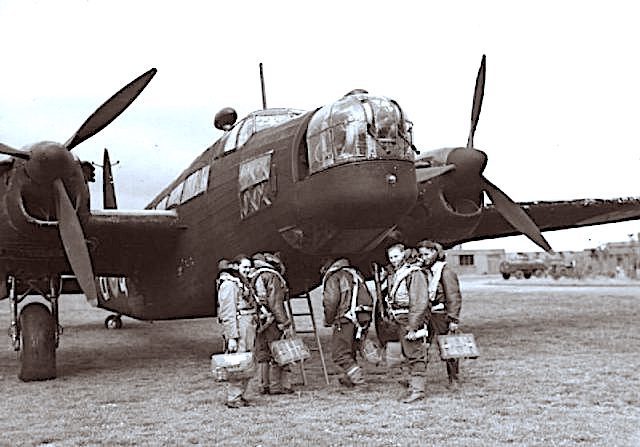
© Wikimedia Commons
For years afterwards, however, the aircraft remained where it had already sat for more than thirty years - that's to say, approximately 230 feet down. Heriot-Watt University's Underwater Technology Unit got involved in the investigation. The results of the investigations, along with help provided by the British Royal Navy, conclusively identified the aircraft as a Wellington. They even managed, in 1979, to identify its serial number: N2980. There was nothing particularly mysterious about N2980: as far back as late 1939, it had taken part in no less than fourteen bombing missions over Germany, before being transferred to Lossiemouth, where it was then used to train newly drafted aircrews. Official records on the crash were quickly accessed and told an unforgettable story.
Military records showed that the aircraft ditched into Loch Ness on December 31, 1940 - New Year's Eve - after experiencing problems with one of the engines during a turbulent snow storm, high above the domain of monsters. It was when the crew was over the Monadhliath Mountains that problems began. They were problems which led Squadron-Leader Nigel Marwood-Elton to give a hasty order to jump ship, so to speak: four crew-members quickly parachuted out of the plane. Tragically, one of them, the rear-gunner, a 20-year-old, Sergeant John Stanley Fensome, was killed when his parachute catastrophically wrapped itself around one of the wings of the doomed plane.
While the crew was racing to exit the aircraft, Marwood-Elton and the co-pilot, named Slater, stayed on-board, struggling to control the aircraft as the dusk skies threatened to give way to darkness. With the snow hammering down and a powerful wind blowing, they maneuvered the plane closer and closer to the loch and, incredibly, actually managed to land it on the surface of the water, ditching near Urquhart Castle. With water already flooding into the aircraft from all corners, they scrambled for an on-board dinghy. The two then clambered out of the plane and onto the starboard wing, where they blew up the dinghy and used it to row to shore, as the aircraft was swallowed up by the waves, practically intact. As they reached land, the two men managed to flag down an astonished truck driver, who quickly drove them to Inverness - no doubt for a couple of wee and hearty drams to help steady their nerves.
It wasn't until September 1985, and amid more than a few hazards and hiccups, that the bulk of the aircraft was finally raised from the water, with the recovery of numerous, scattered fragments continuing into 1986. Incredibly, and almost unbelievably, the taillights of the plane were still in good, working order. The well-preserved remains of N2980 can now be seen on display at the Brooklands Museum, Surrey, England. Now, we come to the strangest parts of the story - those that are focused on nothing less than the world of the paranormal, the domain of the afterlife, and those mysterious creatures that have, for so long, haunted Loch Ness.
For more, go to here.
Nick Redfern works full time as a writer, lecturer, and journalist. He writes about a wide range of unsolved mysteries, including Bigfoot, UFOs, the Loch Ness Monster, alien encounters, and government conspiracies. Nick has written 41 books, writes for Mysterious Universe and has appeared on numerous television shows on the The History Channel, National Geographic Channel and SyFy Channel.



Comment: Loch Ness apparently has more secrets than we thought!