

© NASA/JPL-Caltech/UCLA/MPS/DLR/IDAA variety of craters and other geological features can be found on dwarf planet Ceres. NASA's Dawn spacecraft took this image of Ceres from an altitude of 2,700 miles (4,400 kilometers) on June 5, 2015.
The craft took the photographs on June 9 from a distance of 2,700 miles (4,300 kilometers). It revealed a number of new geographical characteristics, in particular, the high peak that juts out from the surrounding landscape.
"The surface of Ceres has revealed many interesting and unique features. For example, icy moons in the outer solar system have craters with central pits, but on Ceres central pits in large craters are much more common. These and other features will allow us to understand the inner structure of Ceres that we cannot sense directly," said Carol Raymond, deputy principal investigator for the Dawn mission, based at NASA's Jet Propulsion Laboratory in Pasadena, California.
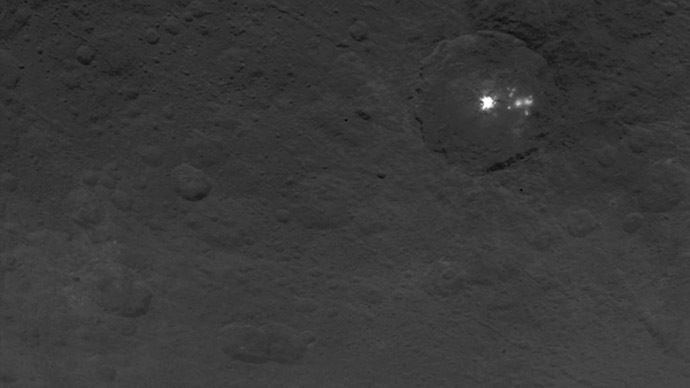
© NASA/JPL-Caltech/UCLA/MPS/DLR/IDAA cluster of mysterious bright spots on dwarf planet Ceres can be seen in this image, taken by NASA's Dawn spacecraft on June 9, 2015.
"The bright spots in this configuration make Ceres unique from anything we've seen before in the solar system. The science team is working to understand their source," Dawn principal investigator Chris Russell of the University of California, Los Angeles said in a statement last week.
"Reflection from ice is the leading candidate in my mind, but the team continues to consider alternate possibilities, such as salt," the Christian Science Monitor reported.
Dawn will continue at its current altitude until June 30 and will continue to take images of Ceres. However, it will then descend to an altitude of 900 miles (1.450 kilometers) in early August, which will bring it even closer to the dwarf planet.
On April 13, photographs were released from the NASA probe, which first showed two bright spots, which have been puzzling space experts.
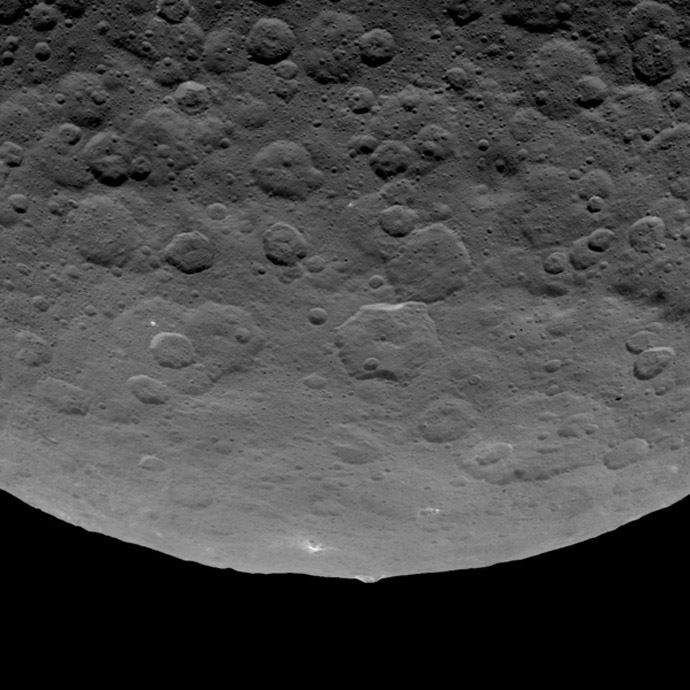
© NASA/JPL-Caltech/UCLA/MPS/DLR/IDAThis image, taken by NASA's Dawn spacecraft on June 14, 2015, shows an intriguing mountain on dwarf planet Ceres protruding from a relatively smooth area.
"This dwarf planet was not just an inert rock throughout its history. It was active, with processes that resulted in different materials in different regions. We are beginning to capture that diversity in our color images," Chris Russell, principal investigator for the Dawn mission, said.
Scientists are still not sure if the spots are water, ice, or "hydrated minerals," but they can say for sure that stable ice would be problematic so close to the sun.
Furthermore, the neighboring Vesta asteroid and Ceres shine differently from each other and, as well as possess different types of craters - both observations hinting at completely different histories.



Reader Comments