
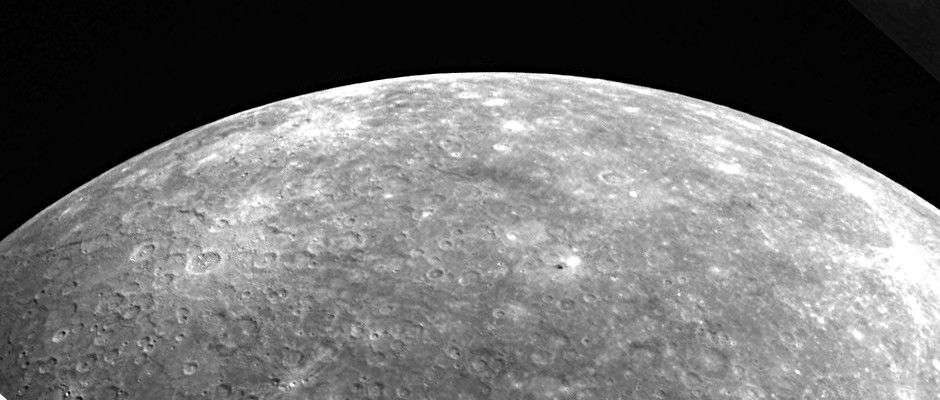
© NASA/Johns Hopkins University Applied Physics Laboratory/Carnegie Institution of Washington
Mercury's dark surface has long been a mystery to scientists. On average, Mercury is much darker than its closest airless neighbour, our Moon. Airless bodies are known to be darkened by micrometeorite impacts and bombardment of solar wind, processes that create a thin coating of dark iron nanoparticles on the surface. But spectral data from Mercury suggests its surface contains very little nanophase iron, certainly not enough to account for its dim appearance.
"It's long been hypothesised that there's a mystery darkening agent that's contributing to Mercury's low reflectance," said Megan Bruck Syal, a postdoctoral researcher at Lawrence Livermore National Laboratory who performed this research while a graduate student at Brown University. "One thing that hadn't been considered was that Mercury gets dumped on by a lot of material derived from comets."
As comets approach Mercury's neighbourhood near the Sun, they often start to break apart. Cometary dust is composed of as much as 25 percent carbon by weight, so Mercury would be exposed to a steady bombardment of carbon from these crumbling comets. Using a model of impact delivery and a known estimate of micrometeorite flux at Mercury, Bruck Syal was able to estimate how often cometary material would impact Mercury, how much carbon would stick to Mercury's surface, and how much would be thrown back into space. Her calculations suggest that after billions of years of bombardment, Mercury's surface should be anywhere from 3 to 6 percent carbon.
The next part of the work was to find out how much darkening could be expected from all that impacting carbon. For that, the researchers turned to the NASA Ames Vertical Gun Range. The 14-foot canon simulates celestial impacts by firing projectiles at up to 16,000 miles per hour.
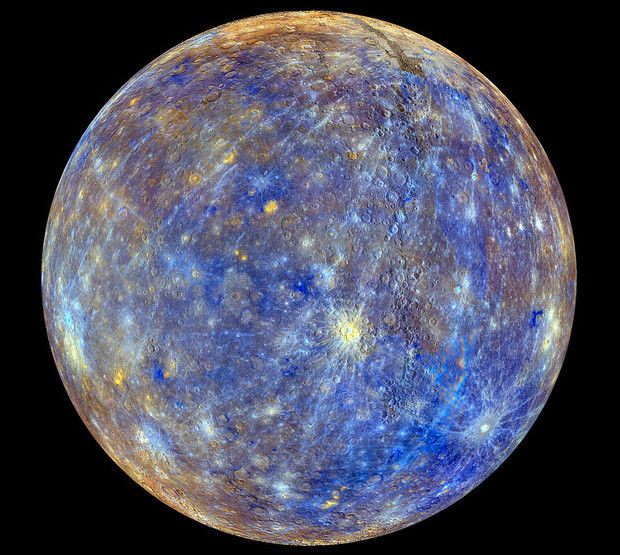
© NASA/Johns Hopkins University Applied Physics Laboratory/Carnegie Institution of WashingtonThis colourful view of Mercury was produced by using images from the colour base map imaging campaign during MESSENGER’s primary mission. These colours are not what Mercury would look like to the human eye, but rather the colours enhance the chemical, mineralogical, and physical differences between the rocks that make up Mercury’s surface.
The experiments showed that tiny carbon particles become deeply embedded in the impact melted material. The process reduced the amount of light reflected by the target material to less than 5 percent — about the same as the darkest parts of Mercury.
Importantly, spectroscopic analysis of the impact samples revealed no distinctive spectral fingerprints, again similar to flat spectral signatures from Mercury. "We show that carbon acts like a stealth darkening agent," Schultz said. "From the standpoint of spectral analysis, it's like an invisible paint."
And that paint has been building up on Mercury's surface for billions of years.
"We think this is a scenario that needs to be considered," Schultz said. "It appears that Mercury may well be a painted planet."



Comment: See also:
SOTT Talk Radio: The Electric Universe - An interview with Wallace Thornhill