
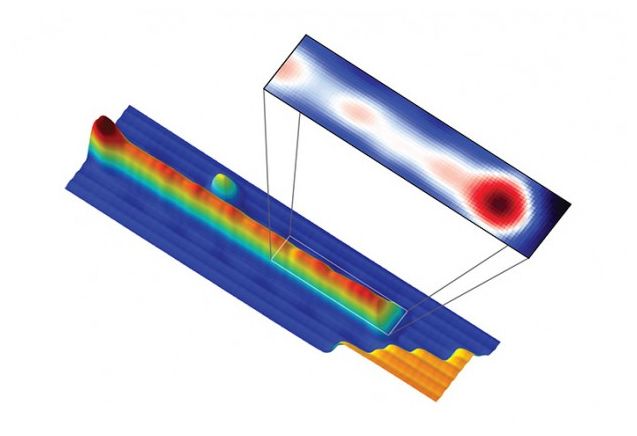
© Ali Yazdani Lab The experiment revealed the atomic structure of the iron wire on a lead surface. The zoomed-in portion of the image depicts the probability of the wire containing the Majorana fermion. Importantly, the image pinpoints the particle to the end of the wire, which is where it had been predicted to be over years of theoretical calculations.
The particle, which is known as a Majorana fermion, was detected and imaged using a two-story-tall microscope floating in an ultralow-vibration lab, the researchers explained. Not only is the discovery "an exciting step forward for particle physics, explained Macrina Cooper-White of The Huffington Post, but it could also impact quantum computer development.
"This is the most direct way of looking for the Majorana fermion since it is expected to emerge at the edge of certain materials," Princeton physics professor and lead investigator Ali Yazdani said in a statement Thursday. "If you want to find this particle within a material you have to use such a microscope, which allows you to see where it actually is."
Using the massive microscope, Yazdani and his colleagues were able to capture a glowing image of the Majorana fermion perched at the end of an atomically thin wire - exactly where scientists have long predicted it would be. In fact, Cooper-White said the existence of a particle that could serve as its own antimatter counterpart was first hypothesized by Italian physicist Ettore Majorana in 1937, and experts have been searching for it ever since.
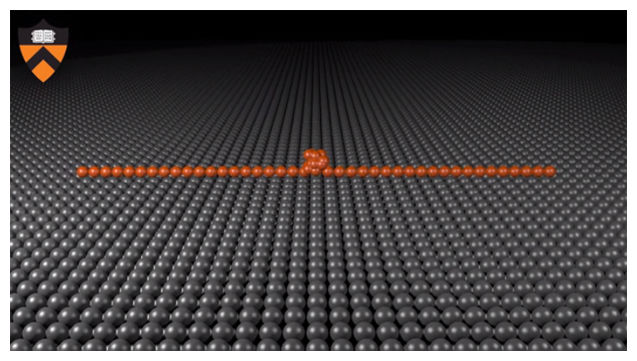
© Ilya Dorzdov, Ali Yazdani LabVideo screenshot. This video shows how the researchers first deposited iron atoms onto a lead surface to create an atomically thin wire. They then used their microscope to create a magnetic field and to map a signal that indicates the presence of the particle, called a Majorana fermion. The signal appeared at the ends of the wire.
Quantum superposition "offers vast opportunities for solving previously incalculable systems, but is notoriously prone to collapsing into conventional behavior due to interactions with nearby material," the university explained. Since the Majorana fermion is surprisingly stable, even though it contains qualities of both matter and antimatter, scientists believe it could be engineered into materials that provide a more stable way to encode quantum information.
As part of their research, Yazdani's team placed a long chain of magnetic iron atoms on top of a superconductor made out of lead, said Scientific American writer Clara Moskowitz. Typically, magnetism disrupts superconductors, which rely on the absence of magnetic fields to allow electrons to flow unimpeded. However, in this instance, they had a different effect.
During the experiment, the magnetic chain turned into a special type of superconductor that caused each electron to coordinate their spins so that they simultaneously satisfied the requirements of magnetism and superconductivity. Each pair could be viewed as both an electron and an antielectron, possessing a negative charge and a positive one, respectively. The arrangement left one electron at each end of the chain with no partner.
As a result, the electrons at the end had an electrically neutral signal and assumed the properties of both electrons and antielectrons, making them Majorana particles, Moskowitz said. The researchers explained that their experiment allowed them to directly visualize how the signal changed along the wire, essentially mapping the quantum probability of finding the Majorana fermion along the wire and ultimately pinpointing its locations at the ends of the wire.
Yazdani said the research was "exciting" and could be "practically beneficial, because it allows scientists to manipulate exotic particles for potential applications, such as quantum computing." He added that, even though the setup for the experiment was complex in nature, the new approach did not require the use of exotic materials (using only lead and iron) and would be easy for other scientists to reproduce and build upon.
California Institute of Technology physicist Jason Alicea, who did not participate in the research, told Moskowitz that while the Princeton paper offered "compelling evidence" for the Majorana fermion, it was important to consider "alternative explanations - even if there are no immediately obvious candidates." He also praised the experimental setup, and in particular the way in which it made it possible to easily produce the new particle.



Reader Comments
to our Newsletter