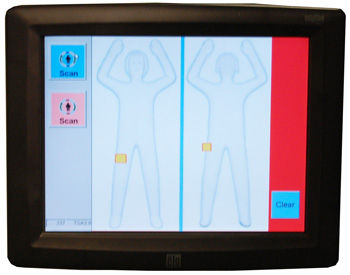
© TSAATR Monitor After Alarm
You may remember
us blogging about new privacy software we rolled out for the L3 Millimeter Wave body scanners. It's called Automated Target Recognition (ATR), and with the use of this software, our officers no longer see an image of the person being screened. This is what our officers see if the passenger alarms:
You can read more about the ATR software
here.
Congress mandated as a part of the
The FAA Modernization and Reform Act of 2012 that all TSA body scanners should be equipped with ATR by June 1, 2012 (There has since been an extension to June 1, 2013).
At this point, all Millimeter wave units have been equipped with ATR, but even with the extension to 2013, Rapiscan was unable to fulfill their end of the contract and create the ATR software that would work with backscatter units. As a result, TSA terminated the contract with Rapiscan in order to comply with the congressional mandate.
All Rapiscan AIT units currently operational at checkpoints around the country, as well as those stored at the TSA Logistics Center, will be removed by Rapiscan at their expense and stored until they can be redeployed to other mission priorities within the government. Most of the backscatter units being removed will be replaced with millimeter wave units. The millimeter units will be moved from the inventory currently deployed at other airports and from an upcoming purchase of additional millimeter wave units.
By June 1, 2013 travelers will only see machines which have ATR that allow for faster throughput. This means faster lanes for the traveler and enhanced security.
As always, use of this technology is optional.
Comment: The TSA blog ends with a calming statement about how scanner use is 'always optional', but there are hundreds of damning reports on the invasive TSA body search alternative. While the end of use of backscatter scanners is a positive development, there are still many unanswered questions on the safety of their replacement that uses millimeter waves.
Prevent Disease writes:
The TSA's millimeter wave scanners that shoot high frequency radiation at you, operate at an estimated power level of 0.013 mW/cm2 - 0.02 mW/cm2 , and the time you are exposed is relatively brief 1.5 seconds. This power dosage is well bellow the maximum allowed dosage or radiation of 1 mW/cm2 for five minutes. As a result, the TSA's military radiation scanners (millimeter wave) are considered safe. But, this safety level is based only on the heating effects of the scanner's radiation, not on the non-heating biological effects.[...]
In a 2010 report by the California Institute of technology, titled "Impact of low intensity millimetre waves on cell functions," scientists tested the effects of millimeter wave radiation that is over 1000 times below the government's safe dose on mice cells. They tested doses of radiation around 0.0003 mW/cm2. Far less power than the TSA's millimeter wave scanner uses. These tests were done at 60GHZ and in short radiation doses there were merely 5 seconds long. This is the first, and perhaps only experiment where real time changes from millimeter wave radiation was tested. The study showed that rat neurons changed their firing rate, and the cell membranes changed their level of permeability. The recent study concluded that "We have only begun to evaluate the real-time effects of millimetre waves on cellular functions. Further work is certainly needed, and we hope that the results presented in this Letter will catalyse governmental bodies and private foundations overseeing the safety and applications of millimetre-wave technologies."
As of yet, real time human effects of low power radiation has neither been tested, nor observed. Yet the TSA negligently, and fraudulently insists the scanner is safe not because it has been tested to be safe, but because science does not understand what mechanism is involved, or what the biological effects would even be by these low doses of high frequency radiation were even tested.




Comment: The TSA blog ends with a calming statement about how scanner use is 'always optional', but there are hundreds of damning reports on the invasive TSA body search alternative. While the end of use of backscatter scanners is a positive development, there are still many unanswered questions on the safety of their replacement that uses millimeter waves. Prevent Disease writes: